Planetary Defense changes technology against deadly asteroids
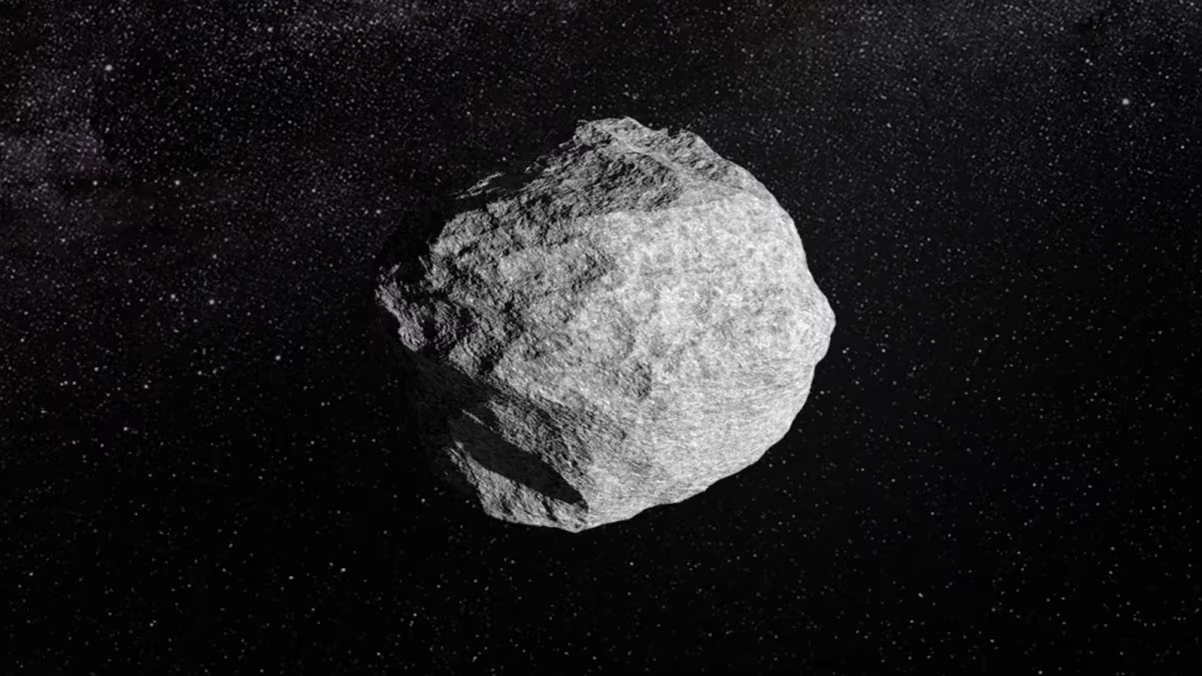
Update in ESA (European Space Agency) communication improves sending of asteroid impact alerts through instant voice calls, instead of sending email alerts.
With voice API integration, monitoring and alerts are generated regardless of time or location, a factor that speeds up the process of alerting the responsible team with data about potential asteroid impacts that could hit planet Earth in a deadly way.
Following the trajectory of asteroids that approach our planet, also known as NEOs (Near-Earth Objects, in free translation), is crucial and time-sensitive, taking into account that, 65 million years ago, the impact of an asteroid extinguished a large part of life on Earth, including dinosaurs.
READ ALSO: Brazil on the Moon: national satellite will carry out daring mission to the lunar south pole
Meteor explodes and causes loud bang in Massachusetts | CNN BRAZIL
After a successful test phase, it was found that the voice messaging system produced by Infobip, a global cloud communications platform, works in 100% of applicable cases, generating rapid alerts, up to five minutes after detection of probable impacts from the tests carried out, in addition to the collection of scientific data from these episodes.
"This new partnership allows us to respond more quickly and effectively to potential imminent asteroid impacts, ensuring we collect critical data to better understand these natural threats. Receiving instant alerts has significantly improved our response times and our ability to study these events," says Richard Moissl, head of Planetary Defense.
The partnership also improved the European Space Agency's communication, as it guarantees real-time alerts, allowing decision-making to be used more frequently in critical situations in Planetary Defense.
2026: Brazil will have eclipses, meteor showers and a supermoon | CNN PRIME TIME
ESA's planetary defense
Although large asteroids are rare, small and medium-sized ones are more common in the Solar System and can cause serious damage as well.
These asteroids hit the ground or can even create aerial explosions as they disintegrate in the Earth's atmosphere, with shock waves that can shatter glass, collapse buildings and injure people nearby.
Every month, dozens of NEOs come at least 0.05 AU closer to Earth. For monitoring, ESA uses a table that presents a list of these nearby asteroids, both recent and future, with details about the circumstances of their encounter with the planet. See the table:
The table shows the imminent approaches of asteroids towards Earth in the next 12 months - Reproduction | ESA
Dangers constant
CAI (Close Approach Index Column) assesses how often an object of a given size passes at a given distance and speed from Earth.
The colors indicate whether it can be very common (blue), frequent (green), infrequent (yellow), rare (orange) or very rare (red).
It displays the maximum brightness reached by the object at closest approach, to estimate its visibility during the encounter. Data is sorted by date and pattern. In most cases, the size presented in the table is estimated indirectly from the absolute magnitude and is marked with an asterisk.
*Under the supervision of Thiago Félix
Newly discovered asteroid has little chance of hitting Earth in 2032
Source: CNN