World Cup boosts temporary hiring in Brazil; see workers' rights
World Cup: Brazil may have two more games on weekdays
The 2026 World Cup is already moving the Brazilian job market, even though it is being held in the United States, Canada and Mexico. The tournament, which continues until July 19, has boosted the consumption of food, drinks, televisions, sporting goods and products for celebrations.
As a result, companies have reinforced their teams, mainly in bars and restaurants, commerce, logistics, tourism and events, with a focus on temporary hires. (see workers' rights below)
Do you have any suggestions for reporting? Send it to g1
Data from Catho, obtained exclusively by g1, shows that, between April and June this year, the number of vacancies announced in sectors traditionally benefited by the tournament grew 26% compared to the same period in 2025.
There were 40,217 vacancies announced this year, compared to 31,910 in the same period last year.
The biggest increases among the positions occurred for restaurant attendant (+120%), store assistant (+38%), production assistant (+28%) and logistics assistant (+16%). Among the areas of activity, restaurants registered a 47% growth in vacancies, while logistics and supplies increased 16%.
The growth was driven mainly by operational and customer service functions. See the highlights of the second quarter compared to the same period last year.
By profession
Restaurant Assistant: +1,975 vacancies (jumped from 1,634 to 3,609 - a growth of +120%).
Production Assistant: +1,477 vacancies (from 5,215 to 6,692 - growth of +28%).
Store Assistant: +1,472 vacancies (from 3,814 to 5,286 - growth of +38%).
Logistics Assistant: +1,172 vacancies (from 7,128 to 8,300 - growth of +16%). +16%).
Restaurant: +2,922 vacancies (from 6,217 to 9,139 - increase of +47%).
Commercial Administrative: +2,777 vacancies (from 63,575 to 66,352 - increase of +4%). +17%).
Administrative/Operational: +2,065 vacancies (from 25,315 to 27,380 - increase of +8%).
According to the Brazilian Association of Temporary Work (Asserttem), the World Cup is added to other seasonal dates, such as Mother's Day and Valentine's Day, to boost the hiring of workers.
The entity estimates around 600 thousand temporary contracts between April and June of 2026 and states that approximately 20% of professionals end up being hired by companies.
For Alexandre Leite Lopes, president of Asserttem, competition tends to increase the demand for labor, especially in the commerce, industry and services sectors.
"The longer the Brazilian team remains in the competition, the greater the extension of these contracts tends to be", he states.
According to him, many workers see temporary vacancies as an opportunity for relocation and employment.
Employees work at the startup GetNinjas, which decorated the work environment for the World Cup games
Marcelo Brandt/G1
Workers' interest also grows
An InfoJobs survey shows that 65.1% of respondents intend to seek temporary jobs during the World Cup, while 64.8% believe that major events Sports activities increase the chances of getting a job.
For Hosana Azevedo, Human Resources manager at Redarbor Brasil, owner of Infojobs, competition increases the demand for labor in different segments.
"For many professionals, this can be a way to earn extra income, acquire experience or even open doors for future effective hiring", she says.
She highlights that many companies use this period to identify talent and evaluate candidates in real work situations.
Temporary vacancies can often be transform into effective opportunities for candidates who show good performance, commitment and ability to adapt.
According to sector experts, the opportunities are mainly concentrated in operational and service roles, such as waiters, attendants, cooks, bartenders, cashiers, logistics assistants, stockers and delivery drivers.
In addition to technical experience, companies are also looking for professionals with good communication, flexibility, time availability and the ability to work under pressure.
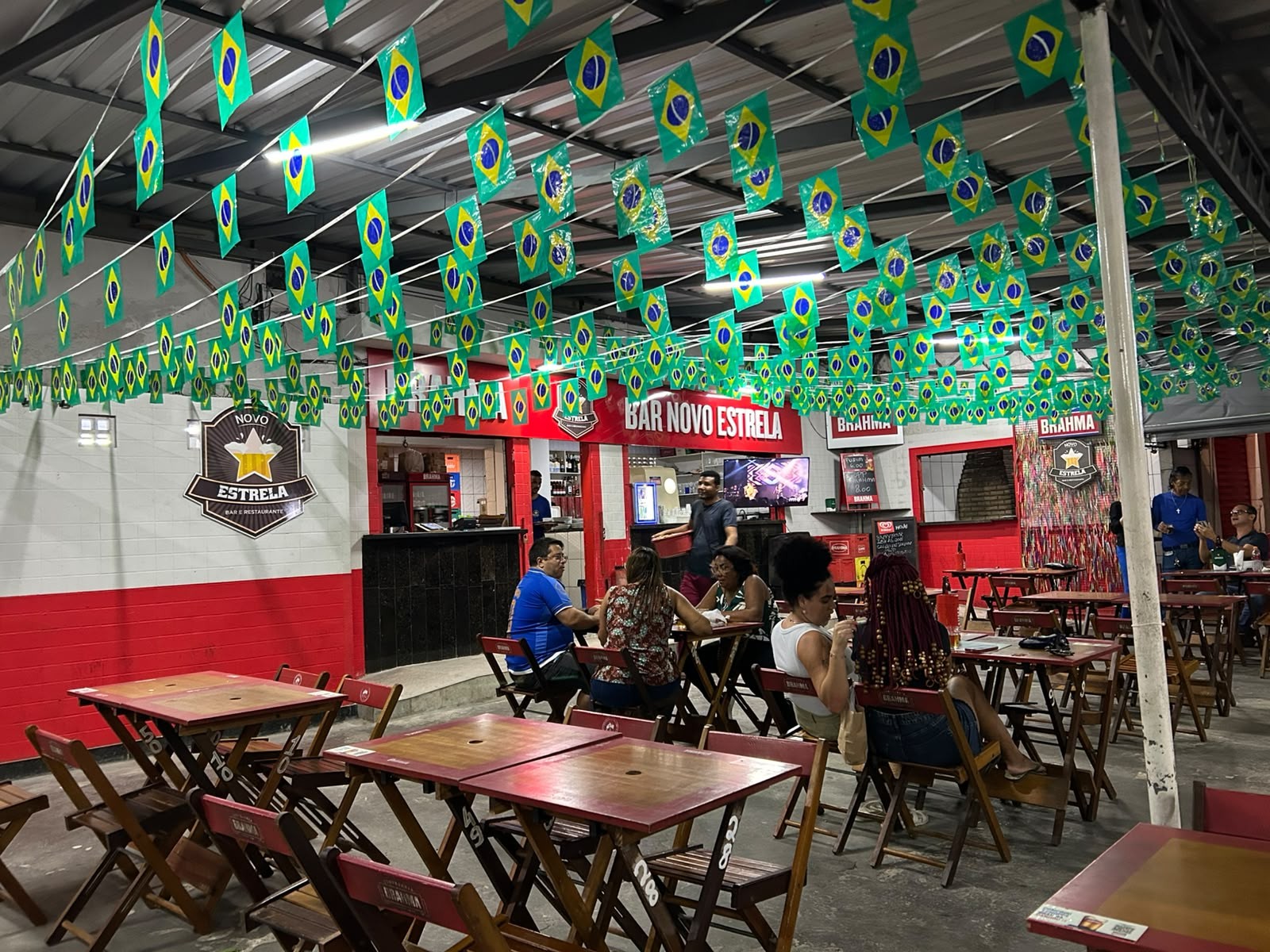
Bar Novo Estrela prepared to host the games of the World Cup
Personal Archive
Bars and restaurants hope to earn more
Among the sectors that benefited most is the food sector. A survey by the Brazilian Association of Bars and Restaurants (Abrasel) shows that 80% of business owners hope to increase revenue during the World Cup, while 52% intend to broadcast the games.
The most impacted segments are bars, restaurants, breweries, beer bars, steakhouses and eateries, which tend to register greater movement during the Brazilian team's matches. Most businesspeople estimate growth of up to 20% in revenue.
According to José Eduardo Camargo, Content and Intelligence leader at Abrasel, the Seleção's performance directly influences consumption.
"The Seleção's games are the main revenue peaks. On these days, there is a significant increase in the flow of customers and in average spending, which turns each match into a relevant revenue generation opportunity for bars and restaurants", explains the Abrasel specialist.
Camargo also highlights that many establishments also show matches from other teams, maintaining the movement throughout the competition and justifying specific reinforcements in the teams during the tournament.
In addition to food, retail should also benefit from the increase in consumption during the World Cup, assesses Thiago Carvalho, economic advisor at the Federation of Commerce of Goods, Services and Tourism of the State of São Paulo (FecomercioSP).
The segments with the greatest growth potential are electronics stores, driven by the sale of televisions and audio equipment, supermarkets, due to the increase in demand for food and drinks, clothing and sporting goods stores, and party goods sales.
According to the economist, the period also works as an opportunity for companies to evaluate professionals for future positions.
As the second half of the year is the best sales period for the sector and, consequently, the time when retail hires the most and invests in opening stores, employees who are well evaluated will have a great chance of remaining."
What are the rights of temporary workers?
The employer has several obligations when hiring a temporary worker, which must be followed in accordance with law 6,019/1974.
This type of contract aims to meet exceptional needs, such as peaks in demand or replacement of permanent employees.
The legislation allows temporary employees to be hired for a period of up to 180 days, consecutive or not, with the possibility of extension only once for another 90 days, depending on the company's needs.
These workers have rights similar to those of employees hired for an indefinite period, such as labor and social security benefits, registration in the portfolio, in addition to the payment of FGTS and the payment of proportional vacations.
"Even if the worker is hired on a temporary basis, this does not mean that there is no need to observe the rights and guarantees established in labor relations, which Brazilian legislation protects", says labor lawyer Márcia Cleide Ribeiro.
See below the main rights of temporary workers:
Remuneration, respecting wage equality;
Eight-hour working day (40 hours per week);
Payment of overtime (which does not exceed two hours per day);
Remunerated weekly rest;
Payment of additional night time, unhealthy and hazardous conditions, if necessary;
Receipt of holidays proportional to the period worked;
Compensation if dismissed outside the time stipulated in the contract, without just cause;
Insurance against accidents at work, as well as social security protection;
Receipt of the Guarantee Fund for Length of Service (FGTS) into an account linked;
13th salary proportional to the period worked.
In addition to financial obligations, the company must guarantee the temporary worker the same working conditions offered to permanent employees, such as safety, hygiene, health and a healthy environment.
"The temporary worker must have access to medical, outpatient and meal care under the same conditions as other employees of the company", adds labor lawyer Agatha Otero.
The FGTS payment, which must be made by the company, is 8% on the remuneration paid to the employee during the contract period. At the end of the contract, the worker can withdraw 100% of the FGTS balance.
However, in this type of contract, there is no payment of the 40% fine on the Guarantee Fund, as this penalty only applies to terminations without just cause of contracts for an indefinite period. This is what Márcio Coelho, a lawyer specializing in labor and social security law, explains.
"They are not entitled to prior notice and do not receive the 40% fine on the FGTS. As for unemployment insurance, the temporary worker will be entitled if they have worked at least six months in the last 12 months before dismissal, not receiving any other social security benefits and if the dismissal occurs without just cause", he states.
One of the most important obligations of the employer is the formalization of the contract in writing. This document must detail the employee's role, period of service, remuneration and all working conditions.
In addition, it is necessary to register in the Work and Social Security Card (CTPS) that the relationship is temporary, ensuring correct fulfillment of the contract and preventing future complications.
Registration in the card is essential to ensure that the contract is terminated correctly. If the employer fails to formalize the contract in writing or does not follow the established legal rules, the employment relationship may be recognized as permanent.
In this case, the employee will have the same rights as a permanent worker, including advance notice, unemployment insurance, a 40% fine on the FGTS in case of unfair dismissal and stability in cases of pregnancy or work accident.
"It is essential that workers carefully read the terms of the temporary contract, understanding the clauses and rights, in order to avoid unpleasant surprises in the future.
Raising awareness about working conditions helps ensure that professionals are treated fairly and respectfully, even in temporary situations", adds Márcio Coelho.
READ ALSO
From the World Cup to the office: why pressure and anxiety affect professional performance so much
What type of fan are you at work during the World Cup? Take the QUIZ and find out
World Cup 2026: is the company obliged to release employees to watch games? Understand
Will there be time off at Brazilian games?
Source: G1