Without regulation, predictive markets grow in Brazil and become a challenge for the government
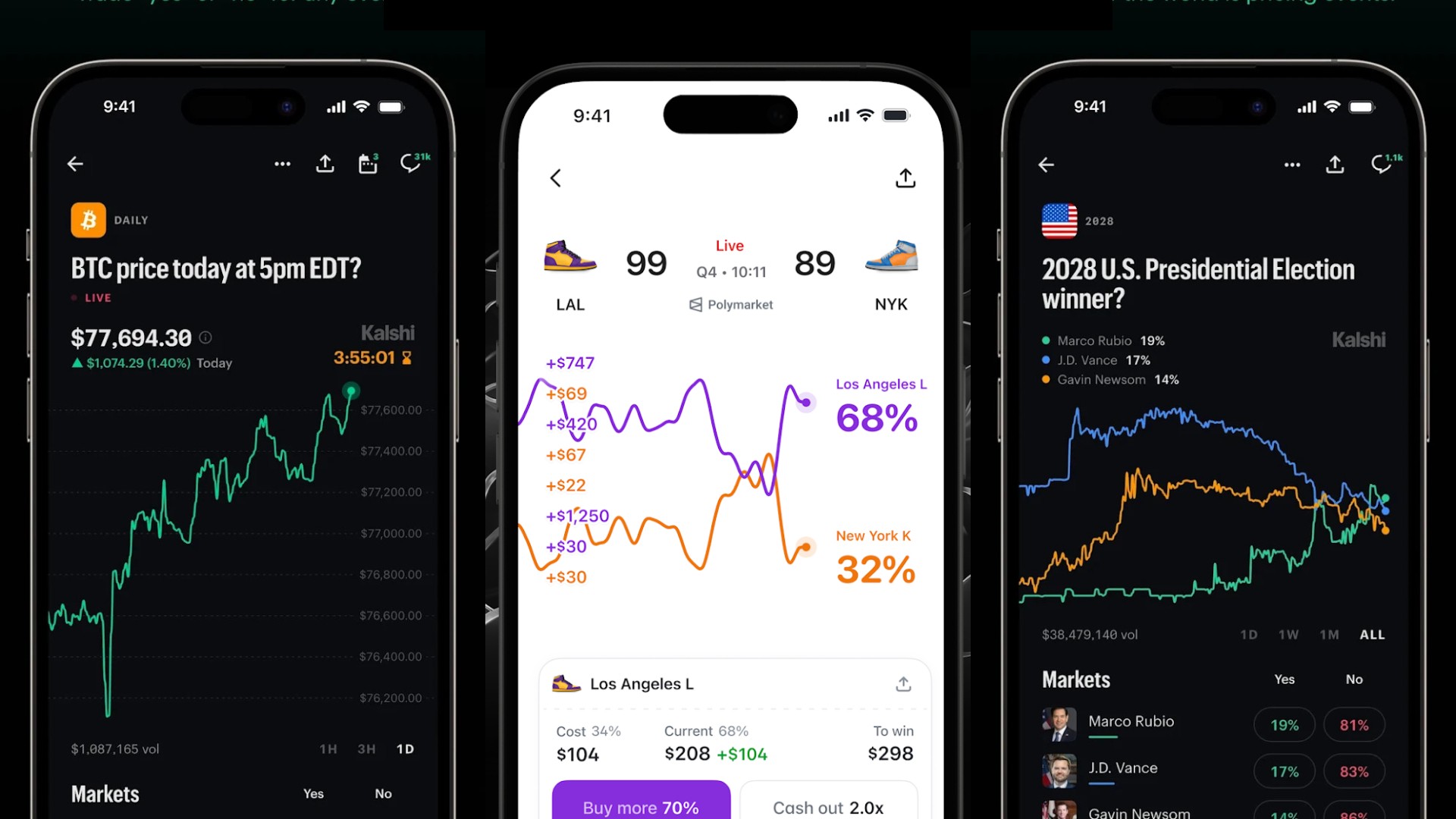
Without regulation, prediction markets become a challenge in Brazil
Reproduction/ Kalshi and Polymarket
Apart from the attention that focuses on betting advertising and regulations, the so-called "prediction markets", which have grown globally in recent years, have become a challenge for Brazilian authorities.
In April, the government blocked 27 platforms that made predictions on the most different topics, such as the American Kalshi and Polymarket, to avoid the consolidation of a betting model without control and that does not follow the country's legislation.
Do you have any suggestions for reporting? Send it to g1
The prediction market works as a kind of "betting exchange" on future events. In it, people buy and sell contracts based on simple questions such as "Will it happen or not?", related to the most diverse events, such as wars, climate change or elections.
If the event happens, such as a politician's victory at the polls or a winner on a reality show, whoever bet makes money. If it doesn't happen, you lose.
Now on g1
The difference in relation to traditional betting is that, in betting, the company defines the rules and pays the prizes. In prediction markets, users themselves trade with each other. These contracts are treated as derivatives, a type of investment that depends on the future value of something.
Despite being prohibited, Brazilian users find gaps in accessing this content. In addition to using VPNs to circumvent blocks, payment methods on these sites are another difficulty. While in the case of illegal betting houses the government has been intensifying checks on transactions with Pix, prediction markets operate, above all, using cryptocurrencies.
DW found four platforms operating in this system irregularly in the country. Additionally, over the past few weeks, others have even offered ads on Instagram. The report also found advertising from conventional clandestine betting houses on the platform.
When asked, Meta pointed out that "advertisers who wish to promote gambling or online gaming need to request written permission and provide proof that their activities are licensed by a regulator or established as legitimate in the territories in which they wish to broadcast this content".
The company highlighted that government bodies can request the restriction of content that violates the laws.
Popularity on the rise in the World Cup
Cristiano Ronaldo
Reuters/Sam Navarro
Prediction markets gained enormous traction in the American elections in 2024 after a legal dispute allowed Kalshi to offer predictions on the winners of that election. Since then, they have accumulated restrictions, controversies and billions of dollars moved.
This year, high volumes of bets associated with United States actions in Iran and Venezuela reinforced fears that agents with privileged information profited from events on these platforms. Furthermore, a bet on the use of nuclear weapons in 2026 went offline after controversy.
In the World Cup, platforms offer conventional bets, such as predictions on the championship's top scorer and the tournament winner, as well as traditional bets. However, there are more personalized markets, such as one that allowed betting on whether or not Neymar would enter the field.
In even more alternative possibilities, bets were also made on the chances of Cristiano Ronaldo crying in public during the competition. At the beginning of the tournament, the analysis house Bernstein predicted a movement of 10 billion dollars in bets in these markets linked to the World Cup.
Bets x predictions
Advertising that promises easy money with bets grows in Brazil
Reproduction/TV Verdes Mares
The differences in how predictions work for bookmakers generate regulatory discussions. Enthusiasts of the first model often claim that the characteristics are closer to the financial market than to a bet.
One of the main defenses is that the bet takes place against other users, and not against the house, as in the other modality.
Predictive markets work based on the purchase and sale of futures contracts. For example, in the World Cup, the bet on the champion will be settled shortly after the final. The value of a guess varies depending on supply and demand. The more people think about an aspect, this contract increases in value. In this model, the platform's profit comes through a commission for each negotiation.
In other words, the final result is indifferent to the operation's revenue. Greater gains for the platform come through higher traded volume. In the case of the World Cup champion, at the beginning of July, Kalshi alone had already generated around 850 million dollars.
In the case of traditional betting houses, each one offers a return according to the evaluated probabilities of an event occurring, the so-called "odds". In this model, it is calculated, normally using algorithms, how much can be paid to each winning user for a result so that the house still makes a profit, normally 5%.
Graph shows sudden interest in María Corina Machado for the Nobel Peace Prize
Polymarket/Reproduction
Despite the differences, studies show that, just like in betting, most users tend to have losses in prediction markets. A recent study on Polymarket showed that the gains are highly concentrated, with 1% of users holding 76.5% of the profits.
To DW, Charles Martineau, one of the authors of the research and professor at the University of Toronto summarized the logic of this market for the vast majority. "It is very difficult to make money betting on sports. It is possible to profit from some sequences of bets, but for the average person, betting will often result in a loss."
"On platforms like Kalshi and Polymarket, where sports betting has a high volume of trading, we have found that the prices are so efficient that it is practically impossible to make a profit", points out Martineau. Furthermore, he adds: "one thing is certain: the introduction of prediction markets will lead some people to develop an increasing dependence on gambling."
Need for regulation
In the view of the Secretariat of Prizes and Betting (SPA), the offering of these betting platforms on sporting events in the country would require specific licenses, as is the case with the houses that have been operating regularly since last year. In the absence of regulation, access to these sites must be blocked in the national territory.
"There were even offers from illegal markets, such as elections. The government acted quickly at an excellent time, before the issue escalated", assesses Plínio Lemos Jorge, president of the National Association of Games and Lotteries (ANJL), when commenting on the government's decision to block the sites.
For Leonardo Henrique Roscoe Bessa, partner at Betlaw and consultant to the Federal Council of the OAB, the current scenario it was a "quick response", especially aimed at limiting betting on elections, which are prohibited in the case of betting. In turn, after the electoral period and with the current popularity, the regulation of these markets should return to the surface, he projects.
Bessa points out that the use of privileged information tends to be an additional regulatory difficulty, something that is more controlled in the case of bets. Current legislation in the sector states that potential players involved in matches, such as referees, players and coaching staff, cannot bet.
In the case of predictions, the actions of agents linked to events are less controlled. "Whoever has information, comes out ahead", he summarizes.
Man sues OpenAI and says that ChatGPT reinforced delusion that he was Jesus Christ
WhatsApp gains usernames and will need no number to start conversation
Why did 'Brazil' become 'bra' in the FIFA rankings translated into Portuguese?
Source: G1