With Samsung and SK Hynix, South Korea launches US$576 billion plan for AI chips
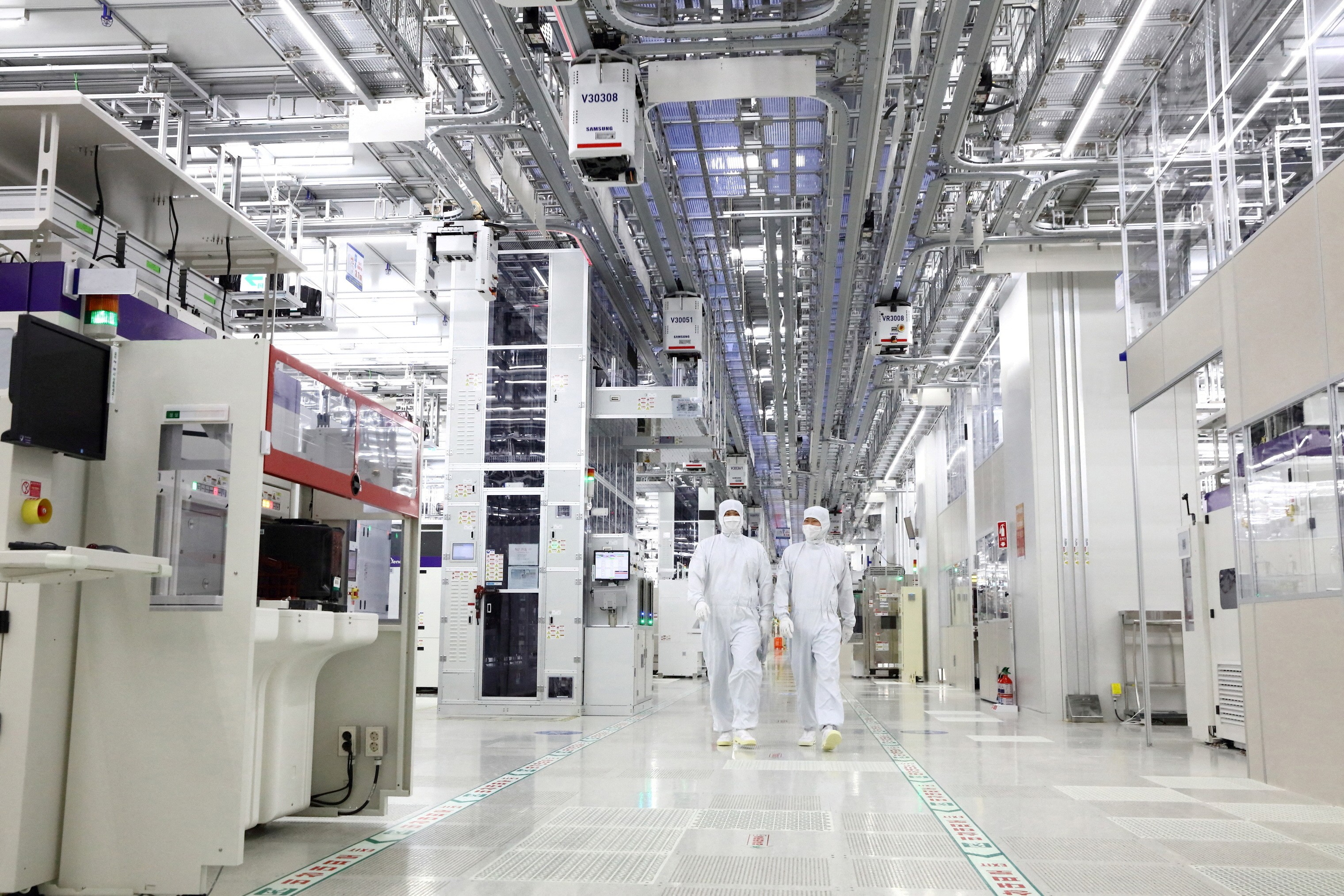
Samsung Electronics chip factory in Pyeongtaek, South Korea.
Samsung Electronics/Disclosure via REUTERS
South Korea launched on Monday (29) comprehensive megaprojects in the chip and artificial intelligence (AI) sector, with President Lee Jae-myung promising to consolidate an overwhelming industrial lead through investments exceeding US$576 billion over the next few years.
The announcement marks the offensive Lee's boldest move to align the country's AI and semiconductor ambitions with his promise to reduce regional disparities and revitalize economies outside the Seoul metropolitan region.
Lee was joined by the leaders of Samsung Electronics and SK Hynix, the world's two largest memory chip makers, during the televised announcement.
"We must secure the core elements of AI faster than any other country," the president declared. "Semiconductors, physical AI and AI data centers form the triple axis for our great leap forward."
Now on g1
Samsung and SK Hynix will invest 800 trillion won ($517.87 billion) with suppliers to build two new chip factories each in the southwest region of South Korea, the official said.
Lee added that the southwestern city of Gwangju and Jeolla province of the South will also invest between 5 and 20 trillion won in the projects, with another 81 trillion won expected for a chip encapsulation hub in the Chungcheong region, near Seoul.
According to Lee, the southwest will be home to large chip production complexes taking advantage of the region's abundant and underutilized energy.
"To meet the rapidly growing demand for semiconductors, we need to quickly complete the production centers that are currently under construction," he said.
"At the same time, we must secure overwhelming production capacity in advance through large-scale new investments, including in the southwest region. Existing complexes around Yongin and Pyeongtaek have already reached their limit."
Representatives from other companies including LG Electronics, HD Hyundai Robotics, Korea Electric Power Corp and Korea Water Resources Corp also attended the event, according to the presidential office.
President defends plan
Lee Jae-myung
JUNG YEON-JE / AFP
High-bandwidth memory chips produced by Samsung Electronics and SK Hynix have become crucial in the global race to develop advanced AI systems. Both companies already operate large semiconductor facilities in and around the Seoul metropolitan region.
South Korean Industry Minister Kim Jung-kwan stated at the event that the country will double the production of dynamic random access memories (DRAM) in five years, bringing forward the construction of factories in the Seoul metropolitan region to the mid-2030s.
DRAM is a type of memory used to power electronics such as notebooks and smartphones, and HBM is produced through stacking of multiple layers of DRAM.
Lee defended the proposed Southwest chip cluster in a series of posts on X over the weekend, rejecting criticism that the move would benefit a progressive electoral stronghold. Instead, he framed the strategy as a "national survival policy" to mitigate regional imbalances and expand capacity for the AI era.
"The creation of a semiconductor industrial ecosystem in the [Southwest] is not a special favor to a specific region," Lee wrote in a post.
"This is about further creating the most rational semiconductor industrial center, through decisions by the companies involved and under the full support of the government."
Industry experts assess that diversifying chip investment beyond Seoul could alleviate infrastructure bottlenecks, but warn that building state-of-the-art factories requires vast electricity and water resources, advanced logistics, dense supplier networks and highly skilled labor - elements that may not advance quickly enough in a new region to meet explosive demand by IA.
Opposition politicians have harshly criticized the plan, questioning whether the proposal is politically motivated, given that 85% of voters in the region supported Lee in last year's presidential election.
The announcement comes at a time of falling popularity for Lee, whose approval rating has declined for the sixth consecutive week, reaching 46.5%, according to pollster Realmeter.
Source: G1