With his own hands, man has already saved around 6 million bees in Singapore
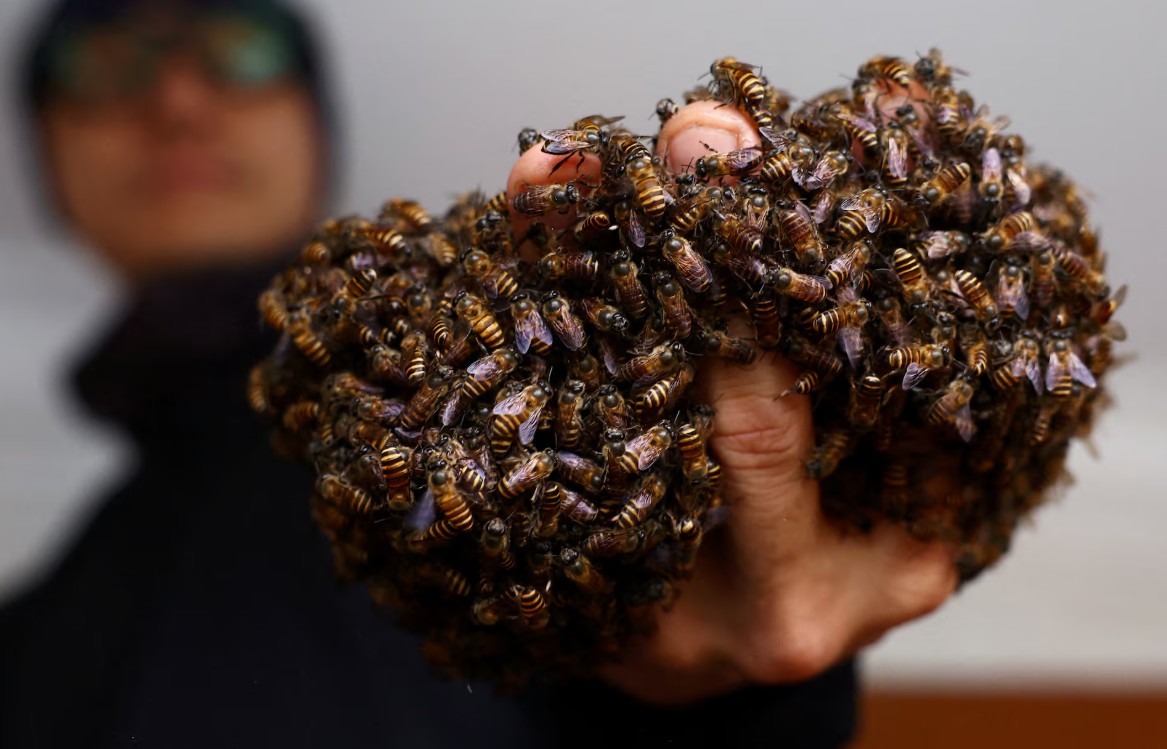
Bee rescuer Clarence Chua holds a handful of bees after removing them from a hive in a public housing apartment in Singapore.
REUTERS/Edgar Su
Armed only with a bandana and his bare hands, Clarence Chua, 42, rescues bees by removing them from hives and placing them in wooden boxes to be relocated - sometimes even to his own backyard.
"What I like about them is that, if you respect them and don't threaten their safety, they are completely at ease with your presence up close," says Chua.
Download the g1 app to see news in real time and for free
When residents of Singapore find bees building hives in their homes, they usually call pest control companies, which can exterminate the nests in a few minutes for around 80 to 150 Singapore dollars (US$ 62 to US$116).
But Chua has been convincing an increasing number of people to allow him to rescue bees, charging between 100 and 500 Singapore dollars.
Over the past six years, he has safely relocated an average of 100 hives per year, representing about 6 million bees saved. The humanitarian relocation process consists of transporting the entire colony, preserving the queen bee, larvae and workers.
Then, they are taken to one of the three apiaries managed by Chua, one of which is in his own backyard.
Chua has rescued bees from the most unusual places: from a small house of spiritual worship in a condominium to the engine of a plane, which couldn't take off until the swarm was removed.
Where does what I eat come from: Honey
Also read:
'I didn't know it was from Brazil': Trump government was unaware of the weight of national honey for the USA
R$ 1 thousand per kilo? Meet the wagyu, a beef from Japan that has the most expensive meat in the world
Between stings and swarms
Bee rescuers Clarence Chua and Jian Ping remove a hive from a lamp in an apartment in a public housing complex in Singapore, on May 15, 2026
REUTERS/Edgar Su
As awareness about rescuing bees grows, he says that municipal councils, responsible for administration of the public housing complexes where almost 80% of Singapore's population live, have also started to hire their services.
Even so, the work is not risk-free. He once tried to rescue a swarm that he thought was docile, installed on the balcony of a condominium, but ended up being attacked. In the approximately 30 seconds it took him to release his safety gear and escape, he was stung approximately 100 times.
"It really taught me to never underestimate nature," he said. He adds that even today he tends to approach hives without beekeeper clothing at first, to assess the behavior of the bees before putting on protective equipment, if he notices that the swarm is agitated.
Chua also promotes bee rescue on social media. Videos of his work, some recorded in first person with Meta smart glasses, have already attracted around 20,000 followers.
"Without bees, there would be much less fruit - or they would be much more expensive - because there would be a lack of fruit in the world. It's amazing how many agricultural crops we depend on for our own survival," he said.
Bee rescuer Clarence Chua records content for social media with his Meta smart glasses while removing bees from a lamp in an apartment in a public housing complex in Singapore, on May 15, 2026.
REUTERS/Edgar Su
Source: G1