Why more and more tourists are avoiding the US
Brazilian citizens who intend to travel to the US have faced obstacles in obtaining a visa
Recently, travelers have experienced waiting times of up to four hours at American airports - the longest in the 24-year history of the United States Transportation Security Administration (TSA).
A partial shutdown of the United States government was to blame. Started in mid-February, it is already the longest in the country's history.
As Congress did not approve a budget for the operation of the airport agency, TSA inspectors worked without pay for more than a month. As a result, thousands of them suspended their jobs and more than 500 resigned.
A presidential order signed on March 30 restored payments to TSA employees and aims to significantly reduce airport waiting times. But the headlines and photos of long lines are just one of a series of obstacles currently facing the US travel and tourism sector.
The disruption, with global consequences, could not have come at a worse time for Americans. After all, the country is one of the hosts of the FIFA World Cup, in addition to celebrating the centennial of Route 66 and the 250th anniversary of its independence in 2026.
In a normal year, any of these events would give the United States tourism sector reasons to celebrate. But the country has been struggling in recent times with a mix of misperception and unpopular policies.
In 2025, tourism in the United States fell by 5.4%, while the rest of the world saw growth of 4%, following the World Tourism Barometer.
The number of Canadians visiting the United States fell by 22% last year, compared to 2024. The index represents the largest reduction of any tourism market in the entire world.
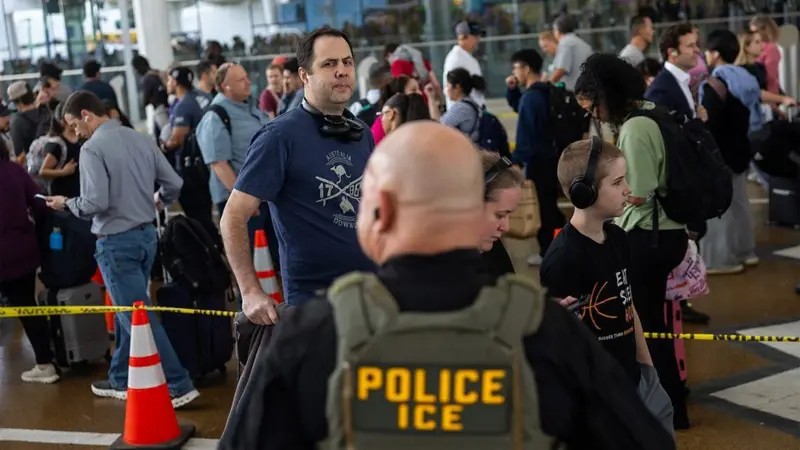
Long lines at airports and rising anti-American sentiment are causing tourists to reconsider their travel plans to the United States
Getty Images via BBC
The continued presence of ICE agents at American airports also does not appear to help promote the country's image.
ICE agents were originally deployed to assist with the TSA staffing shortage. But U.S. Transportation Secretary Sean Duffy said they will stay "as long as necessary."
ICE agents are not trained in aviation security, which makes some travelers wary.
Sandra Awodele was born in Nigeria but is a naturalized U.S. citizen. She says the presence of ICE made her more alert.
"With ICE detaining people who may or may not be citizens and apologizing later if they're wrong, I've had to change my travel plans a few times when the airport I'm arriving at has a large ICE presence," she says.
"I've never had any problems, but now I'm afraid I might have one due to procedures and protocols that I may not be familiar with.
It's scary."
The deployment of ICE agents to airports is just one of a series of rapid policy changes that are confusing some international travelers.
A Trump administration proposal introduced in December 2025 would require visitors from 42 visa-free countries (including the United Kingdom and most of mainland Europe) to provide five years of social media history in order to enter the country.
The proposal has not yet been implemented, but some travelers believe it is already in place. force.
"The law hasn't changed, but the temperature has," says civil rights lawyer Evan Oshan, managing partner at Oshan & Associates.
For him, "when federal authorities feel empowered to push every boundary of their existing authority, that's a policy change - and it simply doesn't require a decision from Congress."
A wave of anti-American sentiment caused by some Trump policies also hurts tourism to the United States
Getty Images via BBC
A combination of sentiment The anti-American situation caused by some of President Trump's policies and the long waits still experienced by some travelers in many American airports has caused some travelers to consider whether this is the right time to visit the United States.
Johan Konst runs a public relations company in Amsterdam, the Netherlands. He usually travels to the United States three or four times a year to attend conferences and meetings.
He says he still plans to go, but is more selective about the timing of his travels.
"The current situation "It seems to treat Europe more like an opponent than an ally, whether it's tariffs, rhetoric toward NATO, or the general tone toward European countries," he explains.
"This changing dynamic makes you feel less welcome, even if no individual American has ever made me feel this way personally." says. "I'm more selective than before, as I can also work remotely."
Konst points out that flights from Amsterdam to the United States have become clearly emptier in recent months. "I've had an empty row to myself several times in a row," according to him.
Anita Shreider lives in Germany and is the head of marketing for the rental platform Bikes Booking.
She also plans to travel to the United States this year, combining business meetings with sightseeing in Chicago and a trip to see the cities. giant redwood trees on the country's west coast. But she understands why some travelers are holding back.
"I have acquaintances who decided to cancel their summer trips to the United States because they didn't agree with the country's actions on the global stage," she says.
And among those who canceled, "it wasn't really about specific policy changes, but a general malaise.
They just didn't feel comfortable traveling to the United States at the moment."
READ ALSO
How much does it cost to eat in the first restaurants in Brazil - and Latin America - with 3 Michelin stars
End of the stamp in the passport: new border control system comes into force in the European Union
Has the war in Iran shaken Dubai's image of 'paradise'?
Standing up for rights
International travelers say recent American policies have caused they felt less welcome
Getty Images via BBC
Some American tour operators say that when international visitors arrive, they report surprise at what they find.
"People arrive expecting difficulties, but instead of crazy, they find a system that may be far from perfect, but is very navigable," says Nashville Adventures founder and historian Paul Whitten.
"Do your paperwork in advance and set a longer time limit "The difference between a stressful trip and a great one usually comes down to your preparation, not the policies themselves."
Oshan agrees and recommends that international travelers carry documents that prove the purpose of their trip and study their rights before boarding. "You need to enforce these rights, and when they are violated, litigate for them."
The head of government relations for the Travel Association of the United States (the American travel industry lobby group), Erik Hansen, stated that the country's travel industry recognizes the need to bridge the gap between travelers' fears and their actual experience on the ground.
He also points out that many airports have created fast customs processes that have reduced lines for international arrivals, while others have implemented a practical security process. to keep the lines moving quickly.
Paul Whitten agrees. For him, "policies adjust, but they are often not indicators of mass cultural change, or at least not radical changes that will affect the average traveler's experience overnight." to six months to train new employees. This means that the full solution to the staff shortage may only come after the World Cup, to be played between June 11 and July 19 this year.
The government shutdown has no resolution in sight, and the current US and Israeli war against Iran, which has been increasing anxiety and the cost of air tickets, shows no sign of easing.
For Johan Konst, the pulling force of the United States is still strong, even as the signals around it are getting stronger. complicated.
"I continue to love the United States and the American people," he declared. "It's just the [policies] that make me reconsider the number of trips there I used to take."
VIDEOS: g1's most watched
Source: G1