Why has a cockroach become India's new political star?
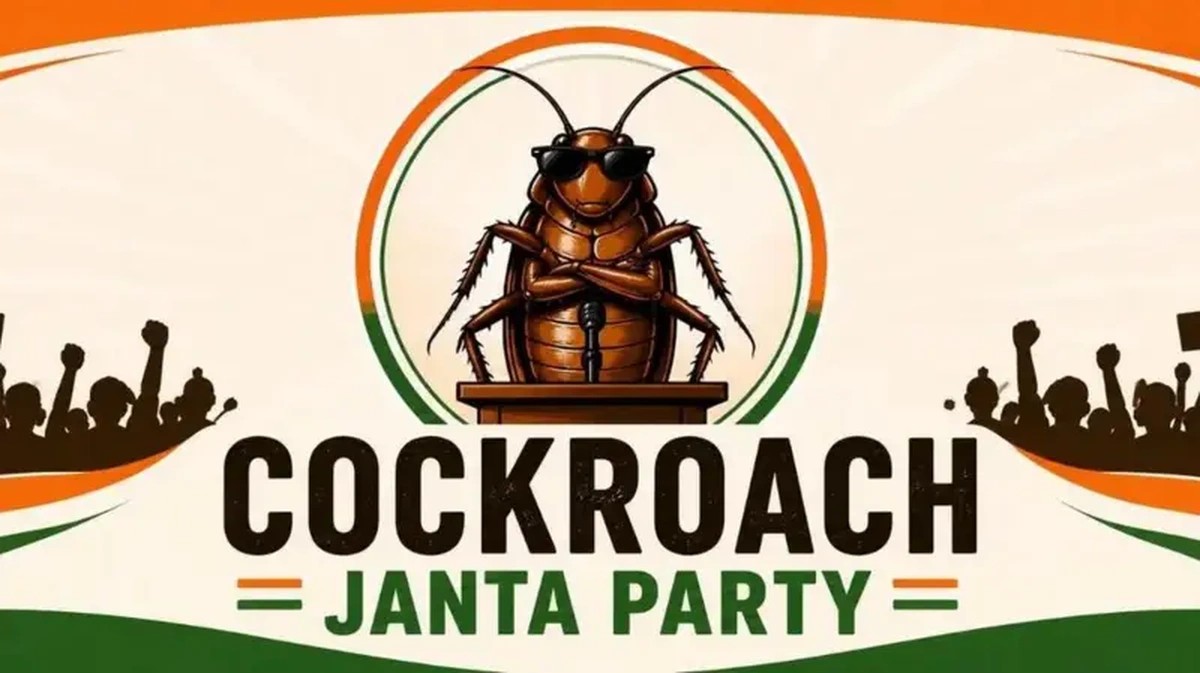
The "Cockroach People's Party", in India, already has a website with a form for anyone who wants to "join"
Cockroach Janta Party website
Indian politics has gained an unusual mascot: the cockroach.
It is not the lotus of the Bharatiya Janata Party (BJP), India's governing party, nor the hand symbol of the opposition Congress Party, but rather a cockroach - stubborn, detested and considered indestructible - which recently became has become an unlikely political symbol, but one that young Indians identify with online.
The insect gained prominence last week following controversial comments made by India's Supreme Court Chief Justice Surya Kant. During a hearing, he reportedly compared unemployed young people who are moving into journalism and activism to cockroaches and parasites.
He later clarified that he was specifically referring to people with "fake and fraudulent degrees," not India's youth in general.
Now on g1
But by then, his comments had already spread across the internet, sparking outrage, jokes and a satirical political uprising called "Cockroach Janta Party" (or Cheap People's Party, in Portuguese, with the acronym CJP in English).
It is not a formal political party, but a highly satirical online collective whose membership criteria include being unemployed, being lazy, spending a lot of time online and having "the professional ability to complain".
The "party" was created by Abhijeet Dipke, political communications strategist and student at Boston University. He says the idea came about as a joke.
Before moving to the US, he worked with the Aam Aadmi Party (AAP), which grew out of an anti-corruption movement and is known for its strong social media presence.
"I thought we should all come together, maybe just create a platform," Abhijeet Dipke told the BBC.
What happened next was much bigger than he expected.
Within a few days, the CJP had amassed tens of thousands of sign-ups via a Google form, inspired the hashtag #MainBhiCockroach ("I'm a cockroach too") and received support from opposition leaders.
The collective was founded by Abhijeet Dipke, 30 years old, who studies in Boston
Reproduction/X
The movement also left the online environment, with young people showing up of their own free will dressed as cockroaches in cleaning and protest groups, in a theatrical adherence to the label.
On Thursday, the CJP's Instagram account surpassed 10 million followers, surpassing the official account of the BJP - which is known as the largest political party in the world by members and has around 8.7 million followers.
However, his X account, with over 200 thousand followers, is currently blocked in India. People trying to access it are told the account is blocked "in response to a legal demand."
But the momentum continues to grow.
For supporters, the move represents what one person called "a breath of fresh air" in a political culture that many consider overly controlled and hostile to dissent. Supporters include opposition politicians such as Mahua Moitra and Kirti Azad, as well as senior lawyer Prashant Bhushan.
The "Cockroach People's Party" has taken an irreverent approach in India - image produced with artificial intelligence
Cockroach Janta Party website
Critics have dismissed it as mere online political theater linked to the opposition, pointing to Dipke's previous association with the AAP party and arguing that it is less about a spontaneous rebellion and more about politics carefully crafted digital video.
In addition to the immediate reactions, the movement has become an indicator of generational fatigue among many young Indians who say they are constantly exposed to online politics but rarely feel represented by it.
India has one of the youngest populations in the world, with about half of its 1.4 billion people under the age of 30.
However, formal political participation remains limited.
A recent survey found that 29% of young Indians avoided political engagement altogether, while just 11% were members of a political party.
"People are frustrated because they don't feel heard or represented," said Dipke.
Across South Asia in recent years, there have been waves of youth-led protests that have shaken governments in Sri Lanka, Nepal and Bangladesh, often driven by dissatisfaction with jobs, prices and stagnant prospects.
Until now, India has avoided anything similar, but the underlying pressures are familiar.
A rapidly growing economy has not alleviated concerns about work, inequality or the rising cost of simply surviving.
For many entering adulthood, education no longer guarantees stability, and the promise of upward mobility can seem increasingly fragile.
Though Dipke rejects comparisons with the uprisings in Nepal or Sri Lanka, saying that India's situation is different, he claims that the frustration among young people is still real - just expressed in more fragmented ways and online.
"Gen Z has given up on traditional political parties and wants to create their own political front in a language they understand," he said.
The CJP website reflects this sensibility, reading less like a manifesto and more like something shaped by Internet culture.
It describes itself as "the voice of the lazy and unemployed" while claiming to have "zero sponsors" and "a stubborn swarm," inviting supporters to join a movement for people "tired of pretending everything is fine."
There are fake forms, purposeful imperfections, and a visual language that's closer to an inside joke than an institution.
And yet, behind the humor are recognizable political demands: accountability, media reform, electoral transparency, and greater representation for women. They appear alongside self-deprecating jokes about content overconsumption, unemployment, and general political burnout.
The tone, somewhere between parody and sincerity, is part of its appeal. The jokes work because the frustrations behind them are familiar: jobs, inequality, corruption and political alienation. Many have pointed out that even the choice of mascot makes sense. The cockroach is not heroic or ambitious, but something more basic: resilient, adaptable and able to survive hostile conditions with very low expectations.
Of course, this mix of humor and politics is nothing new.
In Italy, comedian Beppe Grillo channeled anti-establishment humor into the Five Star Movement, while in Ukraine Volodymyr Zelenskyy went from playing a fictional president on television to becoming a real one. In the US, the era of Donald Trump has generated repeated discussions about whether satire itself has begun to crumble under a political reality that often already feels like a parody.
India's version takes a more online form: a meme-driven, insect-themed movement shaped by hashtags, burnout and ironic despair.
At first glance, it seems unusual. But it's not entirely out of place in Indian politics.
Politicians in the country have long embraced the power of spectacle, from meditating in Himalayan caves to switching parties amid scenes of lawmakers being herded into buses or confined to hotels.
Online campaigns rely on carefully choreographed viral videos and punchy slogans designed for maximum reach.
In this context, an insect-themed political movement seems oddly plausible.
It also helps explain why it has taken off. has spread so quickly - not necessarily because young Indians want another political party, but because many are looking for language to express their frustration.
"I think the CJP is just the beginning," Dipke said.
"Young people are fed up with the current political system and more youth organizations will emerge."
Others, however, are more skeptical, saying the party is likely to disappear as quickly as it emerged.
In any case, the CJP has already done something unusual in Indian politics: for a brief moment, it made some young people feel seen.
In earlier times, youthful political anger produced manifestos. In 2026, it sometimes produces meme parties with insect mascots.
Source: G1