Why Europe's negative reaction to Trump's intervention in the World Cup does not worry the FIFA president
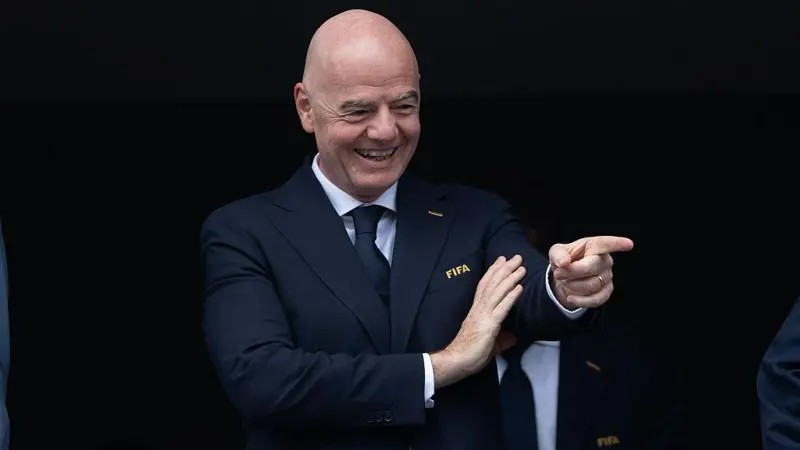
Trump confirms that he asked the FIFA president to review the red card given to a player
Gianni Infantino has been president of FIFA for 10 years and, next year, he is running for re-election.
But Infantino's tenure has been increasingly controversial - from the FIFA Peace Prize awarded to American president Donald Trump to exorbitant ticket prices for the World Cup.
✅ Follow the g1 international news channel on WhatsApp
But Could the unprecedented decision to cancel the red card given to American striker Folarin Balogun be the turning point? Balogun, the USA star, with three goals scored in this World Cup, was sent off in the game against Bosnia and Herzegovina.
He should have been left out of Monday's (06/07) match against Belgium, but had his red card suspended by FIFA. In the match, the Americans ended up defeated 4-1 by Belgium and were eliminated from the tournament they are hosting.
Despite being sent off, Balogun was on the field - even though World Cup rules do not allow appeals against red cards.
On Monday, more than 24 hours after its initial decision, FIFA released an 871-word statement that did little to clarify the reasons for the decision. But someone else also spoke out to provide clarification.
"I was the one who convinced them to do this," said Donald Trump, when asked if he had contacted Infantino by phone.
Trump said that "all" he did was ask for a review. He claimed he did not tell Infantino to lift Balogun's ban.
Gianni Infantino has been FIFA president since 2016.
Getty Images via BBC
But the mere fact that such an intervention took place is a cause for great concern across football.
Among Americans, the narrative has been that there was injustice against the USA, suggesting that Balogun should not be left out of the match against Belgium. Some argue that, having been sent off against Bosnia and Herzegovina, having lost the rest of that match would have been punishment enough.
These sentiments were expressed by Trump.
Infantino rejected any suggestion of political interference, insisting that the body's disciplinary committee is independent.
But people's perception is equally important in this case.
The decision didn't benefit any team - it helped the hosts' selection. And the US is governed by Trump - who supports Infantino and calls the FIFA president his friend.
The suspension of the red card seemed like a kind of presidential pardon.
"This is our sport, not theirs," said former Liverpool manager Jurgen Klopp. "If Donald Trump and Gianni Infantino really resolved this between themselves, it's crazy. It puts everything in doubt."
Could the consequences generate enough pressure to put Infantino's position at risk?
FIFA bans political interference in football
FIFA's statutes are clear on political interference. It is not permitted.
Countries are often suspended from international football due to government interference in national football federations. Pakistan, for example, has already been suspended three times in a period of eight years.
In the case of Infantino and Trump, are the rules different?
Now on g1
The World Cup draw, during which Trump received the first FIFA Peace Prize, felt like the culmination of two years in which Infantino cultivated a close relationship with the US president.
"You can always count, Mr. President, on my support, on the support of the entire football community, to help you bring peace and prosperity to the whole world," Infantino told Trump when presenting the award.
In December, the human rights group FairSquare filed a complaint with FIFA's ethics committee alleging that Infantino violated the organization's rules on political neutrality when creating the award.
Without receiving a response, last month 50 MEPs sent a new letter to the ethics committee demanding action.
As in many situations involving FIFA, there was no response.
So far, Trump has not attended a single World Cup match. But he made his presence felt by taking responsibility for Balogun's situation.
It was yet another example of how football can take a backseat to the political game.
We had already seen this happen with Somali referee Omar Artan.
Artan was denied entry to the US by immigration agents, and Infantino was accused of losing control of the World Cup itself.
However, when he was questioned by the press last month - for the first time in more than three years - his The response was perfunctory at best.
"Just, you know, stay calm, relax," Infantino said of Artan's situation.
This World Cup has always been surrounded by suspicion and controversy - and there have rarely been moments of transparency.
Another example was the five hours of uncertainty last Friday, when FIFA first decided to change the starting time of the round of 16 match between England and Mexico and then reversed itself, pretending that nothing had happened.
Balogun's situation follows the same script: a decision communicated without any justification. Football simply receives information about a decision and must comply with it.
Controversies behind the scenes at the World Cup
FairSquare believes that only 10 people were involved in the creation of the FIFA Peace Prize and that the decision was not made by the FIFA Council.
Getty Images via BBC
If we were to list all the recent controversies in football, this article would be quite long.
But let's consider the decision-making process of the World Cup hosts in 2030 and 2034 two years ago, something that often goes unnoticed.
It was decided that the 2030 edition would be held on three continents - Africa, Europe and South America.
This meant that the 2034 tournament would have to be held in Asia or Oceania.
With no real competition, this virtually guaranteed that Saudi Arabia (in the far west of Asia) - a country facing questions over its human rights record - would be the host.
Saudi Arabia and FIFA, under Infantino, now have a close relationship.
The Norwegian football federation abstained and argued that the bid process
Another example is the Club World Cup - which for some would be a kind of unwanted summer tournament created by FIFA to take a slice of club revenue.
Sergio Marchi, president of the global players union Fifpro, said last year that the tournament was created "without dialogue, sensitivity and respect".
And now we have the case Balogun.
"Football must never become a space for political power", wrote former FIFA president Sepp Blatter in Balogun.
European football's governing body said FIFA had "crossed a red line" and described the move as an "unprecedented, incomprehensible and unjustifiable decision."
This is not the first time UEFA has clashed with FIFA. FIFA.
Infantino was on a diplomatic trip to the Middle East alongside Trump and arrived two hours and 17 minutes late.
UEFA has also tried to reinforce its political position during the World Cup.
As soon as referee Artan landed back home in Somalia last month, UEFA announced that he had been invited to officiate the UEFA Super Cup game between Paris Saint-Germain and Aston Villa, on August 12.
And throughout this year, UEFA has been keen to highlight how cheap Euro 2028 tickets are compared to World Cup tickets. The entity will not introduce hydration breaks or red cards for players who cover their mouths - two FIFA innovations adopted in the current World Cup.
But it is worth mentioning that Infantino himself came from UEFA. For many years, he was responsible for presenting the Champions League draws.
Perhaps he is not exactly persona non grata in the European confederation - he spoke at the UEFA Congress in February - but there are obvious frictions.
Taking all this into account, one would expect that Infantino's position could be at risk.
On the contrary. Infantino is popular with many federations around the world - and much of this is due to FIFA's promotion of football.
Infantino's FIFA Forward program has funded football projects across the globe and created opportunities through the expansion of the World Cup.
The World Cup now has 16 additional teams - the vast majority of them from smaller confederations. Europe received only three of the additional places.
This World Cup showed that the Asian and Concacaf teams still need to improve a lot to be competitive.
But Infantino offered a chance to nations that previously had little hope of playing in a World Cup, such as Cape Verde, Curaçao, Jordan and Uzbekistan.
Despite all the criticism of the 48-team format, will it encourage nations with less tradition to develop their football and become stronger - and isn't that a good thing for the sport around the world?
In fact, there is a problem. Tournaments like the World Cup, with their exorbitant ticket prices, finance these projects.
This year, FIFA hopes to raise $9 billion.
UEFA may oppose much of what FIFA and Infantino represent, but European football is the richest in sport and can largely finance itself.
The rest of football depends on Infantino and the money FIFA generates.
FIFA is made up of 211 countries. Each of them has the right to one vote in the election of the entity's presidency, with 106 votes needed to win an election.
Let's analyze these numbers.
In April, Conmebol - the South American confederation - stated that its 10 countries would support Infantino. Three weeks later, the Confederation of African Football (CAF) confirmed the unanimous support of its 54 associations. Shortly afterwards, the 47 nations of the Asian Football Confederation followed suit.
With 111 votes, Infantino is already unbeatable.
Even though UEFA believes it can put together a viable opposition candidate, the race already appears to be decided.
Infantino was re-elected unopposed in 2019 and 2023. It would take something truly extraordinary for someone to run against him in 2027.
Source: G1