Why Cape Verde is a refuge for the LGBTQIA+ community in Africa
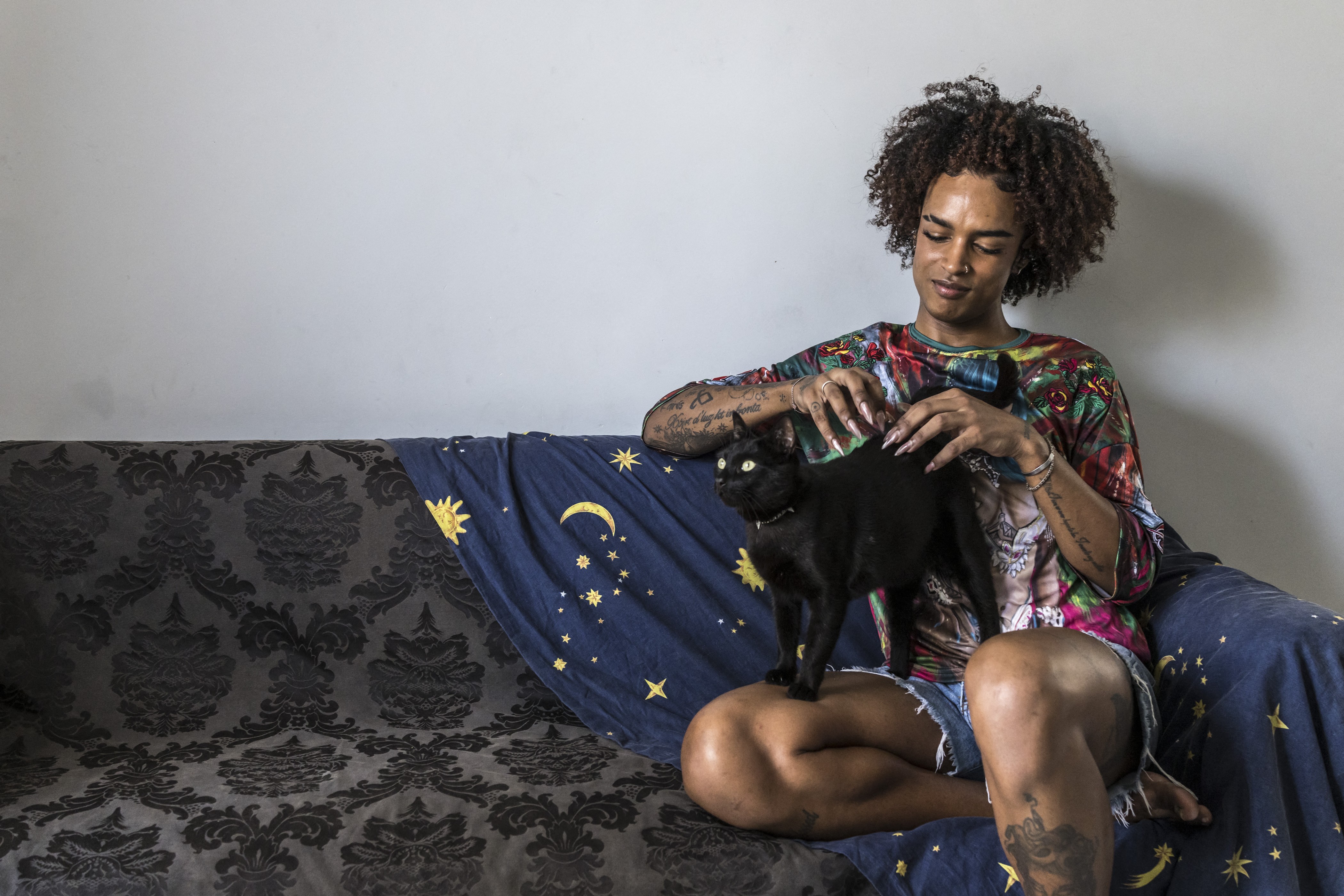
Leonardo Oliveira strokes his cat at his home, in Mindelo, on May 25, 2026
PATRICK MEINHARDT / AFP
Leonardo believes he is "very lucky to have been born in Cape Verde", a haven of tolerance in Africa, where laws against the LGBTQIA+ community are increasingly repressive.
"Makeup has great power, and I love it when I transform people, or when I transform myself," this 29-year-old professional makeup artist tells AFP with a smile as he puts the finishing touches on a singer's look for a music video.
"It's been a passion of mine since I was little; I've always been fascinated by femininity", adds "Léo", as he is known in Mindelo, the second largest city in the archipelago, on the Cape Verdean island of São Vicente, where he can freely live his homosexuality.
He readily acknowledges that he is "very lucky to have been born in Cape Verde". "Here we are safer than in many other countries," he says.
Homosexuality has been legal in Cape Verde since 2004 and discrimination in employment based on sexual orientation has been prohibited since 2008.
According to the Equaldex index, which evaluates rights, laws and public opinion around the world, the archipelago is currently the most welcoming country in Africa for the LGBTQIA+ community, ahead of South Africa.
In contrast to Cape Verde, Senegal approved in March a law that doubles the penalties for relationships homosexuals, from five to ten years in prison, amid a series of arrests for allegations of homosexuality.
More than 30 African countries or territories have prison sentences that can be very severe. Among the ten islands of the archipelago, São Vicente is home to the largest LGBTQIA+ community in the country.
Paradise?
Proof that the archipelago is an exception in Africa lies in an unusual scene that occurred at the end of May in Mindelo.
For two nights, three theater actors - Walter, Alessandro and Stephan - presented a play to an audience of dozens of people.
Alessandro Monteiro (left) and Walter Pires (right) talk to members of the audience invited to evaluate their costumes during the opening night of the play 'Font Flip is Burning', in Mindelo, on May 30, 2026
PATRICK MEINHARDT / AFP
The play portrayed the difficulties, the homophobic rejection on the part of some families and the cases of violence suffered by three transvestites in the neighborhood of Fonte Filipe, in Mindelo, where a large number of LGBTQIA+ people live.
In addition to being a dancer and actor, Walter Pires, aged 37, is a physical education teacher in Santo Antão, an island close to São Vicente. Openly gay, he says he does not feel discriminated against in Santo Antão and that he is respected by his students.
"Today we live almost in paradise (in Cape Verde), the new generations are more open and respectful, but this only happened after a lot of work to raise awareness", he highlights.
"In the past, there was abuse, and many of our friends were kicked out of their homes or lost their jobs," he says.
This is the situation experienced by Sindji Cawinny, 29 years old, who is transgender and met with the AFP in Mindelo, her hometown. After suffering prejudice from the owner of the restaurant where she worked, she works on her own with events and catwalk classes for beauty contests.
"I realized that, if I am a gay man who dresses like a man, it is easier to get a job; I would like to continue with my transgender life, but I am resigned", she says.
SEE ALSO
Cape Verde achieves historic classification and faces Argentina
Residents of Praia, capital of Cape Verde, celebrate the draw against Spain at the World Cup with flags from their country and one from Brazil, on June 15, 2026.
Danilson Sequeira/ Reuters
Source: G1