Who is Raúl Castro, the last great symbol of the Cuban Revolution that is in the sights of the United States
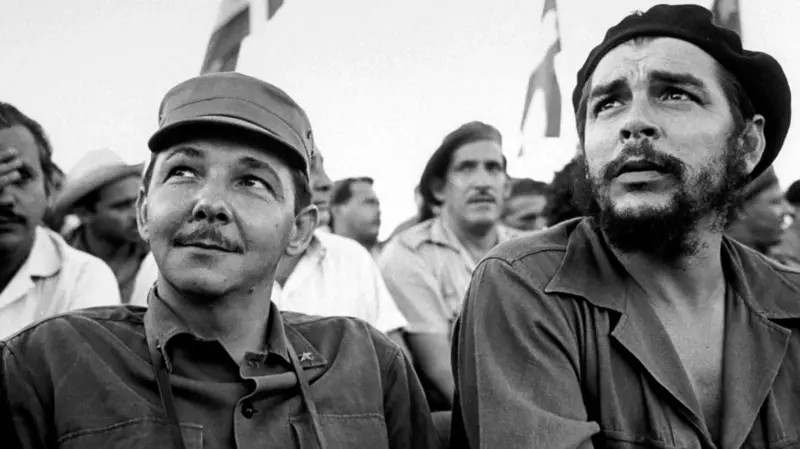
Raúl Castro alongside Che Guevara in 1964
Getty Images
With the criminal indictment of Raúl Castro, the United States places in its sights the most important figure of the Cuban regime in recent decades.
The former combatant of the Revolution, minister of the Armed Forces for almost half a century, successor to his brother Fidel and architect of the greatest reforms of the communist regime, now, at the age of 94, faces a judicial process in the neighboring country with consequences unpredictable.
The United States Justice attributes to Castro a central role in the downing of two aircraft belonging to the exile organization Hermanos al Rescate on February 24, 1996, an episode that left four dead and opened one of the biggest crises in relations between Cuba and the United States.
This Wednesday (20/5), the US government indicted the former Cuban president for four murders, as well as conspiracy to kill American citizens and destroy aircraft.
Raúl Castro commanded the Cuban Armed Forces when two Air Force fighters shot down the aircraft of the Hermanos al Rescate organization in 1996
Getty Images
Crucial figure
The case gains great relevance not only due to the precedent of the capture of Nicolás Maduro in Venezuela in January, but also because of the central role of Army General Raúl Castro in the contemporary history of Cuba.
Always in the shadow of his brother Fidel, he was a crucial figure within the apparatus. regime's military and intelligence until formally taking power in 2008 and governing the country for a decade.
Although he left the presidency to Miguel Díaz-Canel in 2018 and, three years later, the leadership of the Communist Party, analysts believe that he remains the most powerful man in the Cuban power structure.
In addition, the possibility of a judicial process against him comes at one of the most delicate moments for the island in decades.
Cuba is going through an economic and energy crisis extreme, with blackouts and fuel shortages, worsened by pressure measures from Donald Trump's government in the United States.
On the other hand, North American and Cuban authorities, including figures close to Raúl Castro, held discreet meetings in Havana to discuss the island's uncertain future.
At 94 years old, the leader stands out for having maintained a traditional family life, unlike his brother Fidel, known for his numerous and secret love relationships.
Raúl Castro was married to Vilma Espín, a revolutionary he met in the guerrilla that overthrew the Fulgencio Batista regime in 1959, and who died of cancer in 2007.
The couple had four children, including Mariela Castro Espín - deputy of the National Assembly of Popular Power and director of the National Center for Sexual Education (CENESEX) - and Alejandro Castro Espín, director of intelligence and counterintelligence at State Security.
Vilma Espín and Raúl Castro in 1998
Getty Images
In the face of the broad revolutionary visual imagination of Fidel and Che Guevara, Raúl Castro cultivated a more discreet, pragmatic and military image, without concentrating a massive cult of personality.
Despite this, it is common to see his portrait hanging on the wall - almost always next to Fidel's - in offices of Cuban public bodies.
We analyze who Raúl Castro is and his crucial relevance in history and in the present of Cuba.
The president of reforms and the thaw (2008-2018)
Although he participated from a young age in the revolutionary struggle alongside Fidel and Ernesto "Che" Guevara, and for decades he played a key role within the Cuban military apparatus, Raúl Castro achieved his greatest protagonism after assuming power between 2006 and 2008.
He inherited the presidency provisionally in 2006, after his brother fell seriously ill, and two years later he was officially designated president of Cuba.
Different from the charismatic and ideological style of Fidel Castro, the younger brother projected a more pragmatic image and less focused on grandiloquent speeches.
During his term, he promoted economic reforms that, although quite limited, were the most significant since the collapse of the Soviet Union.
His government expanded the space
o for small private businesses, authorized the purchase and sale of real estate and automobiles, relaxed some migration restrictions and promoted timid openings to the market.
It also reduced part of the enormous Cuban state apparatus and encouraged new forms of self-employment.
However, the reforms coexisted with the maintenance of the single-party political system established after the 1959 revolution.
Under the command of Raúl Castro, international human rights organizations continued to denounce the lack of freedom of expression and civil and political rights, in addition to the repression of opponents.
The most striking moment of his presidency occurred in 2014, when he announced, alongside then American president Barack Obama, the beginning of the historic diplomatic thaw between Cuba and the United States after more than half a century of hostility.
Raúl Castro and Barack Obama, in one of their meetings in 2015 at the UN headquarters in New York
Getty Images
That historic understanding between The two presidents allowed the reopening of embassies, the increase in travel and contacts between the countries and Obama's visit to Havana in 2016, an unprecedented event since the 1959 Revolution.
When Fidel Castro died in 2016, Raúl led the Cuban leader's official farewell: he announced his death on television, organized state funerals and promised to defend the continuity of the socialist system.
In relation to the thaw, many of the expectations of economic and political opening ended limited, and part of the process began to be reversed with the arrival of Donald Trump to the White House in 2017, a year before the transfer of power from Castro to Miguel Díaz-Canel.
Raúl Castro in 1959, shortly after the success of the Revolution that gave rise to the socialist system led by his brother Fidel
Getty Images
Fidel and Che Guevara's fighting companion
Raúl Castro was born on June 3, 1931 in Birán, in the eastern region of Cuba, within a wealthy family formed by Galician immigrant Ángel Castro and Lina Ruz.
Like his brother Fidel, he studied at religious schools in Santiago de Cuba before moving to Havana to continue his university education.
In the late 1940s and early 1950s, he joined protest movements against the governments of Carlos Prío Socarrás and, later, against the dictatorship of Fulgencio Batista (1952-58).
Unlike Fidel, whose political formation was initially more linked to Cuban nationalism, Raúl early developed sympathies for Soviet socialism.
He joined the Youth of the Popular Socialist Party and participated in youth meetings organized in Eastern Europe, experiences that decisively influenced his political vision, according to historians and close sources.
His definitive entry into the revolutionary struggle occurred in 1953, when he joined the movement armed group led by Fidel Castro against Batista.
Raúl Castro (center, crouched) with his brother Fidel and other guerrillas who overthrew the Batista regime
Getty Images
At just 22 years old, Raúl participated in the attack on the Moncada barracks, in Santiago de Cuba, a failed operation that, despite ending with dozens of deaths and the arrest of the Castro brothers, would later become one of the main founding events of the Cuban Revolution.
After To benefit from an amnesty in 1956, Raúl moved with Fidel to Mexico, where he participated in the preparation of the Granma yacht expedition alongside other exiles and the Argentine Ernesto "Che" Guevara.
The Granma's landing in Cuba marked the beginning of the Sierra Maestra guerrilla war, which would culminate in the fall of Batista and the success of the Revolution on January 1, 1959.
The general in the shadow of Fidel
Raúl Castro quickly became one of the most powerful figures in the new regime led by his brother Fidel from 1959 onwards.
That same year, he was appointed minister of the Revolutionary Armed Forces, a position he would hold for almost half a century and from which he consolidated one of the most solid military and intelligence apparatuses in Latin America.
Experts point to him as being responsible, at that time, for gar
anti the internal stability of the system and for acting as Fidel Castro's right-hand man.
Unlike the international projection and charismatic leadership of his brother, Raúl maintained a more discreet profile, focused on control of the Armed Forces and the organization of the State.
Raúl and Fidel Castro in 1978.
Getty Images
In the first decades of the new system, Raúl Castro played a crucial role, according to experts, in consolidating the alliance with the Soviet Union and in building the Cuban political model inspired by the socialist regimes of the Eastern bloc.
For years he was identified by exiles and human rights organizations as one of the toughest figures, who did not lack firmness in repressing or eliminating those he considered enemies of the Revolution.
With Raúl Castro at the head of the Armed Forces, on February 24, 1996, Cuban fighter jets shot down two aircraft belonging to the exile organization Hermanos al Rescate, which were flying over waters close to Cuba to assist rafters who were fleeing across the sea towards the United States.
The military attack on the aircraft caused the death of four people.
While the Cuban government claimed that they had violated the island's airspace, international investigations concluded that they were shot down in international airspace, causing a serious diplomatic crisis between Cuba and the United States.
Carlos Costa, who piloted one of the aircraft, was one of the four activists who died in the attack
Getty Images
The indictment announced by Washington refers to this episode.
Historical recordings revealed years ago by US media record the voice of Raúl Castro who apparently orders action against the aircraft, including phrases such as "shoot down the aircraft". Cuba, the most powerful position within the regime.
When, in 2021, he also transferred this role to Díaz-Canel, the Cuban authorities presented the gesture as the symbolic end of the historic generation of the Revolution that has ruled the country since 1959.
Still, experts say that Raúl continued to exert great influence over the State's strategic decisions, especially in military, security and relations with the United States.
After his official retirement, he continued to appear in key events of the regime, such as military parades and revolutionary celebrations, usually alongside Díaz-Canel and the leadership of the single party.
Raúl Castro alongside Díaz-Canel during the parade on May 1, 2026
Getty Images
On July 11, 2021, the largest anti-government demonstrations in more than six decades took place on the island, to which the regime responded with thousands of arrests and arrests.
Although Díaz-Canel publicly led the official response, the security and political control structures that for decades were under the command of Raúl Castro played, according to experts, a decisive role.
Meanwhile, Cuba was entering its biggest crisis since the 1990s.
The tightening of United States sanctions under Donald Trump, the economic impact of the pandemic, the drop in tourism and the energy crisis worsened the economic and social deterioration that the island had already been accumulating for decades and caused a massive exodus - the country lost up to 20% of its population, according to estimates.
In this context, Raúl Castro's family environment stood out as one of the main centers of influence in Cuba: his grandson and bodyguard Raúl Guillermo Rodríguez Castro, known as "El Cangrejo", was mentioned by US media outlets as one of the interlocutors in the recent and discreet contacts between Washington and Havana.
The latest Castro's public appearance took place in the traditional May 1st parade, when, dressed in military uniform, he accompanied Díaz-Canel and other figures of the Cuban regime.
Now on g1
Source: G1