Who are Roberto Sánchez and Keiko Fujimori, and what could be decisive in the election in Peru, an 'ungovernable' country
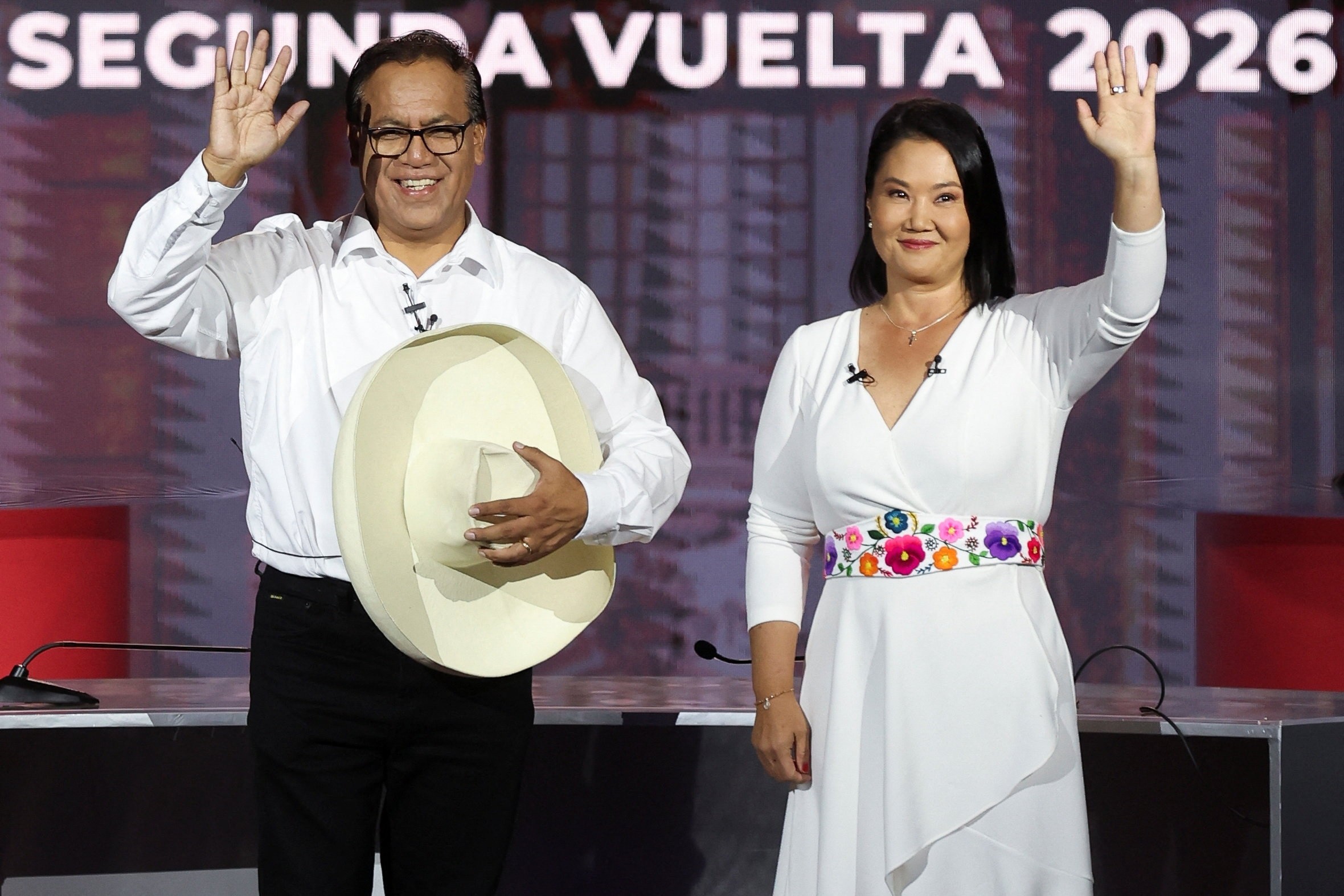
The right-wing candidate for president of Peru, Keiko Fujimori, and the left-wing candidate, Roberto Sánchez
REUTERS/Alessandro Cinque
Peru will elect this Sunday (7/6) its ninth president in just a decade.
After a troubled first round and a vote count that lasted for a month, the country returns to the polls in a climate of political uncertainty.
The right-wing Keiko Fujimori, heiress of the Fujimorist movement and who obtained 17.92% in the first round, is running for President against the leftist Roberto Sánchez, who received 12.03% of the votes.
This election repeats a pattern that has characterized Peruvian politics in recent decades: a confrontation between Fujimorism and another candidate, in which anti-Fujimorism usually plays a determining role.
Peru's court decides to take left-wing candidate to the bench trial
Keiko Fujimori, daughter and political heir of the controversial former president Alberto Fujimori, has stood out for her persistence.
This is the fourth time that Keiko has run for President and she did not recognize the results of the last two elections - in which she was defeated by the right-wing Pedro Pablo Kuczynski in 2016 and the left-wing Pedro Castillo in 2021.
Political scientist Alonso Cárdenas, professor of Science Politics from the Antonio Ruiz de Montoya University, in Lima, states that the non-recognition of the electoral results caused damage to Peruvian democracy.
"This was one of the main catalysts for the process of upheaval and political instability that the country has been facing in the last ten years, with eight presidents, a deeply discredited Congress and an institutional implosion that marks political life today," he told BBC News Mundo.
"This situation also resulted in the rise of organized crime, expressed in phenomena such as 'sicariato' (practice of contract murder) and extortion, and has significantly deteriorated the population's quality of life."
On the ballot will also be Roberto Sánchez, who is running for President of Peru for the first time. He was Minister of Foreign Trade and Tourism during the government of former president Pedro Castillo, of whom he considers himself political heir.
Castillo was sentenced last year to 11 and a half years in prison for the crimes of rebellion and conspiracy, after unsuccessfully trying to dissolve Congress and concentrate powers when he was in charge of the Executive in 2022.
The factors that will influence the election
One of the determining factors in this election will be the undecided vote, which represents around 25% of the electorate, according to a survey by the IEP institute published last week.
"This percentage could go either way.
In recent days, especially on social media, many people have mobilized to remember everything that happened with Fujimori - the cases of corruption, the violation of human rights, authoritarianism, kleptocracy," says Cárdenas. that there be abstention in Lima, its main urban stronghold, while Roberto Sánchez does not want to abstain in rural areas and in the south of the country, where he has great popularity."
In this sense, electoral mobilization in urban versus rural areas could be decisive in what is expected to be a very tight electoral result.
Another determining element is the historical rejection of both candidates, which functions as a political force with its own dynamics.
In the case of Keiko Fujimori, The so-called anti-fujimorismo brings back memories of authoritarianism and corruption; in the case of Sánchez, his association with the administration of Pedro Castillo weighs heavily, which "is remembered as a very disorderly administration, marked by corruption and improvisation", according to analyst Alonso Cárdenas.
In addition to the winner at the polls, another major unknown is the country's governability, in a context in which the Peruvian Congress has become a key agent in political stability, with the capacity to condition the action of the government. Executive.
In recent years, the combination of a fragmented party system and the absence of solid majorities has triggered persistent instability.
The removal of presidents and constant clashes between Powers have reinforced the perception that governability depends less on the electoral result and more on the president's ability to build alliances in a highly volatile Congress.
Check out the profiles of the two candidates running in the election this Sunday below.
Keiko Fujimori, the heiress of Fujimorismo who is running for the 4th time
Many things can be attributed to Keiko Fujimori, but not the lack of perseverance: after three defeats, the Fuerza Popular candidate went through to the second round for the fourth consecutive time.
Keiko became one of the few lasting figures in Peruvian politics, which in recent years has devoured its leaders in the frenetic pace of successive corruption scandals.
She also had her own scandal: a case of money laundering within the context of of the Brazilian construction company Odebrecht. But even after going to prison, the Constitutional Court ended up shelving the case. The decision allowed her to return to being a candidate in time for these elections.
To win over voters tired of corruption and insecurity, Fujimori did not hesitate to claim the legacy of her father, who died in 2024 and spent around 16 years in prison after being convicted of crimes against humanity.
With the electoral slogan of "return to order", she tried to associate her image. to that which admirers have of Alberto Fujimori: a firm leader who stabilized a country shaken by the economic crisis and Shining Path violence in the 1990s.
However, his father remains a divisive figure in Peru, and many also remember the human rights violations that occurred under his command, as well as the severe cuts resulting from his economic reforms.
His surname is his great political asset, but also his main burden. In fact, the figure of Keiko. She was always linked to her father's.
Born in 1975 and the eldest of four brothers, it was up to her to assume the institutional role of First Lady of Peru when her parents' marriage fell apart.
It was then that the Peruvians met a young Keiko as her father's companion in public events and state trips.
After studying Business Administration in the United States, she returned to Peru and dedicated herself fully to politics.
In 2006, with her father already detained in Chile, she was elected congresswoman for the first time.
Five years later she ran for president.
He tried again in 2016 and 2021, losing on each occasion to politicians who did not reach the end of their terms.
Keiko maintained control of Fujimorism, but this came at a cost: family conflicts and controversial decisions, including involving his own father and brother.
In 2022 he separated from American businessman Mark Vito, with whom he had two daughters and who is now part of the world of Peruvian television and entertainment.
This is the first time that Keiko Fujimori is running for president after the death of her father. During the campaign, he tried to further take advantage of this political capital and the feeling of many Peruvians that the country is experiencing an exceptional situation that requires firm measures.
Among his proposals are the construction of maximum security mega-prisons and the withdrawal of Peru from the Inter-American Court of Human Rights.
After this Sunday's elections, we will know if he will once again just come close to the position - or if he will finally achieve his dream of becoming president.
Roberto Sánchez, the survivor of the era Castillo
Surviving the political wreck that was the government of former president Pedro Castillo, arrested and prosecuted for several crimes, seemed a difficult task - but Roberto Sánchez Palomino managed it.
Although a few days before the vote the Juntos por el Perú candidate appeared far behind in the polls, he managed to win votes in a short time and, benefiting from the fragmented Peruvian electoral scenario, he is now the candidate who will compete in the second presidential round with Keiko Fujimori.
Born in 1969 in Huaral, a predominantly agricultural town about 80 km from Lima, and a trained psychologist, Sánchez managed to transform his proximity to Castillo as the person responsible for Tourism and Foreign Trade (he was the only minister who survived the constant cabinet changes) into a political asset when, for all experts, this seemed like a burden.
The candidate did not hesitate to claim his connection with Castillo's government and even appeared in the debates wearing the same peasant hat with which the former president presented himself to Peruvians, which has become a symbol of rural and Andean Peru.
Thanks to this, he managed to garner the support of some of the sectors that led Castillo to the Presidency, especially in the south of the country, which was most affected by the violence in the repression of the protests that followed the fall of the former president and where resentment towards Lima's politicians is widespread.
With his moderate style and calm tone amid the permanent political tension in the country, Sánchez knew how to maneuver with skill and, unlike other members of the cabinet, he did not have to answer in court for Castillo's failed attempt to dissolve Congress, which ended up causing his dismissal and arrest in December 2022.
The then minister Sánchez resigned shortly after Castillo appeared on television announcing, with a shaking hand, his exceptional measures, and abstained in the vote in Congress that ended up removing the president, which many interpreted as an attempt not to sink with him.
Castillo does not seem to hold a grudge. In one of his last court hearings, he asked for a vote for him. And the candidate knew how to exploit the discontent of large sectors of rural Peru with the fate of the former president.
Ramiro Escobar, political analyst at the Pontifical Catholic University of Peru, told BBC Mundo that Sánchez's departure for the second round "shows that Lima's political circles continue to fail to understand the magnitude of discontent in some regions."
Source: G1