Which came first, black hole or the galaxy? Telescope finds answer
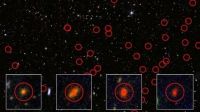
The question of who came first can be answered by the JWST Telescope (James Webb Space Telescope) based on observations of ancient galaxies, called small red dots.
These points were detected for the first time in 2022, by JWST and were considered by scientists to be galaxies never seen before. The researchers also noted that these ancient galaxies are common in the early universe, but studies have indicated that they have disappeared approximately every 1.5 billion years since the Big Bang.
These found by James Webb took a much shorter time, well before the universe even completed its 1 billion years. Thus, this JWST discovery indicates that black holes came before galaxies, as they lack the need for a black hole to form.
Astronomers reveal first image of black hole at the center of the Milky Way | NEW DAY
This means that light from the ancient galaxy studied, which existed 700 million years after the BigBang and is 1,300 light-years in diameter, has traveled to Earth for just over 13 billion years.
Named QS01 (Abell2744-QSO1), it is easier to use as an object of study because it has a gravitational lensing effect, which occurs when a massive object comes between a more distant background object and the Earth.
The telescope also found a large number of supermassive black holes, with masses up to billions of times greater than that of the Sun. The problem for scientists is that, until then, it was believed that black holes took more than 1 billion years to become supermassive.
This means that black holes do not need to feed on large amounts of dust and gas for their galaxies to grow.
"This is a paradigm shift, a complete revision of the classical scenarios of how black holes form and grow.", said research team member and professor at the University of Cambridge, Roberto Maiolino.
Much larger than the Sun
Initially, researchers believed that QS01 was a supermassive black hole. However, its mass is 40 million times greater than that of the Sun, a proportion that indicates that it could not have been born from the collapse of a star with a galaxy, as it was born large and could eventually become a galaxy.
There are still many questions surrounding QS01, especially about how it formed, but scientists believe it may have been born from a "dense seed" made by a collapse between a cloud of gas and dust.
Another option evaluated is that it emerged in the initial moments of BigBang, through a process that is still unknown.
The greatest certainty (but still relative) is that Abell2744-QSO1 is not rare among the red dots of the early universe. To confirm, they are now studying other of these small spots to determine whether they also harbor supermassive black holes with forming galaxies.
*Under the supervision of Thiago Félix
How does a black hole grow? Scientists reveal "secret ingredient"
Source: CNN