What We Know About Trump's Fourth of July Fireworks Event
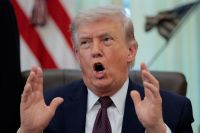
President Donald Trump's celebration of America's 250th birthday will conclude on Saturday with a record-breaking fireworks show on the National Mall, amid scorching temperatures and controversy over his efforts to put himself at the center of the celebration.
Trump has suggested long speeches as part of the "Salute to America" event, despite a dangerous heat wave that could affect the public.
During a rally on Wednesday, the president dismissed any concerns about the heat impeding his speech. "In fact, on the Fourth of July, it's going to be about 100 degrees, and I'm going to go out there and give a really long speech just to show that I can do anything," Trump said.
The high-profile speeches come as another part of Trump's 250th birthday program, the "Great American State Fair," faces modest attendance and logistical problems.
Along with the fair, the "Salute to America" event is organized by Freedom 250 - a Trump-backed nonprofit responsible for holding a series of semiquincentennial events aligned with the president's cultural agenda.
In August, there will be a street-level "Freedom 250 Grand Prix" and a youth sports competition called "Patriot Games", with a top prize of US$250,000.
Freedom 250 advised guests to arrive at the national park area no later than an hour before gates open at 5 p.m. Eastern Time to deal with the heat. The event will feature musical performances and a series of military flyovers.
See what we know about the event:
What will the temperature be like?
Ahead of the holiday weekend, a heat wave is intensifying on the East Coast of the United States and putting a strain on the power grid as people seek to cool off in air-conditioned homes and establishments.
Washington, DC, has activated an extreme heat warning until July 5th, as Saturday is expected to record the hottest 4th of July ever documented in the city, with a current forecast of 38°C. The hottest 4th of July ever recorded in the nation's capital was 38°C in 1919.
The heat also hampered the preparations. The US Capitol Police restricted attendance at a July 2 rehearsal for the traditional "A Capitol Fourth Concert" due to excessive heat, and the opening of the gates was postponed until later due to weather conditions on Friday (26).
Will there be water?
Freedom 250 is offering free water refills and misting stations throughout the venue as participants brave high temperatures.
After a heat warning, the group adjusted the rules to allow the public to bring empty, non-metallic reusable bottles to be filled at hydration stations installed in the park.
Rachel Reisner, spokeswoman for Freedom 250, told CNN that the group will also distribute bottled water.
Participants are prohibited from carrying backpacks, coolers, folding chairs, drones, firearms or aerosols, as in previous celebrations.
However, food and beverages will be available for purchase, and portable fans will be permitted within the perimeter.
This year's event adopts a clear bag policy, which the organization says was created to speed up security screening.
What will security be like?
Despite looming concerns about a new attempted attack on Trump, as well as the ongoing threat of an isolated shooter, Washington, D.C., is well-positioned to ensure the security of this type of large-scale event, several officials involved in the planning previously told CNN.
Federal agencies will also help protect other Fourth of July celebrations across the United States, including in Boston, California, Pennsylvania and New York.
Attendees in Washington, DC will be screened by metal detectors. The Secret Service, which is leading the Fourth of July event, along with the FBI, Metropolitan Police and other federal and local law enforcement, will be responsible for security at both the Trump air show and the "Great American State Fair" on the National Mall.
With extensive road closures in the city, participants are encouraged to use public transport.
DC Mayor Muriel Bowser announced that the Washington Metropolitan Area Transit Authority's transit system will be free after 5 p.m. ET and will operate until 2 a.m.
The president's presence was a factor in the celebration being classified as a Special National Security Event, US Secret Service spokesman Tom Lynch told CNN.
The designation, also known as NSSE, is common at large events that may be targeted by criminals or terrorists. As a result, Lynch said this year's level of security will be unlike any other Fourth of July in recent memory.
When will Trump speak?
Trump is scheduled to take the stage at 9:45 pm (Eastern Time, 10:30 pm EDT), ahead of the fireworks show at 10:30 pm (11:30 pm BSB), but the length of his speech is not yet clear.
The president has presented the Fourth of July event as a "Trump rally" and highlighted his leading role in the celebrations in Washington, despite criticism from Democrats that he had turned the 250th anniversary celebration into a partisan event, more focused on him than on the country.
What about the fireworks display?
Bowser initially announced that the big annual fireworks show would begin at 11pm ET on Independence Day, two hours later than last year's celebration, but the spectacle will now begin at 10:30pm ET and will last about 40 minutes.
The show is expected to set a new Guinness World Record for the largest fireworks display, with nearly 850,000 fireworks being launched from 10 different points, including the Lincoln Memorial Reflecting Pool, barges on the Potomac River and West Potomac Park.
The current record is 810,904 shots during the 2016 New Year celebration in the Philippines.
The spectacle in the capital will be about 10 times bigger than Macy's Fourth of July fireworks show in New York, usually the largest Independence Day celebration in the country.
The fireworks show is estimated to cost US$850,000, according to a previous CNN report.
Will there be an impact on air quality?
Fireworks generate smoke pollution that, in some cases, can equal that produced by forest fires and remain in the air for several hours.
In some cities, air quality only returns to normal around noon the next day, and hot air can prolong this process.
But even before any fires are lit in some urban areas, the heat will have already created another type of air pollution: ground-level ozone, formed by the mixture of vehicle exhaust gases, heat and sunlight.
This ozone can irritate the lungs, which can worsen air quality even before nighttime celebrations. Very hot regions, including Washington, D.C., are expected to experience at least moderate levels of ground-level ozone during the day.
When asked whether the Environmental Protection Agency (EPA) is monitoring any air pollution impacts from the fireworks show, EPA press secretary Brigit Hirsch told CNN: "Fireworks are incredible and we hope everyone enjoys the incredible displays in and around the capital as we celebrate America's 250th birthday."
What about the reflecting pool?
The fireworks are expected to be launched from the Lincoln Memorial reflecting pool - a location shrouded in recent controversy and curiosity since blue material at the bottom of the pool began peeling.
The reflecting pool was painted blue and refilled after Trump ordered a $14 million renovation.
In the weeks following the costly project, the president stated that vandals had damaged the water mirror, which was already suffering from algae problems, and promised to restore it.
A former Olympic kayaker was indicted by a grand jury in Washington on Thursday, accused of damaging the reflecting pool in front of the Lincoln Memorial.
U.S. Attorney for the District of Columbia Jeanine Pirro said Thursday that there are "about a half-dozen" other cases being investigated by the U.S. attorney's office.
Source: CNN