What the improvised morgue looks like where corpses pile up in the open after earthquakes in Venezuela: 'I'm scared of what I'll find there'
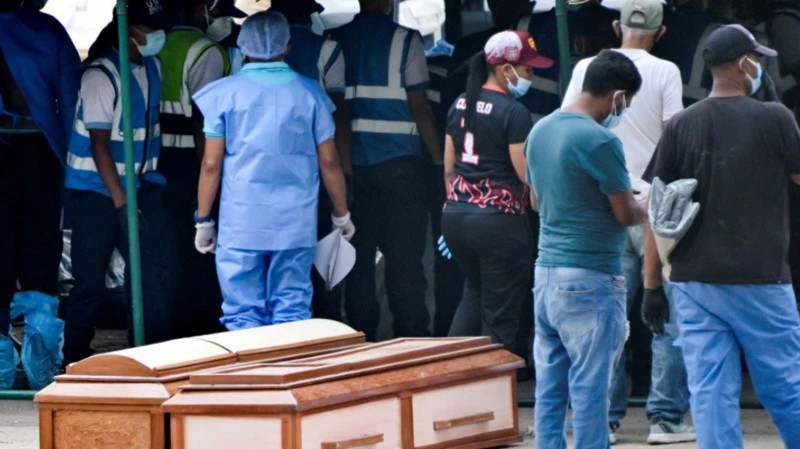
After the 6/24 double earthquake in Venezuela, Los Silos was transformed into a makeshift morgue.
Reuters via BBC
"No, brother, no, brother! No! Why are you doing this to me?" screams a woman as her husband tries to hold her so she doesn't collapse to the ground.
The scene repeats itself time and again on the outskirts of Los Silos, an imposing concrete structure in La Guaira that, amid the tragedy caused by the double earthquake of 24/6 in Venezuela, it stopped functioning as a port storage facility and started to serve as an improvised morgue.
✅ Follow the g1 international news channel on WhatsApp
There, under the strong tropical sun, dozens of families wait in anguish and fear. They came to confirm the death of their relatives.
The authorities set up chairs inside and outside the building, where several tents were also set up. The wait is long. Too long, perhaps, for those who have spent days among hospitals, shelters and rubble.
Now on g1
In the queue, the grief seems to spread from one person to another. Nobody talks. Some stare into space. Others check their cell phones to read the news or respond to messages.
A few meters away, soldiers from the Bolivarian Armed Forces, armed with rifles, control access.
"I'm afraid of what I'll find inside, but it's the only way to put an end to this agony," says a woman before crossing the gate.
She's been looking for her nephew for almost a week.
"I looked for him everywhere: in the building, in the hospitals, I spoke to everyone... and no one knows anything."
Inside, the first thing that catches your attention is the smell of decomposition.
The smell and the images
Several relatives put their hands to their mouths. Most cover their faces with fabric masks, which cannot block the bad smell. Within minutes, many stop reacting: they end up getting used to the nauseating odor.
A few meters away, hundreds of bodies are lined up, covered in plastic bags and exposed to the sun and intense heat of La Guaira, which accelerates decomposition.
The bodies are organized according to the date they were rescued. At one end, a tent offers free cremation. In the other, a small forensic dentistry unit tries to identify bodies that barely retain any human traces.
Families have two options.
Whoever believes they will be able to identify their relative based on the clothes he was wearing is sent to a specific area.
The rest - the majority - sit in front of two televisions.
That's where another ordeal begins.
More than a thousand images of bodies pass on the screen in a sequence that seems endless. The dead have swollen faces, darkened skin and marks caused by impacts, heat and the passage of time. Some can no longer be recognized.
Families look for any trace that allows them to identify their relatives: a tattoo, a bracelet, a piece of clothing or some household object that appeared in the photograph.
When necessary, the two employees who screen the images on an iPad go back to the photo and enlarge details, such as teeth, a tattoo or a scar.
In front of one of the televisions, a woman begins to cry when she recognizes her son because of a blanket full of dust that appears on one of the images. Another woman hugs her, although she doesn't know her.
The silence is interrupted by the ringing of a telephone.
'This looks like a horror movie'
"Uncle, I'm here trying to recognize my mother... but it's very difficult. Most of the bodies look charred", whispers a young man.
"This looks like a horror movie", says as she leaves Liliana González, a 60-year-old resident of Catia La Mar, who managed to recognize her 37-year-old nephew because of a tattoo. "I was looking for my aunt... but my cousin, who is a nurse, told me that my nephew was here," he says.
"[His name] wasn't on the list.
I had to see the images." Her voice trembles.
Then, González reflects out loud: "It's the first time I've been through a situation like this. I saw my mother when she died, but this... this is different."
"There are swollen bodies, with their eyes out, children... I've never seen anything like that in my life," says González.
'No one took them away'
Modesta Alemán, 56, came from Carayaca, in the west of La Guaira, in search of her older sister, Matilde.
The building where she lived, in Playa Grande, one of the most popular beaches on Venezuela's central coast, it was one of the hardest hit in the region.
"They told us there were no survivors. That everyone was dead", says Alemán.
"Then a group of volunteers said they heard voices... that there were people trapped in the elevator asking for help. But no one took them out."
Alemán does not enter the improvised morgue. She remains outside while other relatives carry out the recognition.
Perhaps, she says, it would have been better this way.
The process can take hours. When a body is identified, the stage for its release begins.
After recognition, fingerprints are taken, when this is still possible.
Then the body is placed in a coffin. Then, the process for issuing the death certificate, an essential document so that the funeral home can remove the remains.
Jéssica Soto, 42 years old, resident of the OPP 33B building, in Caraballeda, is sitting in a chair at the entrance to Los Silos.
For two days she has been waiting for the release of the bodies of her daughter, aged 15, and her granddaughter, aged 3, who were trapped in the apartment where they lived after the earthquakes. Tuesday (30/6), almost a week after the tremors.
"They make us wait and wait until the documents arrive, the trucks and who knows what else", says Soto in an interview with BBC News Mundo, the BBC's Spanish service.
"They have been there, inside a coffin, sunbathing since yesterday. I have no other option but to wait and trust in God."
'It's good to feel someone's hand'
After losing her home, Soto is now sheltering at the Tanaguarena golf club. Relatives tried to convince her not to recognize the bodies.
"When I saw her, it was the worst thing. My daughter was... disfigured. I recognized it was her because of the shirt and I knew it was her, but her face was no longer her face. It was the face of a monster."
The death toll is now approaching 2,600 across Venezuela, and authorities believe that this total is likely to increase significantly.
González says she panicked when she was told that she would have to recognize her nephew alone.
"But, when they saw me like that, two employees accompanied me to the body. They helped me find him so that I wouldn't suffer so much," she says. "Thank God, because at a time like this, it's good to feel someone's hand."
When she saw the body, she says she almost fainted. She felt nauseous.
"Even now, I still feel like vomiting," she confesses.
Her aunt is still under the rubble. She fears that she will have to return to the improvised morgue in the next few days and go through it all again.
Source: G1