What people really want at work is changing - and Gen Z helps explain why
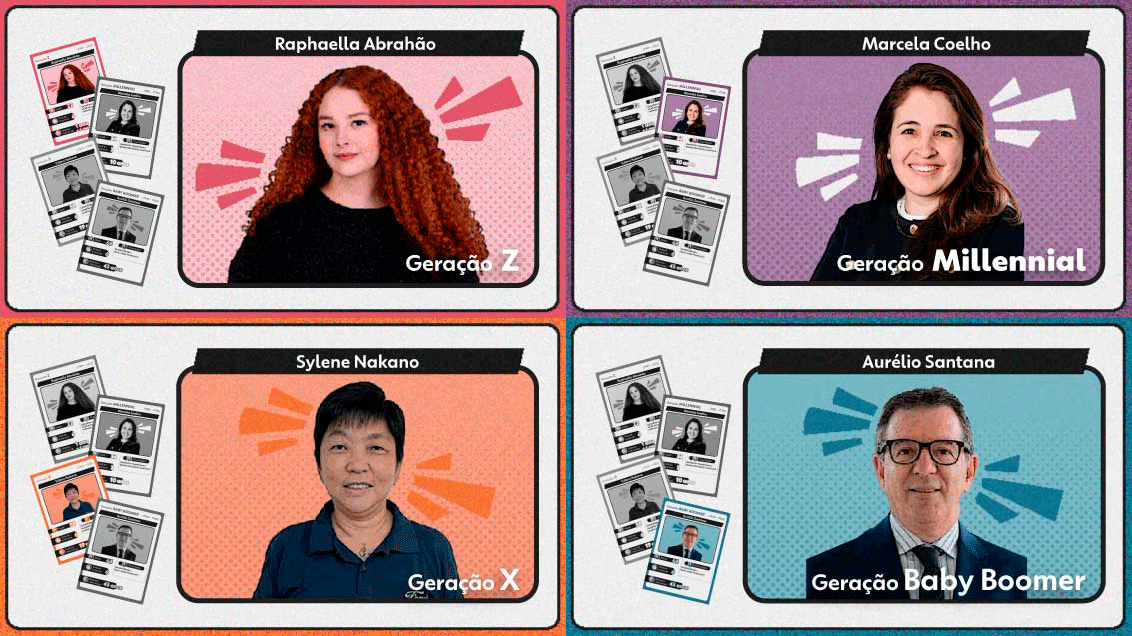
Why do young people quit their jobs more often? See how each generation thinks
The idea that younger people don't care about formal relationships is starting to be left behind. Generation Z (born between 1997 and 2012), often seen as more detached, is today the one that most rejects jobs without a contract in Brazil.
According to the 2026 Labor Trends Study, carried out by WeWork in partnership with Offerwise, 65% of young people say they will not accept jobs without a formal contract or benefits. The rate is the highest among all age groups.
The study interviewed 2,500 professionals. Among older people, such as those aged 62 to 80, 63% say they would not refuse an opportunity under these conditions.
The numbers show a generational difference: while younger people demand more formalization, professionals from older age groups tend to accept this type of proposal more.
The data draws attention because it goes against behavior already associated with generation Z.
Younger people change jobs more, test paths and avoid long careers in one place, as g1 showed in a report published in August last year. Still, they do not give up basic guarantees.
Differences between generations help explain the movement
To understand this contrast, it is necessary to observe how each generation relates to work.
The baby boomers (1946 and 1964) grew up in a period in which stability was the rule. The idea was to build a long trajectory, often in a single company, with the expectation of security in the future.
Generation X (1965 - 1980) maintained this base, but with more openness to changes over time. The balance between stability and growth began to gain ground.
Among millennials (1981 - 1996), work began to need to make more sense. Purpose, environment and development have become important factors for staying in a company.
Generation Z has taken this transformation further. Constant learning, identification with work and the possibility of rapid change have become part of the professional logic. At the same time, they grew up in a more unstable scenario, which helps explain the search for security in essential points, such as formalization.
These differences are even more evident at a time when four generations have started to live together in the same job market. This diversity of profiles has become a challenge for companies, which have started to deal with different expectations about what it means to build a good career.
For sociologist Ricardo Nunes, this behavior is not contradictory.
"The new generations learn from an early age that they need to adapt and seek their own paths", he states. In this context, having a formal contract stops being just a detail and becomes a form of protection.
Flexibility is still a desire
In addition to the generational perspective, the study shows a disconnect between what Brazilians want and what they find in the market. Six out of 10 prefer to work hybrid or remotely. But, in practice, only four out of every 10 are currently using this model.
According to the study, a return to the office is not ruled out, but comes with conditions. Around 82% would agree to return to face-to-face activities if they received a higher salary.
Even with ongoing changes, the majority evaluates the resumption of face-to-face activities positively. According to the survey, 72% consider that their return to the office was organized and structured.
At the same time, the balance between personal life and work remains a priority. For 64%, it would be worth earning less to preserve this relationship.
This scenario reinforces the challenge for companies: finding a balance between different expectations.
While some professionals seek security and stability, others push for more flexible models and a less traditional relationship with work.
The conclusion of the study is that the future of the Brazilian job market will be the result of this coexistence between generations.
Instead of replacing one model with another, the current movement indicates a reorganization of professional relationships, with companies and workers adjusting new ways of working.
Each generation carries values shaped by its time, economic context and social transformations
g1
Source: G1