What is known about the Iranian nuclear program, the most delicate point of the peace agreement between Iran and the USA
USA and Iran officially sign the truce agreement
Among the various points still open in negotiations between the USA and Iran for a definitive peace agreement, the Iranian nuclear program is certainly the most delicate.
US President Donald Trump spent years criticizing the agreement with Tehran signed by his predecessor, Barack Obama, which significantly limited Iran's nuclear capacity.
✅ Follow the g1 international news channel on WhatsApp
Now, however, after a war that failed to overthrow the Ayatollahs' regime and showed the Iranians' ability to keep the Strait of Hormuz closed and affect the world economy, the Trump administration may be in a weaker position to negotiate terms more favorable to the US.
➡This week, the US and Iran signed a "memorandum of understanding", which is an initial peace agreement, with 14 points. The document includes guarantees that Tehran will never have nuclear weapons, the suspension of US sanctions against the country and financial compensation to the Iranian government. The text establishes a 60-day ceasefire period for discussing the details of the definitive agreement - if the parties do not reach an agreement, the period is extended for another 60 days.
But what is the Iranian nuclear program, and why does it concern Western countries, such as the USA and Israel?
President of Iran, Masoud Pezeshkian, shows the signature of a memorandum of understanding with the USA, on June 18, 2026
Iran's Presidential Office via AP
The nuclear program
Iran has maintained a nuclear research and development program for decades, begun during the dictatorship of Shah Reza Pahlavi. The Ayatollah regime, which took over the country after the 1979 Revolution, resumed the project around the 1990s.
According to Tehran, the program has peaceful purposes. The international community is suspicious of this statement, however: in the early 2000s, secret facilities related to the program were discovered.
The International Atomic Energy Agency (IAEA) published a report in 2011 saying that there is "credible information" that Iran carried out activities related to the development of an explosive nuclear device, as part of a "structured program" before 2003.
One of the signs is the maximum level of uranium enrichment with which the country works, close to 60%. Although there are applications in research and medicine, the use of the element for energy purposes requires a much lower enrichment content, less than 4%.
Iran has been a signatory since 1970, during the Pahlavi regime, of the Nuclear Non-Proliferation Treaty. There is speculation that Iran has another reason to develop a nuclear war program: Israel, which is not a signatory to the treaty, has a secret nuclear program, based at the Dimona facilities, in the Negev desert, and which has had atomic bombs for decades.
Israel treats the issue with "deliberate ambiguity", a strategy of neither denying nor denying its existence. As it is not a signatory to any agreement in the area, the country does not allow IAEA inspections, despite pressure from the international community.
Photo from November 5, 2019 by the Atomic Energy Organization of Iran shows centrifuges at the Natanz uranium enrichment facility in central Iran
Atomic Energy Organization of Iran via AP
Iran, which has Israel as its biggest regional enemy, would be interested in developing an arsenal as a way of deterring attacks by Israeli forces against itself.
If Tehran maintains the program, the fear of the USA and Israel, and the West in general, is that the country will reach the so-called "breakout capability": accumulating enough knowledge, material and infrastructure to produce a nuclear bomb in a short time if it takes this political decision.
Material and facilities
There is only one commercial nuclear plant currently active on Iranian territory, the Bushehr complex, built with Russian technology and assistance.
Another facility, Arak, was deactivated in compliance with the 2015 nuclear agreement, signed between Tehran and the USA during the Barack Obama administration (read more below).
After the unilateral withdrawal of the agreement by the USA, during the Trump administration, Iran reactivated facilities and centrifuges for uranium enrichment, particularly in Natanz and Fordow - the latter, bombed by the USA in 2025 during the 12 Day War between Israelis and Iranians.
Currently, the IAEA estimates that Iran has 11 tons of uranium in stock (11 times greater than when Trump withdrew from the agreement), around 410 kg of which is at least enriched to 60%.
Understand how uranium enrichment works
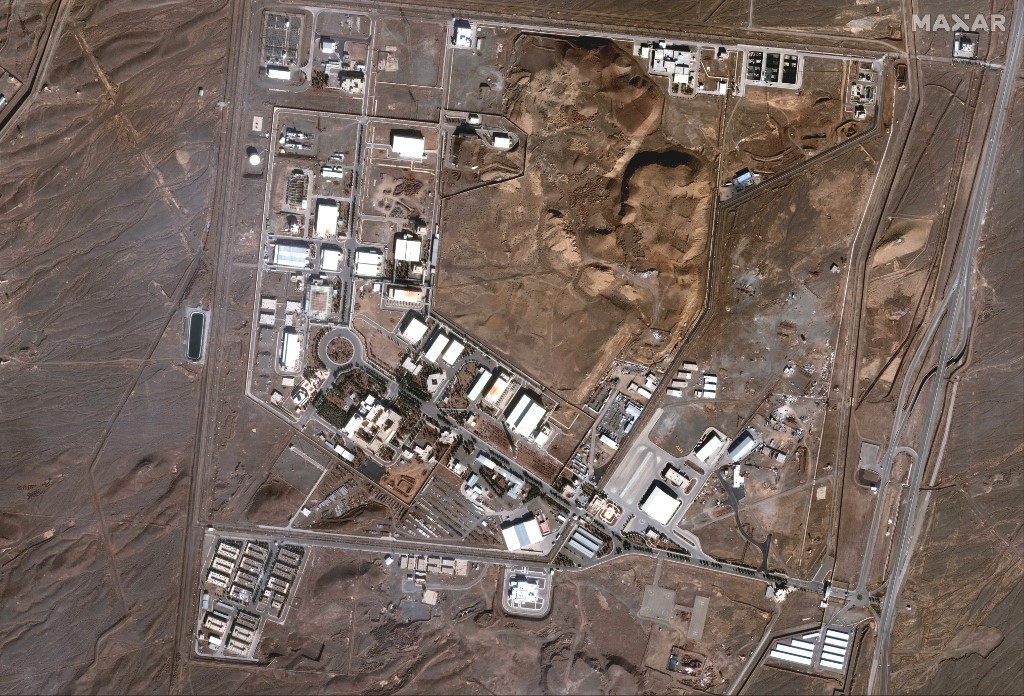
Satellite image shows an overview of the Iranian nuclear facility of Natanz, south of the capital, Tehran
Maxar Technologies/AFP
Obama deal
After years of negotiations, the Obama administration and the Ayatollah regime reached an agreement in 2015 to impose severe limitations on Iran's nuclear program.
Officially called the Joint Comprehensive Plan of Action (JCOPA), its main objective was to ensure that Iran's nuclear program would be exclusively peaceful, in exchange for the end of international sanctions. The main clauses were:
A reduction from around 19,000 to 5,060 first-generation centrifuges for 10 years.
The requirement for a maximum uranium enrichment of 3.67% for 15 years.
A 98% reduction in the stockpile of enriched uranium, maintaining only 300 kg for 15 years.
A ban on enriching uranium at Fordow, where 1,000 centrifuges could operate solely for research purposes (in practice, the program would be almost entirely concentrated in Natanz).
The permanent deactivation of the Arak nuclear reactor, capable of producing plutonium, which can be used for military purposes.
Commitment to subject the program to rigorous inspections by the IAEA, which could monitor the centrifuge park for 20 years and the production of uranium concentrate ("yellow cake") for 25 years.
In exchange for this, Iran would win the lifting of most trade sanctions and the annulment of six UN Security Council resolutions.
The sanctions and resolutions motivated by the ballistic missile program would continue to apply. Human rights abuses, support for terrorist organizations such as Hezbollah and the Houthis and alleged destabilization activities in the Middle East, in the West's understanding, would also continue to be grounds for sanctions.
The agreement was signed in Vienna on July 14, 2015 between Iran and the so-called P5+1 group (USA, Russia, China, United Kingdom, France + Germany).
Uranium enrichment centrifuges at the plant of Natanz, Iran.
IRIB via AP, File
A new agreement?
From the moment it was signed, Donald Trump and Republican senators who would become Trumpists harshly criticized the agreement created by Obama, considering it too lenient with the Iranian program. Israel was also against the document.
Trump assumed the White House for the first time in 2017 and, on May 8, 2018, ordered the unilateral withdrawal of the US from the agreement and the immediate resumption of sanctions.
Iran responded with the resumption of its program, multiplying its stock of enriched uranium by 10 since then. The Arak plant remains deactivated.
After years of fierce criticism of Obama's agreement, Trump now has the challenge of negotiating an even more restrictive text than that agreed by his predecessor.
The Republican has already shown signs of changing his tone.
This week, he compromised Tehran's ballistic missile program, which caused severe damage to American military installations in the region and struck neighborhoods in Tel Aviv and Haifa between March and April.
Now, Trump says it "wouldn't be fair" to prohibit Iran from developing ballistic missiles until other countries in the region are subject to similar restrictions.
What the 'memorandum of understanding' says
In the memorandum signed on Wednesday (17), Iran reaffirms that it will not acquire or develop nuclear weapons, while the USA agrees to resolve the issue of the Iranian enriched uranium stockpile through a mechanism to be defined by mutual agreement.
Donald Trump's task of negotiating a solution to the impasse, however, will not be easy. Analysts estimate that Iran emerges from the war with greater bargaining power, after demonstrating that the ayatollahs' regime is more resilient than many thought.
Source: G1