What happens in the brain when a player hits a perfect pass?
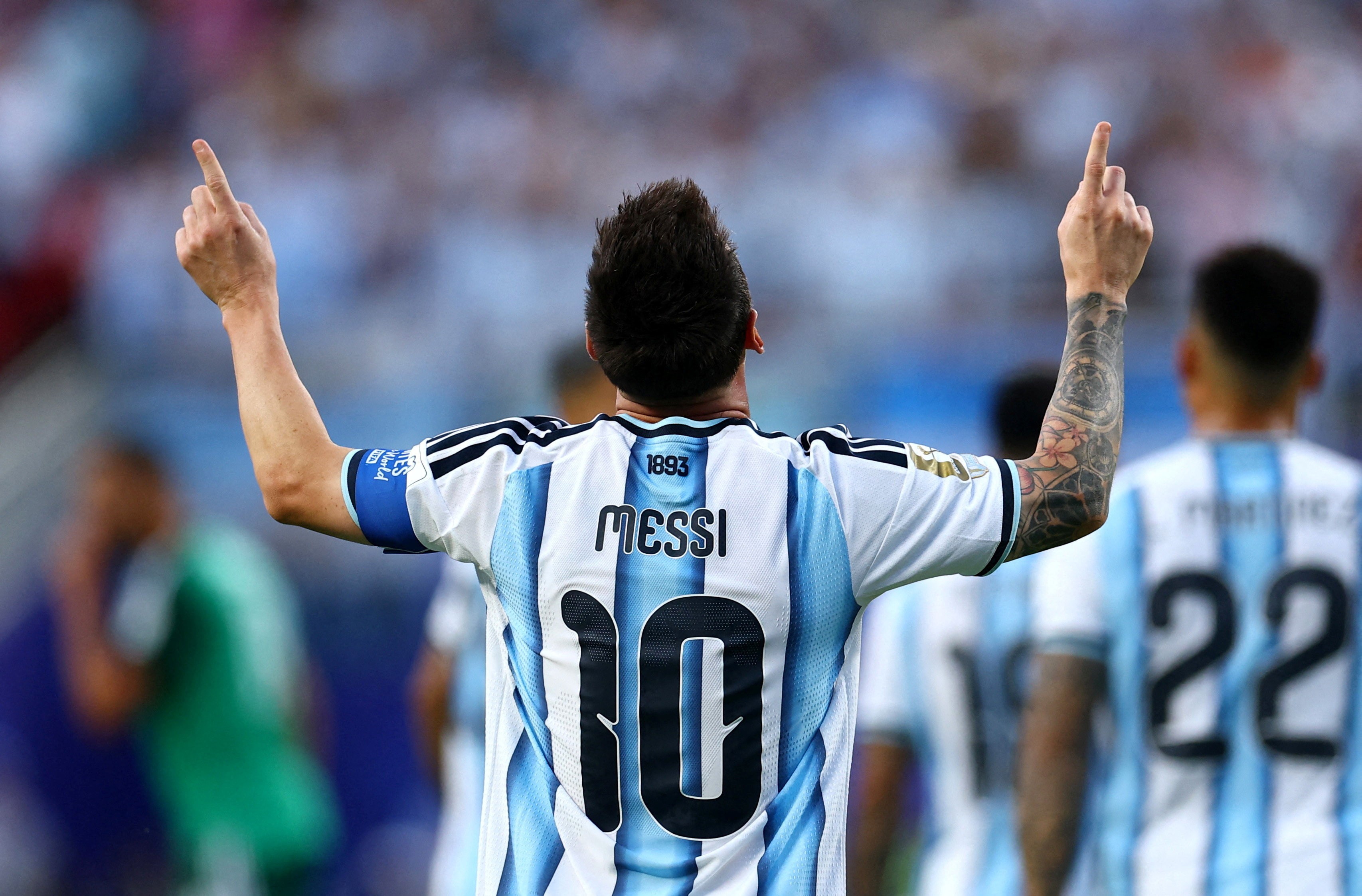
Forward Lionel Messi celebrates one of the three goals scored in Argentina's 3-0 victory over Algeria in the World Cup opener, in Kansas City, on June 16, 2026
Claudia Greco/Reuters
"The technique consists of passing the ball with one touch, at the right time, to the right place." Johan Cruyff
In team sports like football, it's not just the ball that rolls. Empathy and brain synchronization are also combined to strategically develop teamwork.
From brain to muscle
Although they depend on individual resources, skills and abilities in football also reflect the capacity for collective synchronization. In it, complex emotions are contrasted, such as cooperation, solidarity and empathy.
This neuronal route is expressed as a "reflex arc".) (automatic response of the organism) that involves sensory aspects. These aspects are translated and hierarchized in the human cerebral cortex to generate planned motor responses that involve biomechanical elements, strength and resistance movements, fine motor skills, coordination and precision in the executive touch of the ball.
Now in g1
The movement network derives from a systematic training process that combines emotion and cognition to perform precise calculations on the kinetic effect.
This response interacts with motivational aspects of a very diverse nature: ego, recognition, reward, economic benefit, hedonism. There is also a public component of an emotional, identity and affiliation nature. On the field, the bond with fans (supporters or organized supporters) comes into play, who eventually become the most passionate and self-proclaimed defenders of the honor of their team.
It is not uncommon for these groups, in addition, to contain hidden sociopathic profiles in their ranks, which can get out of control and give rise to antisocial, violent and extremist behavior.
Cognition and neuronal coordination
Returning to the field of play, one of the secrets of talent in football is the Motor coordination: in itself, it is fundamental to developing the touch of the ball with the masterful precision, strength and direction necessary to make the pass. It also allows you to guide, with orchestral synchrony, the movement that alternates running, dribbling and shooting.
For a long time, it was considered that the cerebellum, a region of the brain located in the back and lower part of the skull, was strictly responsible for these functions. From this approach, he would have acted exclusively in strengthening our bipedal posture and developing the gait of Homo sapiens. It would even be decisive in coordinating the movements that transformed the guttural expression of the larynx. In other words, it would be the basis of expressive language with codes that we call words.
Now, however, we know that the cerebellum is not a mere mechanical regulator, but also a modulator of more complex mental processes. The interpretation of how this organ works evolved until we began to understand it as part of a structure linked to human cognition.
Thus, cerebellar cells function as a station on an intellectual route that links movement to learning processes, memory preservation and creative and executive skills that require planning. This is why coordinated movement is fundamental for the development of intelligent skills, going beyond the playful context.
Its effects in clinical practice are what support the recommendation that dance is indicated for controlling Parkinson's or that walking contributes to the cognitive functions of memory in the case of dementia.
The neuroscience of the long pass
The other key region, as we saw above, is the human cerebral cortex, where there are groups of neurons specialized in certain functions. But it is also undeniable that the traits that connect these territories through "connections" beneath the surface of the cortex explain functional integrity.
Only in this way can we understand why two cerebral hemispheres function as a single brain.
The connections of the corpus callosum and other fibers provide the possibility of both a specialized function and a more holistic emotional and cognitive response.
In this way, the command to kick a ball arises from the motor area in the middle region of the left brain (in the case of a right-handed individual), but the touch, strength and direction of the impulse are planned with the support of the cerebellum and other structures known as "motor relief", as well as with the help of the extrapyramidal system. As if that weren't enough, we plan the trajectory coordinates and kinetic evolution through cognition and "intellectual GPS". And we execute the final order with the frontal cortex.
The ball as an emotional axis
The ball represents the center of a series of individual and social emotions. It is not surprising that its use is often suggested as a therapeutic prescription to treat everyday frustrations and anxiety. Likewise, it can be validated in the context of leisure, from the perspective of the masses. But it can also be a reason for conflict, hostility, harassment and violence.
This playful perspective, in a fun social environment such as a football World Cup, requires strengthening the basic principles of empathy and respectful behavior towards others. In this way, the collective magic of a popular sport that has prevailed throughout history as a source of healthy fun is preserved.
Rodrigo Ramos-Zúñiga does not consult, work with, own shares in or receive funding from any company or organization that could benefit from the publication of this article and has not disclosed any relevant ties beyond his academic position.
Source: G1