Whale that stranded in Germany and was found dead in Denmark will be 'transformed' into biodiesel
Whale stranded in Germany is released after dramatic rescue operation
The saga of "Timmy", the humpback whale that moved Germany after repeatedly stranding itself on the country's coast and which was later found dead in Denmark, will still have an epilogue: its remains will be turned into energy, with the fat being converted into biodiesel, and the rest, into biomass.
In mid-May, the whale was found dead near the island of Anholt in Denmark, days after a controversial - and unsuccessful - rescue operation that transported the weakened animal from the German Baltic coast to the North Sea.
Now, the whale, which has been decomposing for more than a month, will be processed in a Danish factory, confirmed the company Daka Denmark, which specializes in producing biodiesel from animal fat.
At the company's factory in Randers, remains of whales like humpbacks are often separated into three components, according to a spokesperson. The water is cleaned and returned to the sea. All fat is transformed into biodiesel. The remainder, such as bones, tendons and skin, is processed into a type of flour, which is used as biomass for burning in a cement factory.
Last week, the animal's necropsy revealed that Timmy was a female. The cause of death, however, remains unknown.
During the examination, which lasted several hours, the whale was opened and cut into parts. An excavator placed the carcass pieces into prepared containers. On Friday (5), the remains were removed from the beach and, on Monday (8), transported.
Some bones, collected on Friday, will go to the collection of the Natural History Museum in Copenhagen, capital of Denmark.
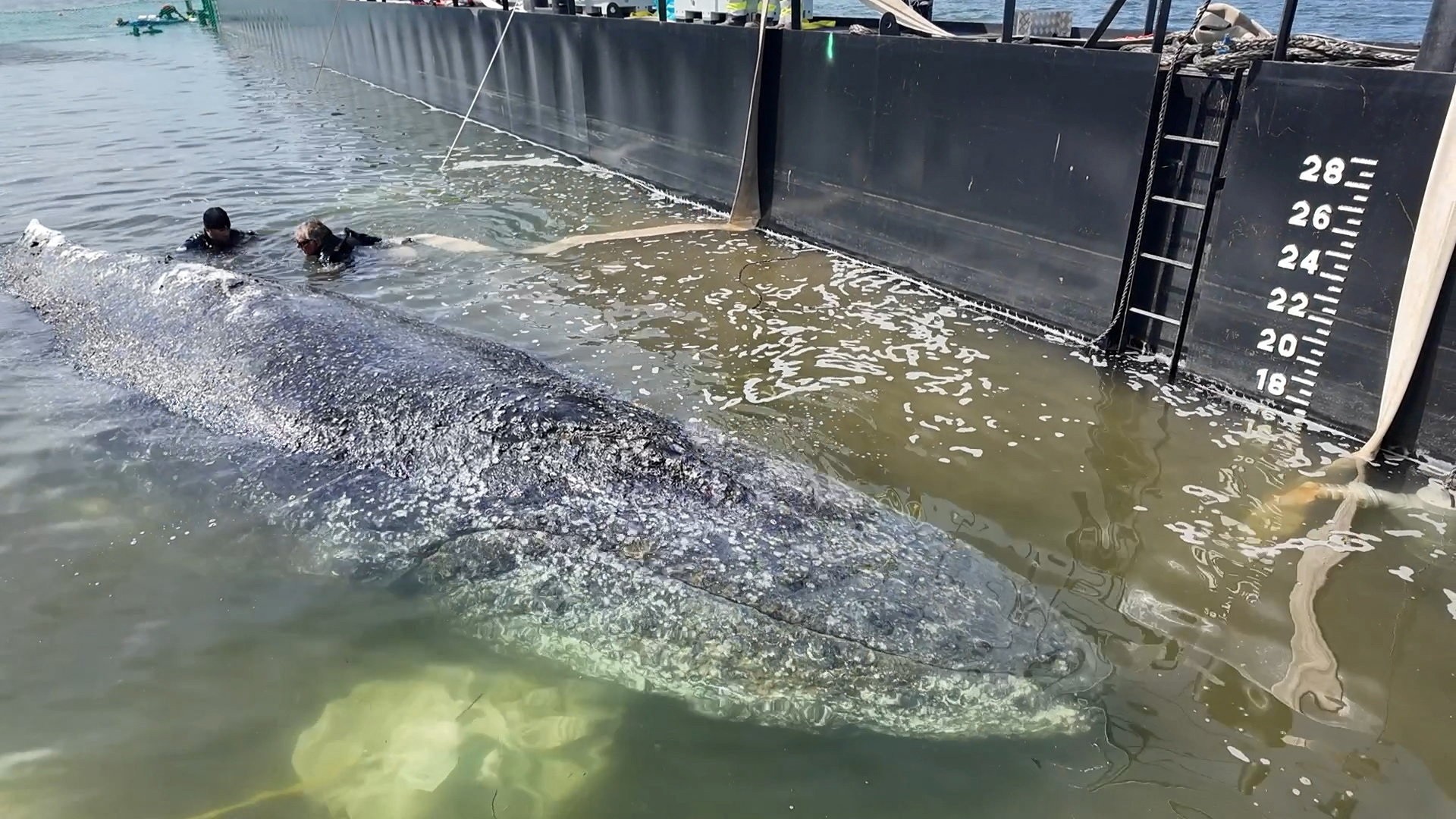
Teams help stranded humpback whale onto a barge in the Baltic Sea, near the island of Poel, Germany.
NonstopNews/Schwarck via Reuters.
Drama of international repercussion
The drama of the whale gained international repercussion after a sequence of strandings on the German coast of the Baltic Sea and a controversial last rescue attempt.
On March 23, the whale initially stranded on a sandbank off the coast of the German state of Schleswig-Holstein, on a beach called Timmendorfer, and this led some newspapers to nickname the whale "Timmy".
After several days and a complex official rescue operation using dredgers, the whale managed to free itself, but shortly after stranded again, this time in Wismar Bay, in the neighboring state of Mecklenburg-Western Pomerania.
At this point, rescue professionals involved in the operation stated that the mammal's health was deteriorating rapidly.
The authorities then decided to give the animal some rest so that it was recovered and ready to take advantage of the rising tide. Initially, it broke free again and the operation appeared to be successful, but soon after the whale avoided heading to the Atlantic, remaining again in shallow waters in the Baltic.
In early April, local authorities and experts involved in the rescue lost hope of saving Timmy and decided to abandon official efforts, pointing out that further attempts would amount to animal cruelty and said that the best thing would be to let the whale die in peace on the spot.
However, the whale remained alive in the following weeks, intensifying the drama and generating appeals among the public for more rescue attempts.
Finally, in mid-April, Till Backhaus, Secretary for the Environment of Mecklenburg-Western Pomerania, announced a change of position in support of the new "unique" rescue mission.
Controversial rescue of the whale Timmy, which ran aground several times in Germany.
Philip Dulian/dpa via AP, File
Last controversial operation
The new operation began to be financed with resources from businessmen, among them, Walter Gunz, co-founder of the electronics retail chain MediaMarkt, who even appeared on the list of the richest in Germany.
The businessman did not listen to the criticisms of whale experts and set up the rescue team according to his own preferences. For him, the risk was inevitable.
"Without trying, the whale will certainly die. If you try, at least there is a chance," he said at the time.
Under the operation, the huge animal would be transported hundreds of kilometers from the Baltic to deeper waters of the North Sea in a kind of aquarium-shaped raft.
But the resumption of the rescue also generated criticism in Germany. Kim Detloff, head of marine protection at the German Nature Protection Association (Nabu), stated that the initiative took place under strong public pressure, to the detriment of scientific evaluation.
Experts also pointed out that even if the operation was successful in transporting the whale to the deepest waters of the North Sea, Timmy's chances would remain slim, highlighting that the whale's health deteriorated over the weeks of stranding in the Baltic Sea.
A group linked to the Oceanographic Museum German, for example, pointed out the risk of the whale drowning after being released on the high seas, pointing out that a weakened animal may not have the strength to move freely at sea.
The private operation was also marked by disagreements between those involved, with a veterinarian abandoning the initiative and accusing two participants, including an influencer, of hindering the rescue.
Release provoked criticism and questions
Timmy was finally released on the high seas in 2 May. Those involved in the operation classified the venture as a "success", but questions soon arose due to the lack of videos of the animal's release and the lack of clear information about the tracker attached to it.
Shortly afterwards, the controversy gained new momentum after veterinarian Kirsten Tönnies, who was part of the crew that transported Timmy, made serious accusations against those responsible for the operation.
According to Tönnies, the method used to remove the animal from the balsa was aggressive, and she would have been prevented from following the maneuver. The main difficulty seemed to be the position Timmy was in after swimming into the raft. Due to the small size of the vessel, the animal could not turn around and swim towards the sea.
Criticism also focused on the lack of information about Timmy's whereabouts and health status in the following days. After release, the signals from the tracker installed on the whale remained inconsistent, with no information about the whale's location or health status. The transmitter apparently was not tested before release.
A few days after release, a whale was found dead near the island of Anholt, Denmark. The tracker that had been placed on the animal before transport confirmed that it was Timmy.
According to the Environment Secretariat of the German state of Mecklenburg-Western Pomerania, the tracker data has already been collected and should be analyzed as quickly as possible. Once this is done, the public will be informed of the conclusions reached, a spokesperson said.
Source: G1