'We are together, Cape Verde': the country that was born from a volcano and sets the World Cup on fire
Fantastic trip to Cape Verde to learn about goalkeeper Vozinha's career
Until a few weeks ago, Cape Verde was known by many Brazilians only as a small African archipelago with paradisiacal beaches and the Portuguese language.
Now, the country of just over half a million inhabitants - a population similar to that of Florianópolis - has become one of the big stories of the 2026 World Cup.
The Cape Verdean team, nicknamed the "Blue Sharks", is competing in its first World Cup and has already attracted attention by pulling off a goalless draw with Spain, the current champion of Europe. Its 40-year-old goalkeeper, Vozinha, became a national hero, moved fans by crying after the match and became a social media phenomenon.
But the interest aroused by Cape Verde goes beyond football. Located approximately 600 kilometers off the west coast of Africa, this small island country has a unique history: it was an important warehouse for the transatlantic slave trade, it has one of the most stable democracies on the African continent, it has no permanent rivers or significant natural sources of fresh water and it is the birthplace of morna, a musical genre immortalized by singer Cesária Évora.
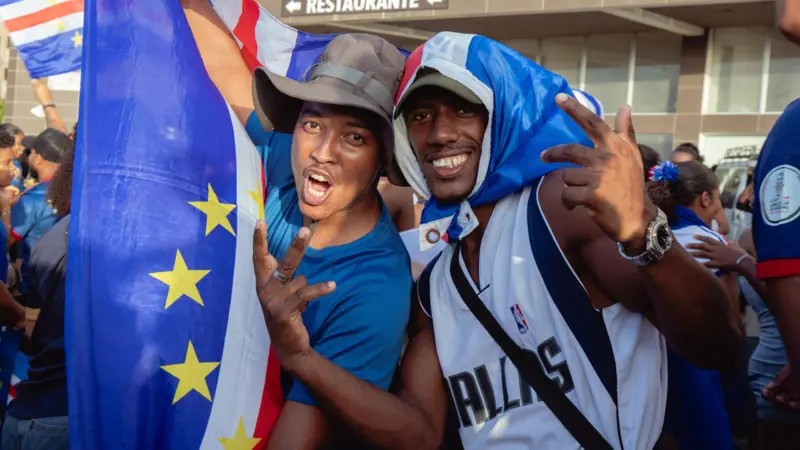
The country is also well remembered for its culture that values unity, national pride and solidarity among the people of islands and its vast diaspora, characteristics celebrated by the famous expression "Nu sta djunto, Kabu Verdi".
In Cape Verdean Creole, the phrase means "We are together, Cape Verde", and has been used by local fans - and football supporters around the world - to support the team.
We have put together six facts that help you understand why Cape Verde, the sympathetic underdog of this World Cup, has captured the world's imagination.
1. It was inhabited only by bats until the arrival of Portugal
The flag of Cape Verde, adopted in 1992, displays blue, white and red stripes that symbolize the ocean, peace and national effort. The circle of ten stars represents the main islands and their unity as a nation.
Getty Images via BBC
With a total surface area of 4 thousand square kilometers, Cape Verde is made up of ten islands, nine of which are inhabited.
Its only endemic species of mammal is the grey-eared bat, which for a long time dominated the archipelago without coexisting with other mammals until the arrival of the first humans in the 15th century.
After disembarking in 1456, according to historical records, the Portuguese founded Ribeira Grande, on the island of Santiago. Today, the city is called Cidade Velha and is a few kilometers from Praia, the capital and most populous city in the country.
Portugal gave the islands the name Cape Verde in reference to the closest point to the African continent: the homonymous peninsula where Dakar, capital of Senegal, is today located.
The archipelago is divided into two groups:
Windward Islands: Santo Antão, São Vicente, Santa Luzia, São Nicolau, Sal and Boa Vista.
Sotavento Islands: Maio, Santiago, Fogo and Brava.
Of these, only Santa Luzia remains uninhabited and constitutes a natural reserve.
2. It was an important hub for the slave trade between Africa and America
Due to its strategic position between Africa and America, Cape Verde established itself, in the 16th century, as one of the main centers of the transatlantic slave trade, an activity that lasted for more than 300 years.
It is estimated that around 3,000 enslaved people from the African continent were sold annually in Cape Verde destined for Europe and the Americas.
Some remained in the archipelago, working in the salt mines and on the first cotton plantations facing Portugal.
The legacy of slavery had a profound impact on the country's demography.
The population is mostly mestizo, the result of the mixture between Africans and Europeans - especially Portuguese -, something confirmed by genetic studies.
Although the official language is Portuguese, the inhabitants also speak Cape Verdean Creole, a mixture of Portuguese and African languages, which has nine variants, one for each inhabited island.
Colonial influence is also reflected in religion: 72.5% of the population is Catholic, according to the yearbook The World Factbook, from CIA.
3. It has only 500 thousand inhabitants, less than half the number of tourists it receives per year
The great distance between the islands, the small territory - less than a fifth of the area of El Salvador, the smallest country in Latin America - and the fact that only around 11% of the surface is cultivable, amidst extensive areas of volcanic rock, have limited Cape Verde's population growth over the last five and a half centuries.
The World Bank estimated the population at 524 thousand inhabitants in 2024.
This represents less than half of the 1.2 million tourists who visited the archipelago in the same year, according to official data.
Tourism is, in fact, the main driver of the Cape Verdean economy, representing approximately a quarter of the Gross Domestic Product (GDP), according to several sources, including the United States Department of Commerce.
Cape Verdeans living outside the country also outnumber those living in the archipelago. The government estimated a diaspora of around 2 million people in 2023, mainly in Portugal and the United States, although this number is debated due to the lack of more comprehensive studies.
4. It is one of the most stable democracies in Africa
Portugal transformed Cape Verde from a colony into an overseas province in 1951, but the change did not satisfy Cape Verdeans' growing aspirations for autonomy.
In the 1950s and 1960s, leaders such as Amílcar Cabral joined Guinea-Bissau's struggle for independence in a bloody war against Portugal.
The process culminated in independence of Cape Verde, on July 5, 1975.
The country lived under a single-party system until 1990, when the Movement for Democracy (MPD) emerged, paving the way for multipartyism and the first democratic elections in January 1991.
Since then, Cape Verde has maintained a peaceful and stable political life, with alternation of power and consolidated institutions, including the elected president, prime minister, National Assembly and Supreme Court of Justice.
This alternation was reinforced in 2021, when the current president, José Maria Neves, from the center-left, won the elections after a decade of government by the MPD, a center-right party.
5. It has no rivers or sources of fresh water, but it is home to an active volcano
With an extremely dry climate, Cape Verde does not have rivers, lakes or significant sources of fresh water.
All drinking water distributed to homes comes from desalination plants.
Rain is scarce and droughts are frequent and can last for years, which affects agriculture and has caused food crises in the past.
The islands, formed by volcanic activity, have arid landscapes and rugged.
Some are flat and covered by dunes, such as Sal, Boa Vista and Maio. Others stand out for their cliffs and mountainous reliefs, such as Santo Antão and São Nicolau.
The highest point in the country is Pico do Fogo, at 2,829 meters high.
It is the only active volcano in the archipelago.
Its most recent eruption, the longest in two and a half centuries, occurred between November 2014 and February 2015.
It destroyed villages entire, forced the evacuation of around a thousand people and caused losses in excess of US$50 million.
6.
It has its own musical genres: Cesária Évora's morna and funaná
Music is part of everyday life in Cape Verde and is present in both popular festivals and family celebrations.
The most representative genre is morna, recognized by UNESCO in 2019 as Intangible Cultural Heritage of Humanity.
With a slow rhythm and melancholic tone, morna expresses longing - for the homeland or loved ones -, especially among Cape Verdeans who live abroad.
Its instrumentation includes guitar, cavaquinho, violin and light percussion.
The great ambassador of morna was the singer Cesária Évora (1941-2011), who took the genre to the main stages of the world.
The other major musical genre in Cape Verde is funaná, characterized by a fast and dancing rhythm, marked by the accordion and the ferrinho.
Source: G1