War in Iran: Is the Middle East tourism boom over?
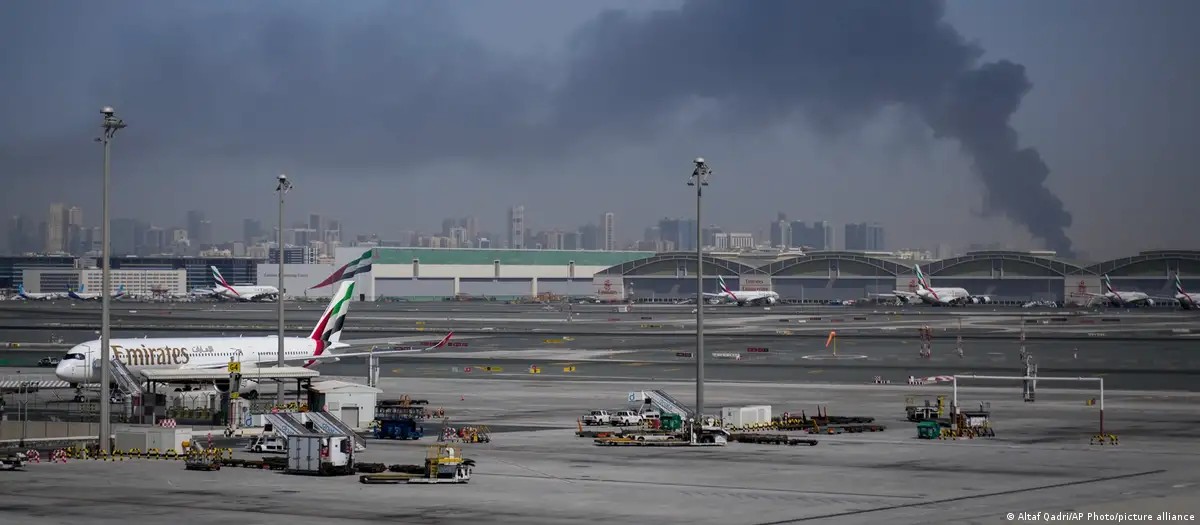
Dubai International Airport suspended flights after retaliatory strikes by Iran
Altaf Qadri/AP Photo/picture alliance via DW
Hundreds of thousands of travelers from around the world are stranded in the Middle East following recent US and Israeli attacks on Iran and Tehran's retaliations. The extensive blockade of airspace over the Arabian Peninsula has left tourists and business travelers stranded there.
In addition, disruptions to maritime traffic in the Strait of Hormuz have also affected cruise ships in the Persian Gulf.
"The current crisis is an absolute shock for the affected countries in the region," says Hans Hopfinger, professor of Cultural Geography at the Catholic University of Eichstätt-Ingolstadt, who has researched tourism development in the Middle East and North Africa.
According to him, some of the Gulf countries have promoted themselves in the past as safe tourist havens. "In Dubai or other emirates, there have never been terrorist attacks like in other Arab tourist centers," says Hopfinger.
See trending videos on g1
See trending videos on g1
No region has seen as much growth in the sector
This aspect has also driven the boom in visitors that the region has experienced in recent years. "The Middle East is one of the fastest growing tourist regions in the world", states the United Nations Tourism Organization.
Last year, almost 100 million international travelers arrived for the first time - from Egypt and Jordan to Qatar and Saudi Arabia, representing an increase of 39% compared to the pre-pandemic period. No other region in the world has seen similar growth since then.
The scale that the travel sector has taken on, especially in the Gulf countries, is well illustrated by Dubai International Airport, which has become a global hub in recent years. According to data from the terminal, in 2025 more than 95 million international passengers were served.
The number is unprecedented and is higher than that of any other airport in the world. At the same time, the emirate recorded a new visitor record, with almost 20 million tourists for the third year in a row.
According to Hans Hopfinger, this success is mainly due to good planning. "They recognized, as a strategy for economic differentiation, that it was necessary to put aside dependence on oil and gas", points out the professor.
In this way, Dubai was the first emirate to draw up, early on, a master plan to promote shopping tourism, golf tournaments and other major sporting events, but also cultural tourism. In addition to the United Arab Emirates, other Gulf countries also changed their route.
Around 20 million tourists visited Dubai last year - one of the emirate's main attractions is the Burj Khalifa, the tallest building in the world
David Davies/empics/PA Wire/picture alliance via DW
Tourist visas in Saudi Arabia
"Rich countries, holders of oil and natural gas, have not had the need to invest in tourism for a long time", explains Hopfinger. This was not the same as what happened in countries without significant natural resources. Egypt, Tunisia, Jordan, Morocco and Oman have been investing in the tourism sector for a long time.
Saudi Arabia, on the other hand, only started granting tourist visas in 2019. With a strategy entitled "Vision 2030", which foresees billion-dollar investments in several megaprojects, the Saudi kingdom is now seeking to rise to the top division of traveler destinations around the world.
The goal is that, by 2030, 70 million tourists will visit the country per year.
Visitors are mainly attracted by the diversity of offerings in the Gulf countries, says Hopfinger. The variety ranges from historic temples to modern megacities with spectacular hotels, shopping centers and museums. In addition, there are major events such as Formula 1 races.
The World Cup in Qatar in 2022 and the Expo in Dubai in 2021 have also considerably increased the image of the tourist destination.
With Mecca and Medina, Saudi Arabia has two of the most important pilgrimage points in Islam, which attract millions of believers every year.
Map shows airstrikes by the US and Israel and retaliatory actions by Iran, Hezbollah and Iraqi militias
Source: Institute for the Study of War and Critical Threats Project of the American Enterprise Institute for Public Policy Research (AEI) | March 5, 2026 via DW
Interferences due to the war in Iran
For efforts to promote tourism in the region, the war in Iran represents a significant setback. Due to the uncertain situation and travel alerts, there are likely to be a large number of booking changes and cancellations. The security situation in the Middle East has never been stable, adds Hopfinger.
"The region has been affected by serious conflicts for decades", he says. Representatives of the travel sector expect, in the coming months, a shift in travel bookings to traditional destinations, such as Mediterranean countries.
The time it will take for international tourism to regain momentum after the situation in affected countries normalizes depends on several factors, explains Martin Lohmann, from the Association for Holiday and Travel Research, who has been studying tourist motivation for many years.
If the risks disappear, the infrastructure remains intact and the typical pull factors are maintained, this will happen quickly, i.e. within a few weeks, he explains. "I can imagine this happening in the United Arab Emirates."
But first, stranded tourists must be taken to a safe location. Travel agencies in particular are scrambling to transport their customers back and forth. Some flights have already been able to take off in recent days. However, due to the instability of the situation, it may still be a few days before all travelers are back home.
Source: G1