Venezuela, Colombia and Cuba: the cases used by Itamaraty when citing 'risk' of using US military force in Brazil
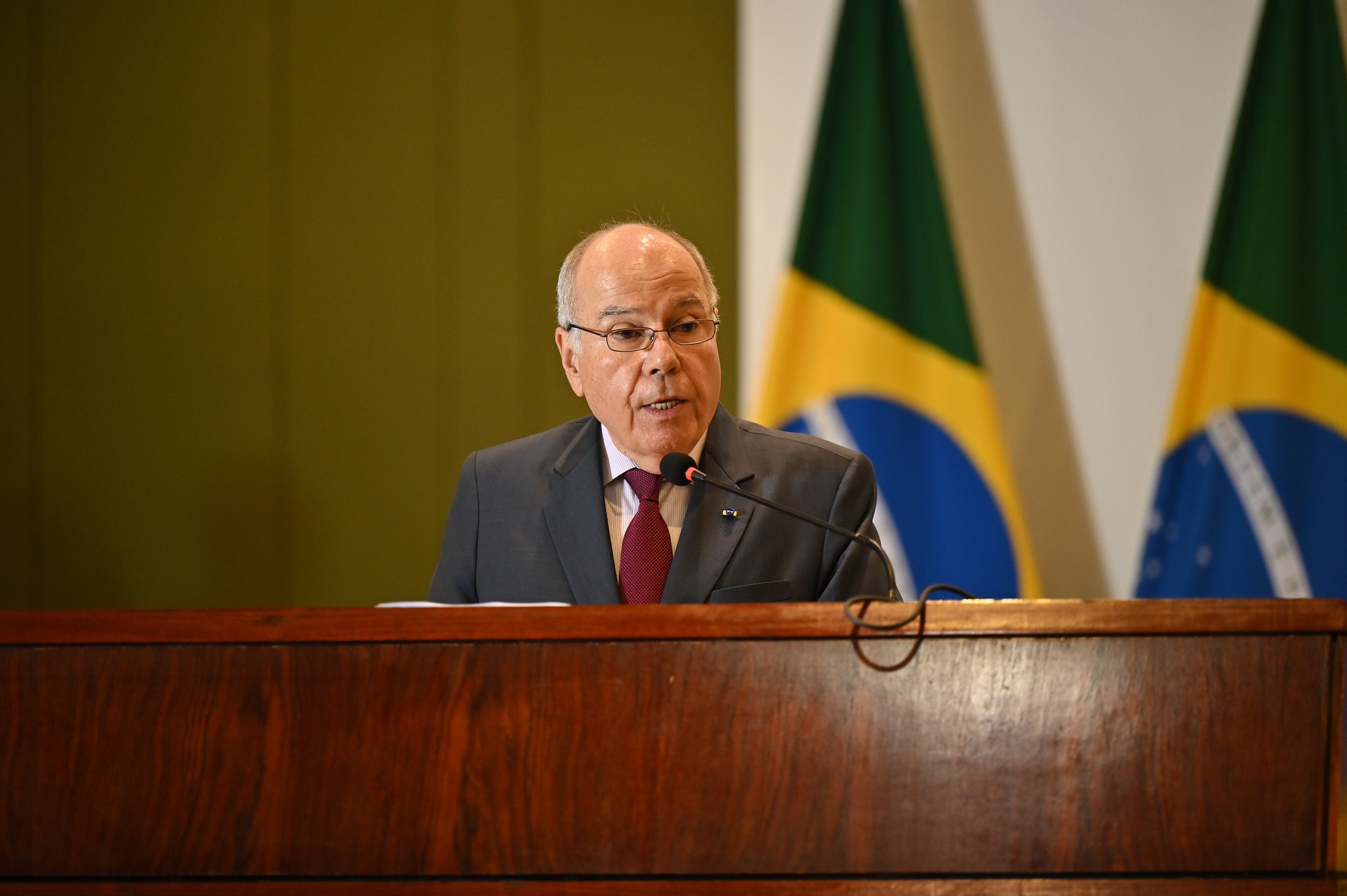
Itamaraty sees the risk of the United States using military force in Brazil after classifying PCC and CV as terrorists
The Minister of Foreign Affairs, Mauro Vieira, sent a document to the Chamber of Deputies in which he cites the "risk of using military force" by the United States in Brazil after classifying the criminal factions Primeiro Comando da Capital (PCC) and Comando Vermelho (CV) as foreign terrorist organizations.
According to Itamaraty, despite the minister's placement in an official document, there is no new element that indicates this possibility. The minister made use of recent episodes in the region, such as the cases of Venezuela, Cuba and Colombia (read details below).
The classification of the PCC and the CV as terrorist organizations was made by the Donald Trump government at the end of May - according to the Brazilian government, without prior formal conversations.
Chancellor Mauro Vieira
Mateus Oliveira/MRE
In the document announcing the designation, the North American State Department, a body equivalent to the Brazilian Ministry of Foreign Affairs, states that the CV and the PCC "are two of the largest and most violent criminal organizations in Brazil".
And that the influence of the factions "and their illicit networks extend far beyond the borders of Brazil", reaching the United States.
Since then, the Brazilian government has criticized the measure, stating that, in practice, it does not contribute to disrupting the factions, does not help combat organized crime at an international level and can even generate consequences for people and companies with no direct relationship with criminal activities.
A helicopter takes off from a US Navy ship docked in the port to support the relief efforts for victims of the earthquake in La Guaira, Venezuela
AP Photo/Matias Delacroix
In this context, Mauro Vieira, when responding to deputy Evair de Melo, cited that one of the possible consequences is the "use of military force" by the USA on Brazil.
The minister used some recent cases in the region to reach this conclusion, including:
➡the bombing in January of this year in Caracas, capital of Venezuela, which resulted in the arrest of the then-president Nicolás Maduro;
On January 3, Venezuela woke up under the impact of a United States operation that resulted in the kidnapping of dictator Nicolás Maduro.
This was the first direct military intervention by the United States in a country in Latin America since the overthrow of Panamanian dictator Manuel Noriega - 36 years ago.
The North American operation occurred after months of tensions between the United States and Venezuela. The military movement began in August, under the justification of combating international drug trafficking.
➡the attacks on boats allegedly operated by drug traffickers near the coast of Colombia
The government of Donald Trump, from the United States, carried out attacks against boats in the Pacific Ocean, close to the coast of Colombia, in October 2025.
At the time, a Trump administration secretary stated that the vessels were being operated by drug traffickers, but without providing proof - he only said that the vehicles were tracked before the attack.
The military actions are part of an attack by the Trump administration against Latin American drug cartels, against which the US says it is at war. The attacks also occurred amid an escalation of tensions between Trump and the government of Nicolás Maduro, and increase fears of an imminent ground operation and bombings on Venezuelan soil.
Months later, the military operation was carried out that resulted in the capture of Maduro.
➡ and Trump's threat that Cuba "is next", when he was asked about the American attacks on Iran.
In recent months, the United States has been increasing pressure on Cuba in an attempt to reach an agreement that could result in the fall of the Cuban government. President Donald Trump has even suggested that he may take the island by force.
On May 20, the US government formally accused Raúl Castro, Fidel Castro's brother and former president of Cuba, of a series of crimes.
The measure represented another chapter in the escalation of tension between the two countries.
Castro's indictment and the military movement in the Caribbean recalled similar measures adopted by the North American government weeks before the offensive against Venezuela. The operation, carried out in January, resulted in the capture of dictator Nicolás Maduro.
Just as is happening now with Cuba, Trump also made a series of threats against Venezuela and ordered the sending of a strong military force to the Caribbean to pressure Maduro.
However, any military action against Cuba could raise questions under international law. The justifications currently presented by the US may not be sufficient to support a military intervention, according to the United Nations (UN).
What the Brazilian government says
According to the minister, the US decision to include Brazilian factions in the list of foreign criminal organizations "represents concrete risks to national sovereignty".
"It is understood that the designation of criminal organizations as terrorists will not bring concrete benefits to international cooperation between the US and Brazil in combating organized crime", wrote Mauro Vieira.
"The aforementioned unilateral classification could be invoked as a justification for extraterritorial actions against Brazilian institutions, particularly in the financial, migratory and criminal spheres. There is, moreover, the risk of using US military force against the national territory", he added.
Brazil has already sent a proposal to the US for bilateral cooperation in the area, but has not received a response.
Itamaraty members say that the fact that Brazil is against the classification does not mean a defense of the PCC and the CV in itself, but rather Brazilian legislation and the understanding of international law on sovereignty, since the Brazilian government's understanding is that it is up to Brazilian institutions themselves to resolve internal problems, even with the support of other countries through bilateral cooperation.
Source: G1