Vatican excommunicates Lefebvrian bishops: what the ultraconservative movement that grows in Brazil and challenges the pope looks like
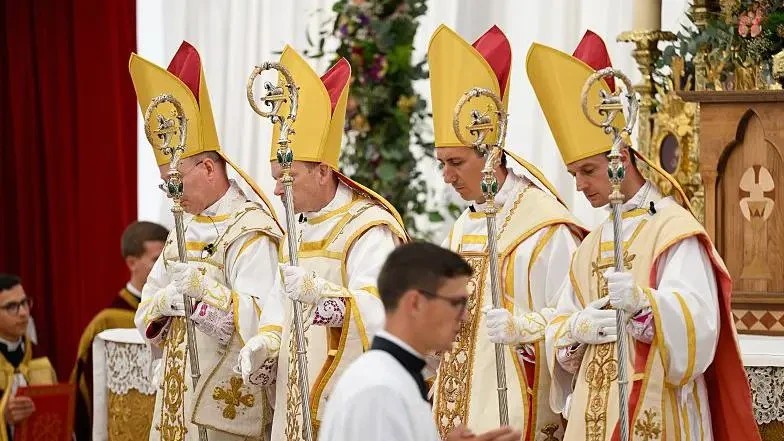
The decision to appoint four bishops without the Pope's authorization provoked a division in the Catholic Church.
Getty Images via BBC
The Vatican declared this Thursday (02/07) that priests and Catholics who were members of a dissident Catholic group - which ordained bishops without the Pope's approval - were excommunicated.
✅ Follow the g1 international news channel on WhatsApp
In a decree, the Dicastery for the Doctrine of the Faith - the Church's main doctrinal supervision body - warned Catholics around the world that the Priestly Fraternity of Saint Pius (Read more below)
With excommunication, religious people are prevented from receiving the sacraments until they repent and ask for forgiveness.
The decree reported that the two bishops - Alfonso de Galarreta and Bernard Fellay - who led the unauthorized ordination, held in Switzerland on Wednesday, were excommunicated, along with the four priests who became new bishops: Pascal Schreiber, Michael Goldade, Michel Poinsinet de Sivry and Marc Hanappier.
Now on g1
The Vatican has declared that all priests of the Priestly Fraternity of Saint Pius confessions validly.
According to Reuters news agency, the Catholic Church has the strict rule that only the pope can authorize the consecration of new bishops, in order to preserve the institution's links with the 12 apostles of Jesus, considered the first priests and bishops.
On Wednesday (01/07), despite last-minute appeals from Pope Leo XIV, the Priestly Fraternity of Saint Pius X had declared that needed to proceed with the ordinations without papal approval "due to exceptional circumstances".
But who are the Lefebvrians?
Church of the Priestly Fraternity of Saint Pius of incense announced the beginning of the 9 am mass in the small chapel of the Priestly Fraternity of Saint Pius Latin.
He stopped in front of the altar and stayed there for about an hour, his eyes focused on the crucified Jesus, the flowers and candlesticks on the altar as he celebrated the ceremony.
Behind him, a full house: with the pews all occupied, the faithful crowded together standing on the sides of the church and on the stairs that led to the mezzanine on the second floor. Most did not need the help of the translation books available in the box at the entrance to follow the prayers in Latin.
Apart from the red and gold of the priest's robes, sober colors predominated. Women and girls wore long skirts and dresses and used lace scarves to cover their hair.
The Priestly Society of Saint Pius See.
In 1988, its founder, the French archbishop Marcel Lefebvre, received the most severe punishment in the Catholic Church: he was excommunicated after appointing four new bishops without authorization from Pope John Paul II.
Consecration of the new bishops in 1988 by Marcel Lefebvre, founder of the SSPX.
Reuters via BBC
Even with the punishment, which prohibits participation in communion and other rites and sacraments Catholics, the congregation grew. It went international, entered South America through Argentina and in the last 20 years has been gaining strength in Brazil, driven by the advance of conservative currents among Brazilian Catholics.
In recent days, it was already known that the group would appoint bishops again, against the authorization of the Vatican.
At the Vila Mariana mass, in the brief moment in which he spoke Portuguese, the priest invited the faithful who wanted to join the Brazilian delegation to go to the ordination event on Wednesday in the city Switzerland of Écône. And he asked everyone to pray for the new bishops.
The Holy See had already warned that consecrations without papal consent would be interpreted as a formal break with the Church - and that they would be punished again with excommunication.
"Excommunication is something that happens very rarely", says historian Vinícius Couzzi Mérida, master and doctor in Religious Sciences. "Something that happens once or twice a century."
Why now then?
Booklets gathered in a crate at the entrance to the church translate part of the rituals into Portuguese.
BBC
Clash between tradition and modernity
The explanation goes through the biggest reform in the modern history of the Catholic Church, the Second Vatican Council, an assembly of bishops that took place between 1962 and 1965 and profoundly changed the way the church is celebrated. Catholic mass.
Until that date, the priest only prayed in Latin, even if the faithful did not understand what he was saying, and the reading and interpretation of the Bible was concentrated on members of the Church hierarchy, such as priests and bishops.
With the council, the official language became the local language of each parish. The Church began to encourage the faithful to get closer to the Bible, the formation of lay groups to read religious texts, and opened up "to dialogue with non-Christian religions and freedom of conscience [the idea that religion is an individual choice and should not be imposed, for example, by the State]", as Mérida explains.
It was a progressive movement, which displeased the more conservative Catholic wing.
One of these figures was the French archbishop Marcel Lefebvre, who in 1970 founded the Saint Pius According to Mérida, more than 40 thousand priests left the priesthood at that time.
"Many priests and seminarians understood that the Church was in a process of rupture for the birth of another church, more progressive, aligned with the modern world. This, in fact, caused a lot of confusion", he highlights.
From Switzerland, the SSPX expanded to France, Germany, the United States, Argentina and even to Oceania.
Faithful gathered after Sunday mass: chapel in São Paulo began with a property donated in the early 2000s.
BBC
Arrival in Brazil
The entry and growth of the SSPX in Brazil is related to another group of traditional Catholics, the Diocese of Campos dos Goytacazes, in Rio de Janeiro.
Like the Priestly Fraternity of Saint Pius X, the Diocese of Campos also rejected the Second Vatican Council and celebrated mass Tridentine, in Latin.
The two congregations were quite close, in fact. One of the bishops of the diocese, Dom Antônio de Castro Mayer, even participated in the ordination of the Brotherhood's bishops and was excommunicated along with Lefebvre in 1988.
After years of rupture, however, in 2002 the diocese made peace with the Vatican.
He accepted Pope John Paul II's proposal for reconciliation, which allowed his parish priests to continue celebrating the Tridentine Mass, as long as he finally accepted the Second Vatican Council. nod from the diocese to the Vatican and no longer wanted to attend the masses celebrated by his priests, so he asked the Fraternity to start operating in Brazil.
As a rule, it is the bishops of the dioceses who determine when and where a new church is opened, but as the SSPX is in an irregular canonical situation, that is, it is not in accordance with Vatican norms, this decision is generally taken on the initiative of the Fraternity itself when there are requests from devotees. traditional Catholicism in the country.
Today there are 14 chapels in four of the five regions. The congregation is only not present in the North, according to the addresses listed in the bulletins distributed to the faithful: São Paulo, Indaiatuba (SP), Ribeirão Preto (SP), Sorocaba (SP), Itapetininga (SP), São José do Rio Preto (SP), Passos (MG), Curitiba (PR), Cuiabá (MT), Campo Grande (MS), Fortaleza (CE), Parnaíba (PI), Teresina (PI), São Luís (MA).
Pope Leo 14 warned the congregation that unauthorized appointments would be punished with excommunication.
Reuters via BBC
"This is a growing movement", says Mérida, pointing out that the group today brings together around a million faithful around the world and has around 700 priests.
"In addition to the growth of the Fraternity, there are dissident groups, which also continue to divide and multiply."
The number It is relatively small compared to the universe of 1.4 billion Catholics, but representative of the advancement of so-called traditional Catholicism. This is not the case with the Fraternity, but some of these groups, although small, are quite active on social media and influence the public debate around conservative issues.
The researcher explains that both the Fraternity and traditionalist groups that do not accept the council continue to be considered Catholic even though they are in an irregular canonical situation because the Vatican, according to him, continues to try to promote reconciliation with them.
This stance will now be tested for the first time in the papacy of Leo XIV.
"It seems that the Holy See will remain irreducible, demanding that the Fraternity accept the Second Vatican Council so that it can receive the pope's consent", says Mérida.
In addition to the capital of São Paulo, the Fraternity is in 13 other cities in the country.
BBC
The leaflets with the prayers for the new bishops recommended by the priest in the Vila Mariana chapel were available in the small bookstore at the entrance of the church, but they sold out quickly early that Sunday morning.
The books remained for sale on the shelves, including 1492: The end of Barbarism, Beginning of Civilization in America, by the Argentine Cristian Iturralde, who defends Spanish colonization as a positive event for the American continent.
By the same author, The Inquisition, A Court of Mercy, is proposed as a response to critics of the religious courts created by the Catholic Church in the medieval period with the aim to investigate, judge and punish people accused of heresy.
On leaving the mass, the reporter tried to talk to one of the priests who was circulating among the faithful on the sidewalk. He answered some questions about the church - a house donated almost 20 years ago that underwent successive renovations to expand -, but stated that issues related to the new bishops should be addressed with Father Juan María de Montagut Puertollano, superior of the congregation in Brazil.
BBC News Brasil tried to contact him by phone and email, without success.
The National Conference of Brazilian Bishops (CNBB) also did not return interview requests.
* With reporting by Camilla Veras Mota
Source: G1