US prepared mission to capture uranium from Iran; Trump ordered suspension
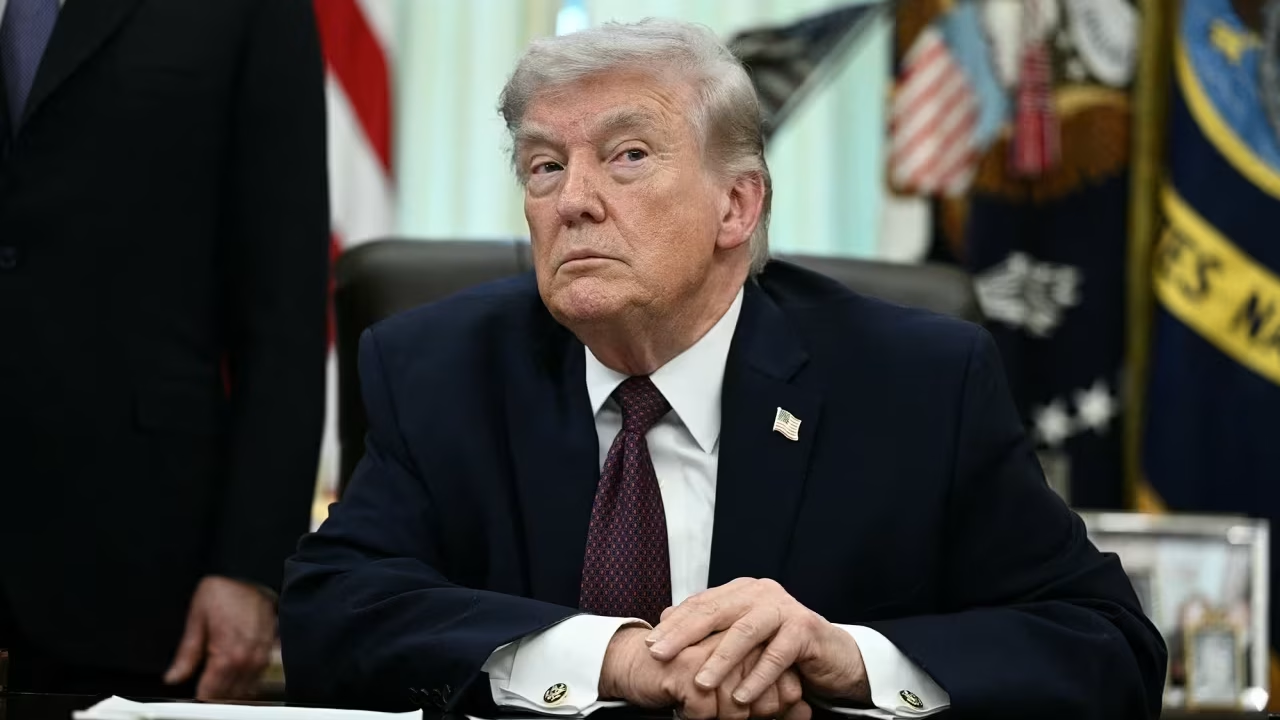
The United States' top military commander made a secret and urgent visit to the US Central Command (Centcom) headquarters in Florida late last month to personally receive information about plans to send ground troops to Iran. The aim was to forcibly seize the country's highly enriched uranium - an essential component for the production of a nuclear weapon, two sources familiar with the matter told CNN.
The meetings were considered so urgent and sensitive that they required General Dan Caine, chairman of the US Joint Chiefs of Staff, to hastily leave a meeting of senior NATO officials in Brussels and return to Tampa, Florida, on May 19, according to the sources. The urgent and high-level nature of the discussions shows how close the government came to authorizing the risky ground operation.
A spokesman for the Joint Chiefs of Staff declined to comment on preparations for a possible operation.
Caine later presented President Donald Trump with options for such a mission, one of the sources said.
However, Trump decided to suspend the plans after being warned that the operation would likely provoke strong Iranian retaliation, prolonging the war and plunging the global economy into even greater turmoil, according to the sources. Trump has also expressed concern about the possibility of a significant number of American casualties.
The advanced planning came as Trump repeatedly stated that the US and Iran were close to a deal to reopen the Strait of Hormuz and conclude negotiations on Iran's nuclear program.
On Thursday, Trump said the two countries could sign an agreement soon, possibly as early as the weekend.
But discussions about sending ground troops to Iran show how close the US came to a major escalation of the conflict.
"Too much risk," said one of the sources familiar with the plans. According to her, it was not surprising that Trump chose not to give the green light to the operation.
Tehran and the economic "nuclear option"
If negotiations fail and the war resumes, Tehran has also considered an economic "nuclear option," three people familiar with the issue told CNN: convincing the Houthis, Iran's main allied force in Yemen, to close the Bab el-Mandeb Strait - one of the world's most important shipping routes and a strategic point for global trade, especially after months of closing the Strait of Hormuz.
A senior U.S. government official responded to a CNN request for comment on Friday with a list of conditions that Iran reportedly accepted in negotiations, including the destruction and removal of nuclear material, the dismantling of the nuclear program, the reopening of the Strait of Hormuz and the end of Iranian funding to allied armed groups. Only after that would there be sanctions relief.
Iran's Foreign Minister, Abbas Araghchi, stated that the memorandum of understanding should address Iran's nuclear program and sanctions relief, among other topics, including a solution to the conflict in Lebanon "and on all other fronts."
Also according to Araghchi, a statement on future control of the Strait of Hormuz should be released "soon".
Iran's uranium stockpile
Securing control of Iran's highly enriched uranium remains one of Trump's main goals that has yet to be achieved, whether through diplomacy or military force.
Although the president has repeatedly mentioned the possibility of the US confiscating the material by force, he has been reluctant to move forward with an operation that could result in many American casualties.
Trump says the US will acquire uranium stock from Iran | CNN 360°
Commenting on another possible military action - the seizure of Kharg Island, Iran's main oil export terminal - Trump told Fox News this week: "I don't know if the Americans are willing to do that."
Despite the risks, the possibility of seizing Iran's uranium - especially the approximately 970 pounds (approximately 440 kilograms) enriched to levels close to those needed for nuclear weapons - has not yet been completely ruled out.
Trump's frustration grew as Iran was slow to accept a deal that would require significant concessions in its nuclear program, including the voluntary surrender of its stockpiles of enriched uranium. According to CNN sources, this material is distributed among several Iranian nuclear facilities, mainly in the Isfahan, Natanz and Fordow complexes, buried deep in underground tunnels.
Nuclear energy experts question whether an American military operation would be able to locate and verify all the material, let alone remove it safely under hostile conditions. It is believed that the uranium is still in gaseous form, as it was at the last inspection by the International Atomic Energy Agency (IAEA), in June 2025.
Iran expelled international inspectors the following month after joint US-Israeli airstrikes on its nuclear facilities. Although these bombings caused damage, they did not destroy all the nuclear material, which remained in the underground tunnels.
In a recent interview, the director general of the IAEA, Rafael Mariano Grossi, warned that the existing stockpile could allow Iran to produce up to ten nuclear bombs, if the country decided to transform its program into a military project.
The US intelligence community believes it knows where all this material is thanks to continuous aerial monitoring, according to two sources. In addition to highly enriched uranium, Iran has large quantities of low-enriched material that could be used to make a "dirty bomb."
An extremely risky operation
According to previous CNN reporting, physically securing control of the uranium would require a large American ground force, including hundreds of special forces operators.
"It would be absurdly difficult to search those tunnels and all the containers," said one source. "We would have to establish a massive presence. In practice, we would have to invade."
Military commanders have classified such an operation between the "high" and "extreme" levels of risk acceptable to special forces, meaning it could result in a significant number of American casualties even if successful.
Risks of an Iranian response
If a ground operation to capture uranium were launched, the closure of the Bab el-Mandeb Strait - a scenario predicted in intelligence assessments - could cause catastrophic economic damage to the world economy.
A source familiar with these assessments highlighted that the Houthis have not yet resumed large-scale attacks against American or European ships, limiting their actions mainly to vessels linked to Israel. Expanding the targets would represent a significant escalation.
According to the sources, Iran has so far avoided turning to the Houthis in this way because it knows it could jeopardize ongoing peace talks.
The regular Iranian army has been significantly weakened, but the main threats to American troops would be the booby-trapped tunnels where uranium is stored, as well as anti-aircraft and shoulder-launched missiles. The country also maintains a significant portion of its stockpiles of drones and ballistic missiles.
Dan Caine and other military leaders have previously warned about the scale, complexity and potential for American casualties in a protracted campaign against Iran. They have also warned that an extended war would significantly affect U.S. weapons stockpiles and military readiness.
Despite previous statements about the possibility of capturing uranium, Trump downplayed that option on Thursday, in statements in the Oval Office: "Nobody's going to go near it because it's buried under a mountain," the president said.
Survey: 6 in 10 Americans see war with Iran as a mistake
Source: CNN