US and Iran intensify conflict and hit Bahrain and Kuwait in dispute over Hormuz
USA and Iran exchange attacks again amid ceasefire
It is the third day of reciprocal bombings in the region, threatening ceasefire. Tehran launches drones against Bahrain and Kuwait; Trump warns Iranian leadership.Iran launched missiles and drones against United States military bases in Kuwait and Bahrain this Sunday morning (28), shortly after American President Donald Trump threatened to eliminate the Iranian leadership if it did not respect the provisional agreement to end the war.
✅ Follow the g1 international news channel on WhatsApp
Tehran's aggression was a response to a new American attack, hours after an oil tanker was hit in the Strait of Hormuz. The waterway, through which a fifth of the world's oil and gas passes, was kept closed by Iran during the conflict, which had negative repercussions on the economy around the world.
The US and Iran have been exchanging hostilities since the Islamic Republic attacked another ship in Hormuz on Thursday, accusing it of using an unauthorized route.
"There may come a time when we are no longer able to act reasonably and we will be forced to conclude militarily the work we began with great success," Trump posted on social media on Saturday night. "If this happens, the Islamic Republic of Iran will cease to exist!"
Trump raises the tone when mentioning attacks on Iranian facilities and possible military escalation
Reproduction/Truth Social
About an hour after posting, the Kuwaiti Army reported that its air defenses were responding to missile and drone attacks, and said it had intercepted two ballistic missiles. Earlier, Bahrain had also been targeted.
Iran's Revolutionary Guard confirmed the attacks and said they targeted American military bases. An American government emissary told Reuters news agency that there were no American casualties or significant damage.
READ ALSO:
USA attacks targets in Iran, in action that challenges truce between countries; Trump makes threats again
Iran retaliates and launches missile and drone attacks against US military installations in Kuwait and Bahrain
Hours later, alarms sounded a second time in Bahrain, where authorities said an Iranian attack damaged a residential building in Muharraq province, with no casualties reported. Bahrain has called on the UN Security Council to convene an urgent session to hold Iran accountable.
The Guard accuses the US of violating the ceasefire and warned of the risk of "complete disruption of all diplomatic processes", promising to "make hell" US bases in the region in the coming days.
The elite Iranian force, which controls Iran's ballistic missile arsenal, answers only to the supreme leader, Ayatollah Mojtaba Khamenei, and is believed to be exerting even greater influence now in the Islamic Republic.
The US and Iran have signed a 14-point interim peace agreement aimed at stopping the fighting and reopening the strait. In return, Washington eased sanctions against Tehran. Meanwhile, the two sides would hold talks on issues including Iran's nuclear program.
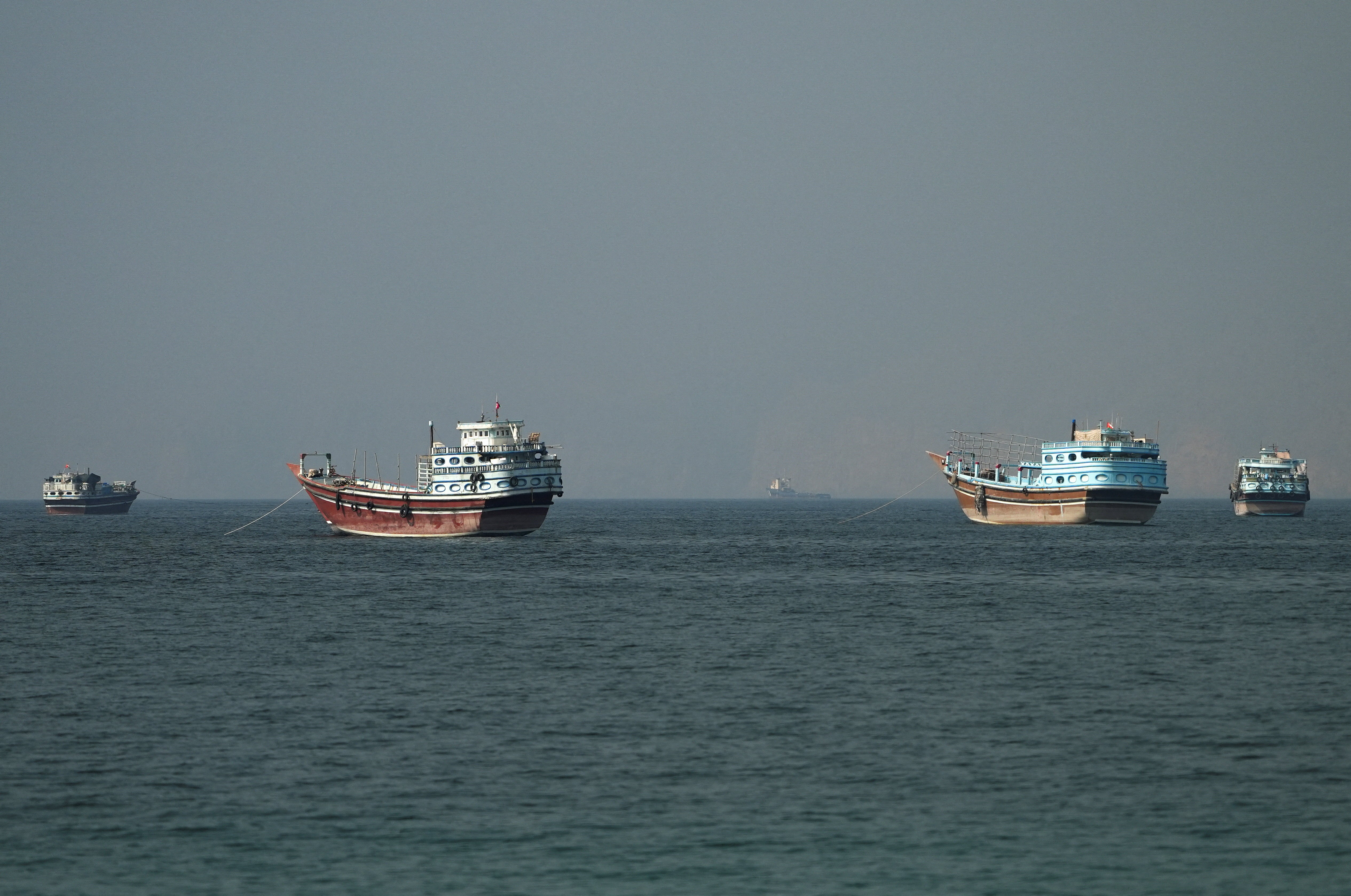
Vessels in the Strait of Hormuz, seen from Musandam, Oman, June 26, 2026
REUTERS/Stringer
Dispute over control of Hormuz
Iranian Foreign Minister Abbas Araqchi said responsibility for resuming normal levels of maritime traffic in Hormuz rests solely with Tehran and called on others not to interfere "in Iranian administration of the strait."
Washington has been promoting a southern route along the coast of Oman, while Tehran, which ultimately intends to charge fees for use of the strait, wants ships to use a northern route through its waters and under its control.
The United States and Gulf Arab states reject Iran's demands.
The strait is considered an international maritime route around the world, despite being within the territorial waters of Iran and Oman.
With the provisional peace agreement between the US and Iran, hundreds of ships stuck in the strait, including tankers loaded with oil, began to leave in the last two weeks, causing oil prices to return close to pre-war levels.
The situation is also unstable in Lebanon
In another event that could intensify tensions in the region, Israel announced on Sunday that it had attacked Hezbollah militants in Lebanon, just one day after signing an agreement with the country to de-escalate the conflict with the Shiite militia allied with Iran.
Hezbollah, which rejects the agreement, insists on the unconditional withdrawal of Israeli troops from southern Lebanon - as does Iran, which claims that a ceasefire must include both fronts of the war in the Middle East.
Under the terms of the agreement, Israel agreed to gradually withdraw from Lebanese territory through the disarmament of Hezbollah.
But attempts to establish a ceasefire in Lebanon have had limited effect given the irreducibility of Israel and Hezbollah.
US ally, Israel invaded southern Lebanon in March after Hezbollah attacked it in support of Iran.
Araqchi stated that Israel's withdrawal and halt to its attacks in Lebanon were required by the interim agreement with the US and that it was up to Washington to stop these operations.
Lebanese President Joseph Aoun said that the new Iranian attacks on Kuwait and Bahrain were a "sabotage" of attempts to achieve peace in his country, where the conflict with Israel has already left more than 4,000 dead and displaced more than a million.
Source: G1