Union spending reaches R$ 2.6 trillion in 12 months and approaches the peak of the pandemic
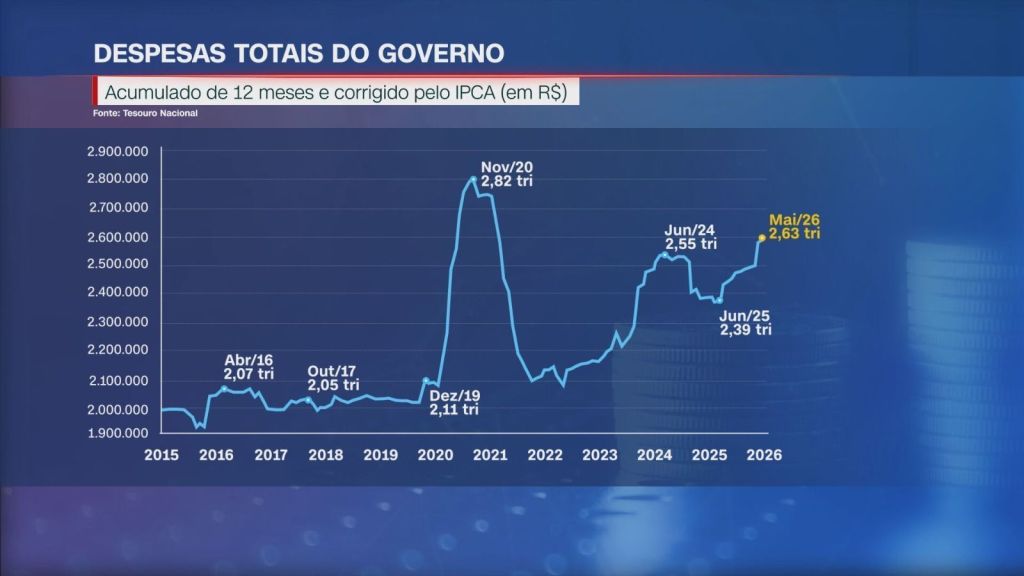
Federal government expenditures are heading towards the highest level in history, reached in November 2020. During the period, Union expenditures totaled R$2.822 trillion in 12 months, with data updated by inflation.
Now, the May data released last Monday (29) shows a distance of R$ 189.5 billion from the peak of the pandemic. Last month, government spending over the 12 months totaled R$2.633 trillion.
- Reproduction/CNN
According to economist Alexandre Schwartsman, expenses have been pressured mainly by the growth in spending on social security and the BPC (Continuous Payment Benefit).
In May, Social Security cost R$1.117 trillion over 12 months. It's more than double what the government spends on personnel: R$440.1 billion.
In Schwartsman's assessment, the pace of expenditure growth is not compatible with the rules of the fiscal framework.
The economist explains that the government adopts a policy that guarantees the adjustment of the minimum wage based on inflation (measured by the INPC) and this causes mandatory expenses - such as Social Security and BPC - to increase automatically, putting even more pressure on the budget space for investments.
"Expenditure cannot grow more than 2.5% per year above inflation, and what we see is that this set of rules that determine the evolution of mandatory spending - social security, civil service, social program, health floor, education - leads to growth in mandatory spending that exceeds the maximum growth allowed by the fiscal framework," Schwartsman told CNN Money.
The escalation of these benefits led the government of President Luiz Inácio Lula da Silva (PT) to increase the budget blockade to R$23.7 billion.
In the second two months of this year, expenditure growth projections rose to R$14.1 billion in BPC (Continuous Payment Benefits), and to R$11.5 billion in Social Security Benefits.
- CNN Reproduction
The blockade is an instrument adopted by the economic team to ensure compliance with fiscal rules. The fiscal framework limits expenditure growth to 2.5%. The government also has a target to meet. This year, for example, the economic team predicts a primary surplus of 0.25% of GDP (Gross Domestic Product).
"Brazilian-style shutdown"
For public accounts specialist Murilo Viana, the Union Budget is experiencing a kind of "Brazilian-style shutdown". In an interview with CNN Money, he stated that the growth in mandatory expenses has strangled the space for discretionary expenses, putting pressure on the public sector.
"The lights are going out little by little. We are seeing, for example, significant restrictions in regulatory agencies, the Central Bank complaining about the lack of servers and the lack of space to make investments in technology. This perception is becoming generalized within the government machinery. This is a reflection of this very serious fiscal limitation and which leads to a situation in which we are having this Brazilian shutdown", he declared.
For this reason, Murilo Viana assesses that it is necessary to reduce the growth trajectory of expenses immediately under the risk of the public machine stopping in 2027. The expert considers, however, that this brake involves politically complex discussions in the National Congress in an election year.
"The adjustment will have to come regardless of which candidate wins, because, otherwise, the public machine, in fact, will stop in 2027, 2028, even if it has extraordinary revenue gains. Since this space provided by the fiscal framework of the expenditure limit is becoming increasingly difficult to execute", declared Murilo.
In this context, the experts interviewed by CNN Money already consider the need for new structural reforms, such as a new pension reform, to slow the increase in mandatory expenses.
"If we don't change the rules, obviously the tendency is that we will have an increasingly tight budget. There's not much doubt about that. When we talk about spending control in the country, what we typically emphasize is that this strategy requires an ambitious set of reforms", said Schwartsman.
Debt
In addition to putting pressure on the Budget space for investments and the functioning of the public machine, the growth in expenses also affects debt. When the Union spends more than it collects, there is a primary deficit.
To cover this gap, the National Treasury needs to issue more public bonds - and this increases the debt.
In April, Brazil's federal public debt rose 1.91%, reaching R$8.798 trillion. The value corresponds to almost 70% of Brazil's GDP in 2025.
According to the director of macroeconomics Brazil at UBS GWM, Solange Srour, the trajectory of Brazil's primary results in recent years is incompatible with the stabilization of the federal public debt.
"The problem is that fiscal dynamics lead to a situation in which the debt only grows and this increases the cost of financing it and ultimately translates into higher interest rates, which ends up obviously impacting economic growth and also generating an expectation of high inflation", said Solange to CNN Money.
For her, if the adjustment to public accounts is not made immediately, Brazil is at risk of entering a recession. In Solange Srour's opinion, specific changes are not enough to solve the problem.
"We can enter a very deep recession, which was a bit of what happened in 2015 and 2016. And then the adjustment comes with much more pain, with unemployment rising, with high inflation. I would even say that I think the next president-elect has to present this even before 2027 because we have great uncertainty about what will be done", he said.
Source: CNN