Typhoon Bavi causes 15 deaths in the Philippines and leaves Taiwan on 'high alert'; Timelapse VIDEO shows passage of the phenomenon
Timelapse shows typhoon Bavi passing off the coast of Japan
After leaving at least 15 people dead in the Philippines, super typhoon Bavi advanced this Friday (10) towards Taiwan, where more than 2,000 people were forced to abandon their homes before the phenomenon passed through the island.
✅ Follow the g1 international news channel on WhatsApp
The typhoon is expected to hit the north and east of Taiwan, as well as the remote southwestern islands from Japan, between Friday and Saturday, and will later touch down in China.
In the Philippines, two landslides caused by heavy rains worsened by Bavi killed at least 15 people and left six missing on the island of Mindanao, authorities said.
In the Taiwanese port city of Keelung, one of the areas expected to be affected, residents stocked up on food, reinforced windows and placed sandbags in front of commercial establishments.
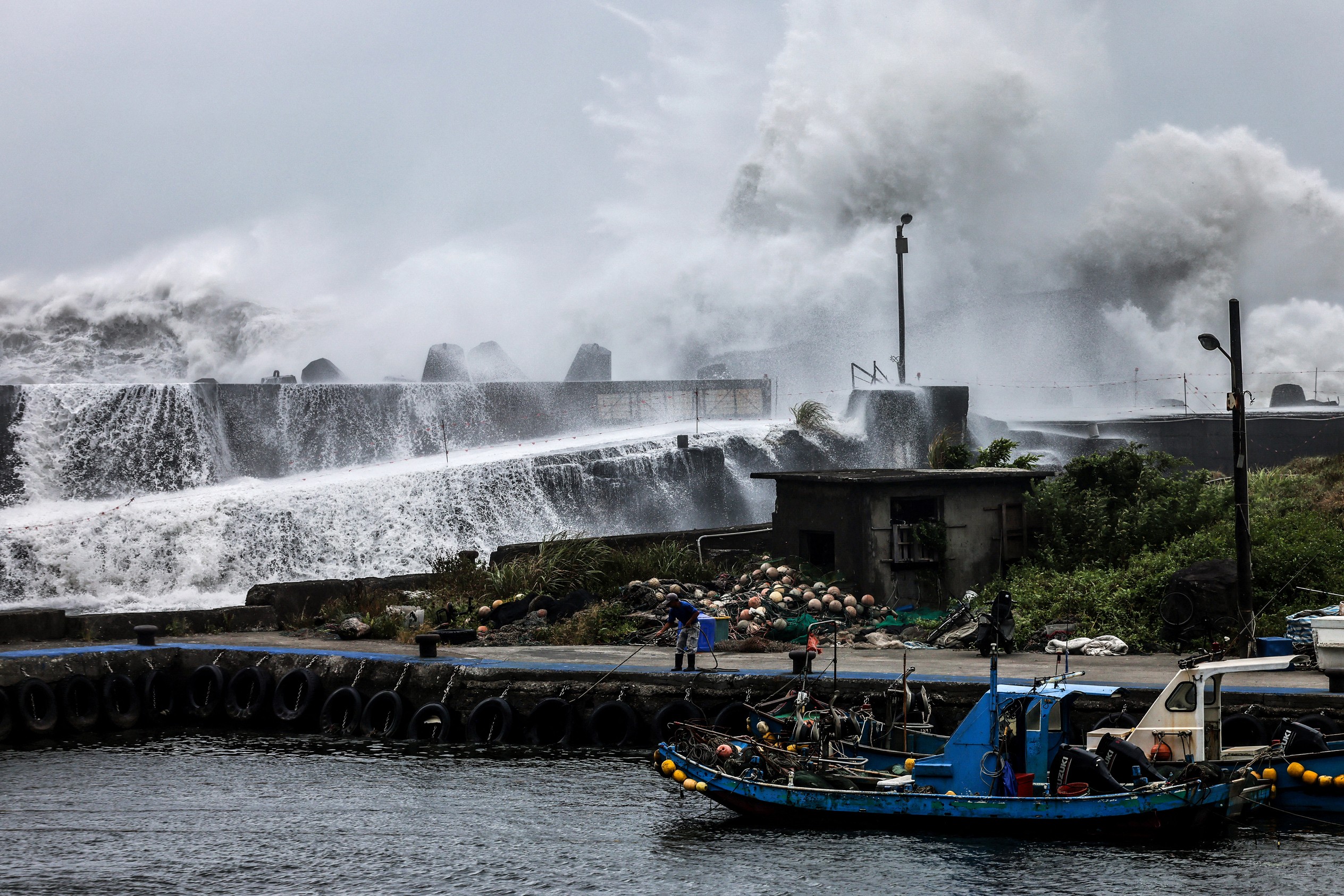
Boat of fishermen near violent waves crashing against a sea barrier off the coast of Yilan, Taiwan, as Typhoon Bavi moves towards the island on July 10, 2026.
I-Hwa Cheng/AFP
Categorized as a Category 5 super typhoon earlier this week, Bavi lost intensity after hitting Guam and the Northern Mariana Islands on Monday, and was downgraded to typhoon category as it moved across the Ocean Pacific.
This Friday, winds reached 155 kilometers per hour, with gusts of up to 190 km/h, according to the Taiwan Central Meteorological Administration (CWA).
"The typhoon is expected to continue to lose strength because environmental conditions are not favorable," Wang Ping-hsiang, CWA meteorologist, explained to AFP news agency.
Many schools and commercial establishments closed this Friday in the north and east of the island. Hundreds of flights were cancelled.
'High alert'
Satellite image shows Typhoon Bavi over the Philippine Sea on July 8, 2026.
Nasa Worldview/Handout via REUTERS
In Keelung, one of the most exposed cities, residents rushed to markets in search of food. "What you're seeing now is something we haven't experienced in the last 10 years," Penny Pan, 48, owner of a restaurant in the city, told AFP, as her husband placed bags of sand at the entrance to the establishment.
Meteorologists predict that Bavi will cause almost a meter of rain, which increases the risk of flooding and landslides. More than 2,000 people have fled their homes, mainly in the mountainous Hualien county in eastern Taiwan, where authorities are monitoring two dams.
Taiwanese President Lai Ching-te called on residents in the most exposed areas to remain on "high alert." Almost 28,000 military personnel were mobilized to act in case of emergency.
In Japan, on the remote Sakishima islands, some schools and establishments remained closed before the arrival of the typhoon.
A man removes mud from the street after heavy rain caused by Typhoon Maysak in the city of Sanli, in Guangxi Zhuang, China, on July 9, 2026.
cnsphoto via REUTERS
Bavi is expected to hit eastern China. China over the weekend. The country has already faced major storms this week in the south and central regions, such as the recent typhoon Maysak, which left at least 39 people dead, caused several rivers to flood and a dam to collapse.
The oceans recorded the highest temperature in the historical series in June, according to the European Union's Copernicus Marine Service. The warming of the oceans favors the intensification of tropical cyclones and causes more humidity, which can translate into more intense rains.
Now on g1
Source: G1