Trump turns the US birthday into a political showcase, and the 250th birthday party exposes the country's division
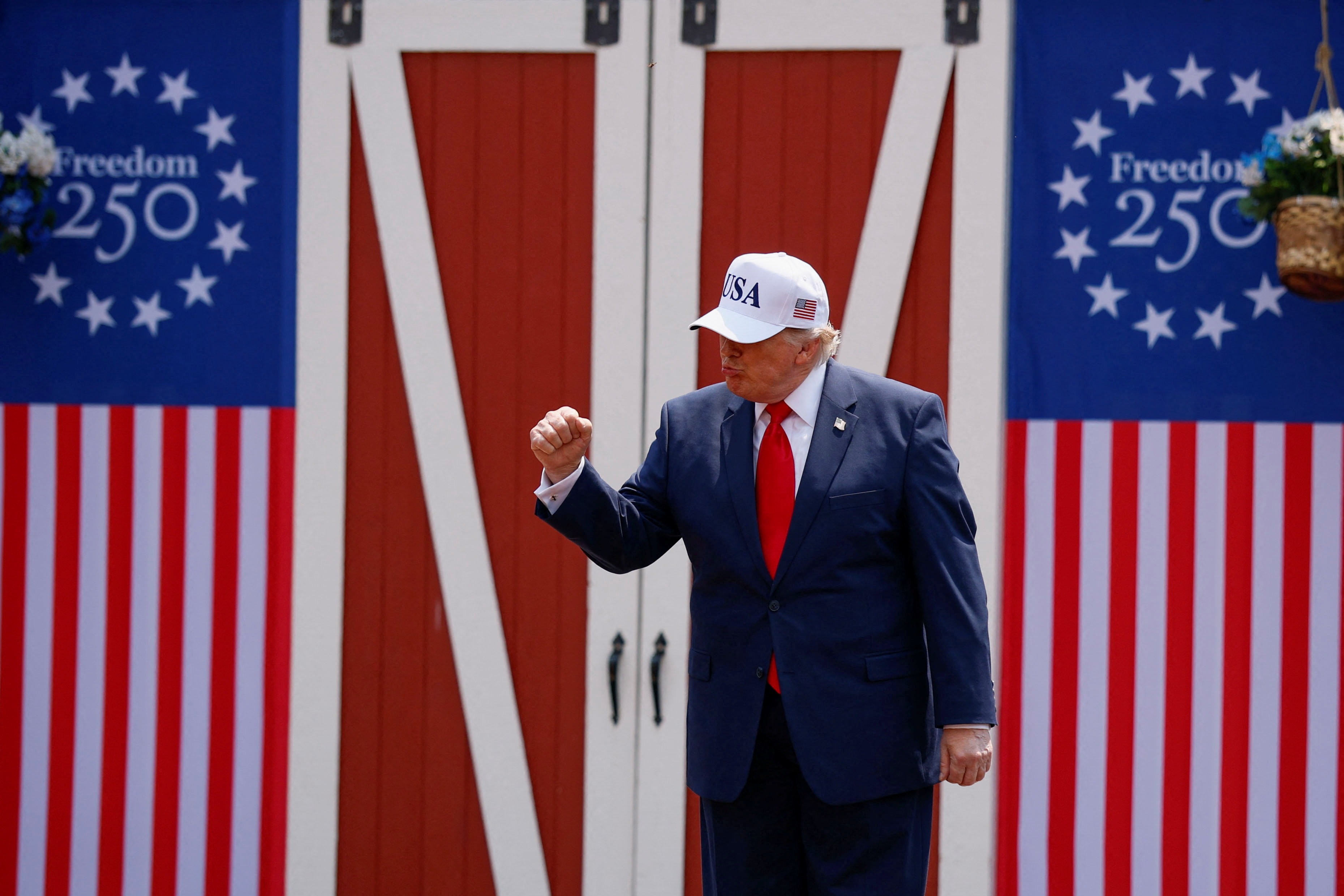
US President Donald Trump gestures as he arrives to speak at the Burning Hills Amphitheater, on the opening day of the Theodore Roosevelt Presidential Library, in Medora, North Dakota, USA, on July 1, 2026
REUTERS/Evan Vucci
The celebrations for the 250th anniversary of the independence of the United States, celebrated this Saturday (4), were surrounded by pressure, conflicts and controversies before they even took place.
The historic anniversary, planned for nearly a decade to serve as a moment of national unity, has turned into a dispute over who has the right to define the narrative of American history and the meaning of patriotism.
✅ Follow the g1 international news channel on WhatsApp
Planning for the celebrations began in 2016, when Congress created the bipartisan America250 commission to coordinate events across the country. The proposal provided for a national program focused on education, culture and popular participation.
The scenario changed after Donald Trump's return to the White House. In January 2025, the president signed a decree creating Freedom 250, a group in charge of organizing the main federal events in Washington.
The decision divided the celebrations into two fronts:
In the American capital, Freedom 250 promoted a program centered on the figure of Trump, with performances by the Armed Forces Joint Orchestra, a large 40-minute pyrotechnic show and the forecast of launching 850,000 fireworks from ten points in the city.
At the same time, America250 organized, in Los Angeles, a show focusing on cultural diversity, presented by Queen Latifah and with shows by Chris Stapleton, Chaka Khan and the band Smashing Pumpkins.
Water mirror of Washington
REUTERS/Nathan Howard
Behind the scenes, however, the relationship between the two groups was marked by conflicts. Members of the committees reported differences over the budget, programming, publicity campaigns and division of responsibilities, according to Reuters.
The two organizations promoted different student contests, competed for private sponsors, launched their own advertising campaigns during the Super Bowl and competed for press attention.
The change also altered the plans originally drawn up for Washington. Documents prepared in 2024 predicted a parade with floats representing different communities, a cultural festival organized by the Smithsonian Institution and musical performances spread across the country.
After the creation of Freedom 250, part of these initiatives was replaced by the Great American State Fair, a patriotic fair inaugurated by Trump. At least nine states decided not to participate directly in the event.
Read also:
'Largest criminal organization in the Western Hemisphere': PCC puts Brazil at the center of Trump's strategy for the Americas
Trump's companies have billion-dollar revenue in 2025 and reignite debate about conflict with government decisions
'It's a party for Trump, not for the United States'
According to Roberto Uebel, professor of International Relations at ESPM and coordinator of the institution's American studies and business center, the change in tone of the celebration is something unprecedented in the country's history.
Historically, he says, associating large national celebrations with the personal image of a ruler or a specific political project is not common in North American politics, which tends to adopt a strictly protocol and institutional tone. 1876, under the logic of the Monroe Doctrine and the country's rise as a power. In none of these moments was the figure of the ruler personified", said the expert.
However, the 250th anniversary seems to follow a different path in the country's political history.
Uebel states that the tendency is for the celebration to be marked by the president's personalistic appeal.
This change in perspective and the more personalistic tone have repercussions for the country's international projection. Although the United States still projects itself globally as a superpower in political, economic and cultural aspects, the actions of Trump's second term put to the test the traditional North American values of freedom, individuality, justice and democracy, explains Uebel.
"We see Trump in evidence. He on the passport, he on the commemorative coin, in short, he tries to bring this to himself. It's a party for Trump, not for the United States."
According to Uebel, these values are now being questioned by the international community - including rival powers such as Russia and China, and even historic allies such as the European Union and the United Kingdom.
The dispute over the narrative of American history
Since the 2023 presidential campaign, Trump has promised to hold a celebration that would last an entire year and would be the biggest independence party ever promoted by a country. After his return to the White House, the Republican turned the 250th anniversary into one of the main showcases of his government.
In addition to the national fair, Trump promoted a military parade, a UFC event in the White House gardens and began to defend an approach based on what he calls "patriotic history".
'UFC Freedom 250' event at the White House, in Washington D.C., in the United States, in the early hours of June 15, 2026.
Jacquelyn Martin/Pool via REUTERS
The strategy provoked criticism from opponents and members of the commission created by Congress itself.
Democratic senator Alex Padilla stated that the president turned the independence anniversary into a platform for personal promotion. "He couldn't help but turn America's 250th birthday into something aimed at himself," he said.
The dispute also reached funding:
Although Congress approved US$150 million for America250, the commission received only US$25 million of the US$50 million allocated for its activities linked to the federal events.
At the same time, at least US$68 million was allocated by the government to the non-profit organization responsible for Freedom 250.
Companies such as Palantir, United Airlines, Deloitte, Boeing and UFC ended up sponsoring both initiatives, while others preferred to choose just one side.
The polarization also affected cultural programming. Freedom 250 initially announced a series of shows featuring artists such as Martina McBride, Young MC, Milli Vanilli and Bret Michaels, but almost all of them dropped out just days later. Some said they were taken by surprise by the political nature of the presentations.
With the casualties, part of the concerts were canceled and the program ended up being reformulated, starting to bring together artists and personalities more aligned with the conservative universe and the Trump administration, such as country singer Lee Greenwood, tenor Christopher Macchio and artist Alexis Wilkins, girlfriend of FBI director, Kash Patel.
Polarization deepens
National celebrations act as a thermometer to assess the state of a nation, according to the associate professor of International Relations at Fundação Getúlio Vargas (FGV), Oliver Stunkel. He explains that these events end up being "a mirror of the president" and the dominant narrative about the country's past, present and future, revealing a lot about the current political scenario.
As a practical example of this dynamic, Stunkel points to the deep political polarization observed in the United States:
"Opinion polls show that around 90% of Republican voters say they are proud to be American. Among Democratic voters, this percentage is approximately 45%. Obviously, the scenario would probably be different if the country had a president or a president of the Democratic Party.
This shows the degree of polarization experienced by the United States today."
The contestation of the official historical narrative of the United States is not a recent phenomenon, according to the professor. He recalls that, in the post-Civil War period, there was an effort in the South of the country to idealize the memory of the Confederates, in some cases with the attempt to present slavery as a supposedly benign institution.
He assesses that initiatives such as Freedom 250 are not limited to organizing events, but express a specific reading of the "This project is entirely an interpretation of history aligned with Trumpism and used as a political instrument", he states.
The professor also highlights that the division goes beyond the institutional field and affects the perception of society. For him, the United States is currently experiencing a scenario of deep division, with disagreements about the past, the present and the future.
States are trying to achieve a broader celebration
While Washington concentrated the political dispute, states from different regions followed their own path.
Many had been preparing their celebrations for years, often. with reduced teams and limited budgets. Instead of focusing celebrations solely on the American Revolution, local governments decided to highlight the contribution of their communities to the construction of the United States.
The challenge was greater for states that were not part of the 13 original colonies - which founded the USA. in society.
In Colorado, for example, the exhibition "Moments That Made Us", brings together 50 events considered decisive in American history and seeks to present different interpretations of each episode, including the war with Mexico and the civil rights movements. Oregon addressed the persecution of Chinese immigrants and the internment of Japanese Americans during World War II; Kansas included the creation of the first LGBTQIA+ pride flag; and Utah began using the expression "complete history" to address the diversity of experiences that shaped the state.
Even far from Washington, polarization remained present.
Source: G1