Trump talks to Gulf leaders as he weighs Iran proposal
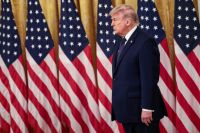
US President Donald Trump spoke on Saturday afternoon (23) with leaders from the Gulf and other countries in the region to analyze Iran's latest proposal to end the war, a source familiar with the matter said. At the same time, mediators left meetings in Tehran suggesting that the parties had made progress toward a possible preliminary agreement.
Trump, in a phone interview with Axios, described the chances of a deal with Iran as "a solid 50-50" ahead of the call with regional leaders, adding that he could decide by Sunday whether to resume military action against Iran.
The president said negotiations could result in a "good" deal or lead to the US deciding to "blow the hell out of them."
Earlier on Saturday, American and Iranian officials indicated they may be closer to a preliminary agreement to end the war, after mediators from Qatar and Pakistan held talks in Tehran. A regional source stated that the US and Iran are approaching an understanding to work on a more detailed agreement in the future.
"There may be news later today. I have no news right now, but maybe there will be some news a little later today. Maybe there won't be. I hope there will be, but I'm not sure yet," US Secretary of State Marco Rubio told reporters in New Delhi on Saturday.
According to a regional source interviewed by CNN, Trump's call this Saturday would include Gulf leaders and officials from Pakistan, Türkiye and Egypt.
Trump also told Axios that he planned to speak with envoy Steve Witkoff and adviser Jared Kushner, his son-in-law. Meanwhile, Vice President JD Vance was seen arriving at the White House on Saturday.
Separately, Israeli Prime Minister Benjamin Netanyahu will convene a restricted security meeting on Saturday night with selected ministers and security officials to discuss progress in negotiations with Iran, according to an Israeli source interviewed by CNN.
The mediation efforts come after Trump met on Friday with senior US national security officials to discuss the next steps in the war, including the possibility of resuming fighting.
Rubio said diplomatic efforts remain underway behind the scenes and that Washington remains focused on ensuring Iran cannot possess a nuclear weapon and addressing the country's stockpiles of enriched uranium.
"Even as I speak to you now, there is work being done," Rubio said. "There's a chance that, whether it's later today, tomorrow or in a few days, we'll have something to announce."
Meanwhile, Trump also expressed optimism this Saturday, saying in an interview with CBS News that he has seen a draft of the Iranian proposal and that the two sides are "getting much closer" to an agreement, according to the broadcaster's correspondent Nancy Cordes.
Trump has not said whether he will accept the text, saying: "I can't tell you before I tell them, right?"
Meanwhile, Republican Senators Roger Wicker of Mississippi and Lindsey Graham of South Carolina - both proponents of a hard line against Iran - expressed caution about the possibility of Trump reaching a peace deal with Tehran.
Graham expressed concern about the perception that Iran could consolidate itself as a dominant force that would require a diplomatic solution, something he said could have broad implications for the region.
"This combination of Iran being seen as capable of terrorizing the Strait [of Hormuz] indefinitely and causing massive damage to the Gulf's oil infrastructure represents a major shift in the region's balance of power and, over time, will be a nightmare for Israel," Graham wrote in X on Saturday.
Wicker, chairman of the Senate Armed Services Committee, said he believes the negotiations will "define" Trump's legacy and encouraged the president to "finish what we started."
"His instincts were to finish the job he started in Iran, but he is being ill-advised to pursue a deal that would not be worth the paper it is written on," Wicker wrote on Friday, adding that "continuing to pursue a deal with Iran's Islamist regime risks conveying a perception of weakness."
'A positive trajectory'
Iran's Foreign Ministry said Tehran is focused on finalizing a memorandum of understanding through Pakistan-mediated talks.
According to Foreign Ministry spokesman Esmail Baghaei, the memorandum would address the end of the war, the end of the US naval blockade of Iran and the release of Iranian assets blocked abroad, but would not address Iran's nuclear program.
"Sanctions are certainly part of the negotiating topics, but as we are not discussing the nuclear issue at this stage, there will also be no negotiation on the details of the suspension of sanctions," Baghaei said, quoted by the semi-official FARS agency.
Several regional sources told CNN there was cautious optimism regarding the negotiations.
"Things are moving on a positive trajectory," said a regional source.
Another source with knowledge of the talks said "the impasse is over", although it was not yet clear whether this referred to the main points of disagreement or just the text of the memo.
Among the main disagreements are the fate of Iran's stockpile of highly enriched uranium, the domestic enrichment program and navigation through the Strait of Hormuz, which Tehran has effectively closed.
Earlier this week, the source said there were also discussions about a possible unlocking of Iranian assets.
After meetings in Tehran on Friday and Saturday, Pakistan's military chief, Field Marshal Asim Munir, left the Iranian capital for Islamabad in the late afternoon local time. The Pakistani Armed Forces said the visit was "highly productive" and that the talks "significantly contributed to the mediation process."
"The intense negotiations of the last 24 hours have resulted in encouraging progress towards a final understanding," the Army said in a statement.
Baghaei said that deadlines of 30 and 60 days were included in the text of the memo, but that it has not yet been finalized.
"In the last week, points of view have become closer," he said. "We need to wait and see what happens in the next three or four days."
Baghaei also said that any mechanism related to the Strait of Hormuz must be agreed between Iran, Oman and countries bordering the waterway, and that the United States "has nothing to do" with it.
War in the Middle East: Iranian negotiator says Tehran will not give up rights | NOW CNN
Lead Iranian negotiator Mohammad Bagher Ghalibaf struck a defiant tone after talks with Munir, warning that Iran "will not back down from the rights of our nation and our country - especially when dealing with a party that has never demonstrated sincerity and in which there is no trust."
"Our armed forces have rebuilt themselves during the ceasefire in such a way that if Trump makes the mistake of restarting the war, it will certainly be more devastating and bitter for the United States than on the first day of the war," Ghalibaf added, according to Iranian state broadcaster.
A member of Iran's National Security and Foreign Policy Commission, Fada Hussain Maleki, said in an interview with the semi-official ISNA news agency that "it seems like we are getting closer to a final agreement, but there are still challenges", adding that further talks would take place this Saturday.
Why is the Strait of Hormuz so important to the world economy?
Source: CNN