Trump says US and Iran will hold talks, but ceasefire is over
American President Donald Trump said the United States and Iran agreed to continue negotiations despite the escalation of hostilities this week, but declared that the ceasefire signed between the two countries last month has come to an end.
The United States also increased pressure on Friday (10) for Iran to stop attacks on vessels in the Strait of Hormuz, where recent clashes have driven up oil prices, a politically sensitive topic for Trump ahead of November's legislative elections.
Trump's statements came on a relatively calm day, at the end of a week of renewed conflict, during which three commercial tankers from Qatar and Saudi Arabia were targeted by attacks. The episode led the United States to bomb Iranian targets, and Iran responded with attacks on American military installations in Gulf countries.
Trump says US is ready to 'destroy all areas of Iran'
No attacks were reported on Friday, as regional mediators tried to preserve diplomatic efforts to permanently end the war, which began on February 28 with strikes by the United States and Israel against Iran.
"The Islamic Republic of Iran has asked us to continue 'talks'. We agreed to do so, but the United States has made it clear beyond any doubt that the ceasefire is OVER!" Trump wrote on the Truth Social platform.
Iran contested the version presented by Trump, stating that it did not request talks with the United States, but that it agreed to receive a mediator from Qatar, state television reported. According to a source with knowledge of the matter heard by Reuters, Qatari negotiators were meeting this Friday with Iranian authorities to try to reduce tensions and discuss the situation in the Strait of Hormuz.
As CNN showed, Trump also published that he ordered the US Armed Forces to be prepared to launch attacks against Iran if Tehran carries out or attempts to carry out an attack to assassinate the American president.
"One thousand missiles are armed, ready to launch and aimed at the Islamic Republic of Iran, with thousands more ready to be fired immediately, should the Iranian government carry out its threat to assassinate or attempt to assassinate the current president of the United States - in this case, US!", he wrote.
"The orders have already been given, and the US Armed Forces are ready, willing and able, for a period of one year, subject to extension, to completely devastate all regions of Iran. Praise be to Allah!", he added.
Israel shared intelligence with the United States indicating that Iran had recently developed a new plan to assassinate Trump, according to two sources familiar with the matter.
One of the sources stated that the alert was received this week. Another source said the US had been receiving a steady stream of information in recent weeks about possible plans to assassinate Trump, but Israel's warning was new and concerned a specific plot.
Other American officials have suggested that the Israeli report could be an attempt to influence Trump's decision-making as he weighs whether to step up American military action against Iran.
So far, Iran has not commented on the American president's most recent statements.
During the funeral of Iranian supreme leader Ayatollah Ali Khamenei, killed on the first day of the war in an airstrike, a crowd carried banners reading: "Let's kill Trump."
Strait of Hormuz concentrates diplomatic efforts
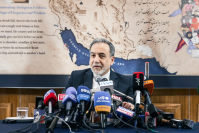
Iran's Foreign Minister, Abbas Araghchi, arrived in Oman this Saturday (11) to discuss measures to guarantee the safe passage of vessels through the Strait of Hormuz, the semi-official Tasnim agency reported.
Araghchi's visit is "part of ongoing bilateral consultations between Iran and Oman on regional developments, especially the issue of the Strait of Hormuz," according to a statement from Esmaeil Baghaei, spokeswoman for Iran's Foreign Ministry.
According to Baghaei, the foreign ministers "will discuss and exchange views on the establishment of appropriate mechanisms to ensure the safe passage of ships through the Strait of Hormuz."
The visit takes place as interlocutors try to reactivate the diplomatic process, which lost momentum after the recent attacks between the United States and Iran.
Senior US government officials said Washington expects Tehran to issue a public statement in the coming days confirming that the Strait of Hormuz is open and that commercial vessels attempting to cross the waterway will not be attacked.
According to senior American officials, the United States demands that Iran publicly declare that it will stop attacks on ships in the strait and that all shipping routes will remain open, without charging fees, in the waterway that, before the war, was responsible for the passage of about a fifth of the oil consumed in the world.
During the conflict, Tehran largely assumed control of the strait, creating a stalemate in its confrontation with the United States Armed Forces.
At least 17 people were killed and 115 injured in US attacks carried out on Wednesday and Thursday against six Iranian cities, said the head of the Iranian Ministry of Health's public relations and information center.
Even so, American officials stated that talks between the two countries have been productive in recent days. Tehran declared that any violation of commitments made by Washington will be responded to with "reciprocal action", according to the Foreign Ministry spokesman, cited by state media.
The interim agreement reached last month was intended to pave the way for an end to the conflict, which is now entering its fifth month and has killed thousands of people, disrupted global energy supplies and raised fears of a slowdown in the global economy.
The resumption of clashes in the Gulf also raised costs for American consumers. After weeks of decline, oil prices posted their biggest weekly rise in eight weeks.
*with information from Reuters and CNN
Why is the Strait of Hormuz so important to the world economy?
Source: CNN