Trump praises Iran deal, but doubts - and risks - remain
Vessels in the Strait of Hormuz, seen from Musandam, Oman, on June 14, 2026
REUTERS/Stringer
The announcement of an agreement to end hostilities between the United States and Iran was something of a birthday present for Donald Trump - albeit one surrounded by considerable uncertainty.
In his social media post celebrating the agreement, the American president said that the Strait of Hormuz would be open to commercial navigation and that the US would lift its naval blockade.
"Let the oil flow!" Trump exclaimed on Sunday.
He said that, unlike the failures of previous American presidents, he secured a "grand bargain" that would bring "peace and security to the entire region."
Such hyperbole is nothing new for Trump, of course. His statements about last year's agreement that would have ended the war in Gaza - "a peace for all eternity" and "the beginning of the era of faith, hope and God" - were equally grand, even if the reality of the facts fell far short.
US and Iran reach peace deal, say Trump and Pakistani prime minister
In high-stakes diplomatic deals like this, success or failure often depends on the details. And so far, there are few details.
In an interview with Fox News on Sunday night, Vice President J.D. Vance said that Iran's commitment to never possess a nuclear weapon is "built into the deal" and that the US will have a way to verify its compliance.
Some of this will certainly be resolved in subsequent negotiations and "technical" talks conducted over a 60-day extension of the current ceasefire. But if one thing has become clear after decades of efforts to persuade and pressure Iran to abandon its nuclear ambitions, it is that there are no guarantees - regardless of what the US believes it has secured in this "memorandum of understanding." agreement will hold.
Energy market experts have warned that the flow of oil through the strait is unlikely to immediately return to pre-war levels. Clearing a massive tanker jam, removing mines and restoring transportation and regular oil production could take weeks.
With several days still before the official signing, Iran and the US have time to fine-tune key details to ensure the deal's success - but there is also time for it to fall apart.
Another unpredictable factor is Israel.
This has always been a three-party war, and Trump told the Wall Street Journal on Sunday that he was furious with Israeli Prime Minister Benjamin Netanyahu for ordering attacks in Lebanon this weekend that, according to him, could derail the almost concluded agreement with Iran.
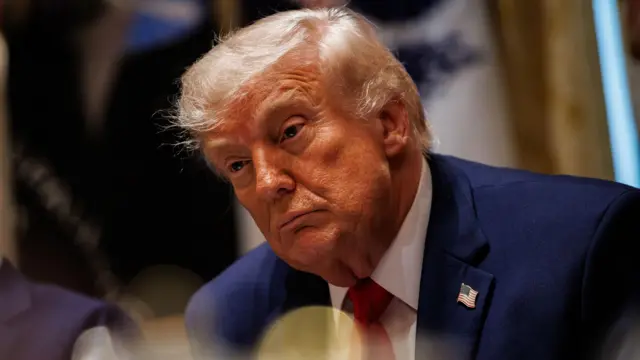
Donald Trump
EPA via BBC
The agreement held up - at least enough to be announced. But if Israel resumes military operations in Lebanon, Iran could again close the Strait of Hormuz, once again putting the global economy at risk.
In his comments, Vance also acknowledged the impact this war has had on many Americans because of higher energy prices and their knock-on economic effects.
"My main message to the American people is thank you," he said, as he promised that energy prices would begin to fall.
How quickly this occurs - and how quickly it will translate into lower costs for U.S. consumers, many of whom are facing financial hardships - will carry significant weight in determining whether growing political pressure on Republicans eases ahead of November's midterm elections.
According to recent polls, Trump and his party face an increasingly disaffected population.
A YouGov poll found that 63% of Americans disapprove of his handling of the economy, with 57% saying it is getting worse.
At the very least, however, Sunday's agreement should help alleviate, if not completely eliminate, some of the economic pressure caused by the conflict. If gasoline prices start to fall significantly, it could be a tangible sign to Americans that things are getting better.
This is a notable step toward the situation before the start of the war, even though Trump's broader goals have not been achieved so far and he continues to face domestic political risks.
We used artificial intelligence to translate this report, originally written in English. The text was reviewed by a BBC journalist before publication. Find out more here about how the BBC is using artificial intelligence (link to English text).
Source: G1