The 'silent war' between China and Panama for control of Canal ports
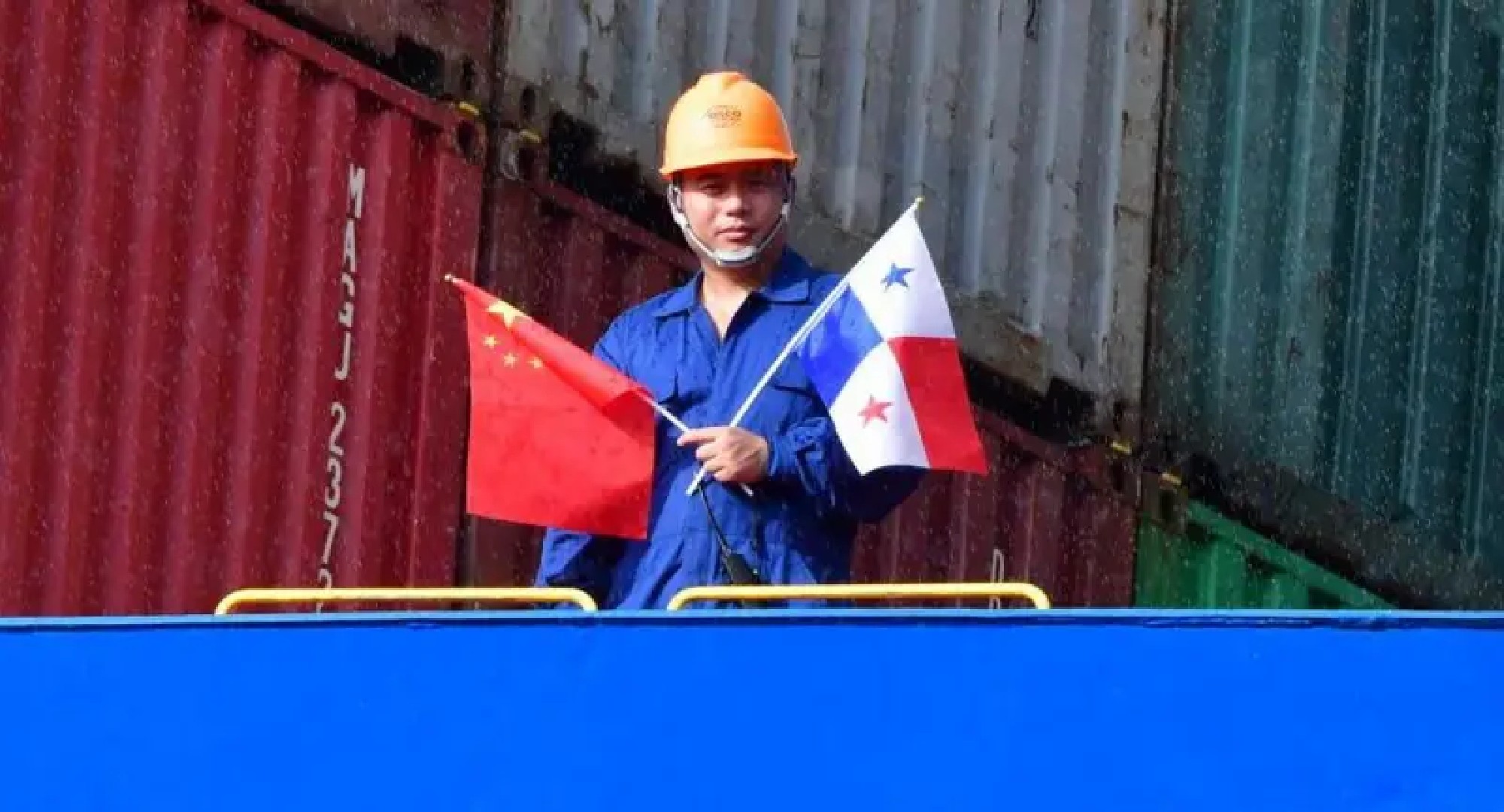
The 'silent war' between China and Panama for control of ports on the Canal
Getty Images via BBC
The story of the company CK Hutchison Holdings and Panama has turned into one of the biggest geopolitical conflicts linked to the Panama Canal in recent years.
The clash involves two superpowers, the United States and China, a waterway through which up to 6% of world trade passes and some of the most important port operators in the planet.
And the exclusion of this Hong Kong-based Chinese company from the administration of two ports provoked what appears to be a harsh punishment from Beijing, amid the growing dispute for influence between the United States and China in Latin America.
"Since March 8, 2026, and still today, China has been detaining Panamanian-flagged merchant ships at an unprecedented rate, justifying the measure as port state inspections," explains Ambrey Analytics, the intelligence division of the British maritime security company Ambrey.
In April alone, China detained 136 vessels registered under the Panamanian flag, a number 6.4 times higher than the 2025 average. In March, there were 96 ships, around 74% of all retentions carried out by China that month. Adding all the vessels immobilized since the beginning of the year, the total reaches 272.
"The retentions are justified by technical deficiencies and usually last between one and five days, but they interrupt stopovers and increase costs", explains the analysis company.
The situation coincides with a decision by the Supreme Court of Panama that removed from CK Hutchison the concession of two container terminals in the Panama Canal.
One of them is the port of Balboa, the second most movement of the country in volume of containers. The other is the port of Cristóbal. Both are in areas adjacent to the canal.
Due to their strategic location, at each end of the canal's entrances from the Pacific and Atlantic, these two ports aroused particular concern in the Trump administration, which made the issue a priority on its agenda shortly after assuming the White House.
American pressure reached its peak when Trump threatened the Panamanian government with forcibly regaining control of the canal - administered by the Central American country since 1999 - alleging Chinese interference.
Panama breaks agreement with the China
'An act of bad faith'
There is no public evidence that the Chinese government exercises any control over the canal.
However, Chinese companies have a significant presence in the region and, over the years, have made significant investments in the waterway and its infrastructure.
Panama's president, José Raúl Mulino, has repeatedly stated that there is "absolutely no Chinese interference" in the canal.
But, at the end of January, the Panamanian Supreme Court declared unconstitutional the 1997 concession - and its renewal in 2021 - that allowed the Panama Ports Company, a subsidiary of CK Hutchison, operate the terminals.
The authorities in China and Hong Kong expressed opposition to the decision and classified it as an "act of bad faith".
CK Hutchison, which managed the ports for almost 30 years, accused the Panamanian authorities of illegally confiscating its assets and initiated an international arbitration against the country, claiming compensation in excess of US$2 billion for losses and damages.
Beijing argues that the Panamanian court's decision was motivated by pressure from the United States rather than an independent judicial process.
Meanwhile, Panama's National Port Authority has taken control of both ports, and Chinese reprisals have begun on the other side of the world.
The punishment of Panamanian ships arriving at Chinese ports is the latest stage in an escalation of tensions between China and the United States, intensified by disputes over strategic port infrastructure and control of key trade routes.
"Through these With the mass detentions of Panamanian-flagged ships, Beijing is sending a direct and practical message: decisions that affect the interests of Chinese or Hong Kong-linked companies will have a tangible and immediate cost," Alicia García-Herrero, chief Asia-Pacific economist at investment bank Natixis and senior researcher at the European think tank Bruegel, told BBC News Mundo.
A clear message
For García-Herrero, the detentions will far beyond port bureaucracy.
They represent a form of asymmetric economic pressure designed to generate delays, costs and real disruption to maritime trade.
"The objective is to dissuade other countries from adopting similar measures and to remember that Beijing reacts when it considers that its 'legitimate rights' have been violated," he says.
Construction of the canal was completed in 1914 and it remained under United States control until 1977
Getty Images via BBC
Evan Ellis, professor and researcher of Latin American studies at the The United States Army War College's Institute for Strategic Studies agrees.
"It seems quite clear that the Chinese harassment of Panamanian-flagged ships is part of a broader message that China is sending to the government of Panama, as well as other governments, about the price of not cooperating with Beijing or adopting measures that harm its companies," he says.
"China's actions in this specific case seem a little more explicit and comprehensive than what we have seen in responses to actions by other governments," the analyst.
The increase in retentions is part of a broader Chinese response, which also includes the suspension of COSCO container services in Balboa, the summoning of executives from Maersk and MSC - the world's two largest shipping companies - to meetings in Beijing, and the halting of new Chinese investments in Panama.
"There are documented attempts to pressure Maersk and Mediterranean Shipping Company into not accepting contracts awarded for temporary operations of the ports that are being removed from Hutchison", says Ellis.
BBC News Mundo contacted the State Council of the People's Republic of China and the Chinese embassy in London to find out their position on the issue, but had not received a response until the publication of this report.
Offensive on several fronts
The reason for this Chinese offensive on several fronts is that the Panama Canal represents a critical point in the Asian giant's maritime strategy, connecting two oceans and serving as a privileged gateway to Latin America.
"The Balboa and Cristóbal terminals were important parts of the global network of ports that Beijing built to guarantee supply routes, reduce dependence on points controlled by third parties and expand its commercial influence in the Western Hemisphere", explains García-Herrero.
For this reason, losing operational control of these terminals represents a setback for its logistical capacity and economic projection in an area that Washington has historically considered part of its sphere of influence.
Shengyu Wang, assistant researcher at the Center for Analysis of China by the Asian Society Policy Institute, which spoke to the BBC, recalls that Chinese business interests and the Chinese state do not always act as a single actor.
For this reason, he believes that Chinese reprisals could also target CK Hutchison Holdings itself.
In March 2025, the company announced an agreement to sell the majority of its global port business - including the ports of Balboa and Cristóbal, in Panama - to a consortium led by BlackRock and MSC for around US$20 billion, something that may have displeased Beijing.
"A attempt to sell these port assets may have created a problem for the Chinese government.
In Beijing's view, the fact that a company linked to China sells strategic port assets without consulting the authorities could be interpreted as a challenge to the State", says the analyst.
The Panama Canal is important for China because it represents a strategic point in world trade
Getty Images via BBC
Disciplining companies
The initial reaction may not only target Panama or the United States.
"It could also reflect Beijing's effort to discipline companies linked to China and demonstrate that strategic infrastructure agreements cannot be undone in a way that harms the Chinese State", he adds.
The ship retentions have also provoked strong dissatisfaction in the United States, as Panamanian-flagged vessels transport a significant portion of American containerized cargo. a mass shift of vessel registrations out of Panama has occurred.
Most merchant ships flying the Panamanian flag are owned by foreign shipowners seeking to avoid stricter maritime regulations imposed by their own countries.
Panama operates a system known as open registration. Its flag offers advantages such as simpler registration processes - often done online - and the ability to hire cheaper foreign labor.
However, Ambrey Analytics says Chinese marine leasing companies are demanding that they do so. shipowners transfer their registrations to other countries, ceasing to use the Panamanian flag, as a condition to finance the construction of new ships. This could have long-term impacts on the Panamanian naval registry.
Other punishments from China to Latin America
"All of this fits into a broader pattern of discreet Chinese coercion that has been developing for years and that is possibly even more aggressive than the pressure normally exerted by the United States," says Ellis.
The analyst argues that China tends to prefer indirect mechanisms of control. pressure rather than formal trade sanctions.
As an example, he cites the suspension of purchases of soybean oil from Argentina following anti-dumping actions brought against Chinese companies by the Argentine Congress in 2010.
"Or the threats against Guyana when its government considered allowing Taiwan to open a trade representative office in the South American country in 2020, as well as the suspension of purchases of nuts and other products from Guatemala when President-elect Bernardo Arévalo declared that intended to maintain cooperation with Taiwan", he recalls.
Chilean cherries and grapes also experience this type of pressure.
China alleged phytosanitary problems to stop imports of these products, in "a subtle reminder of China's power to stop purchasing strategic products", concludes Ellis.
Source: G1