The 'most expensive and most politicized' World Cup: 4 important points about the 2026 World Cup
Mexico beats South Africa and opens the World Cup with victory at Azteca
"Simply, the greatest event humanity has ever seen."
This is how FIFA president Gianni Infantino described the FIFA Men's Football World Cup that began on Thursday (11) in the United States, Mexico and Canada.
✅ Follow the g1 international news channel on WhatsApp
The organization's top manager described this first World Cup played in three countries, with 48 teams and 104 matches, as the most inclusive, welcoming and unifying edition of the tournament ever promoted to date.
But many other people would use different adjectives.
This could be, for example, the most politicized edition, the most expensive, possibly the hottest or the most polluting. And, without a doubt, the most profitable for FIFA.
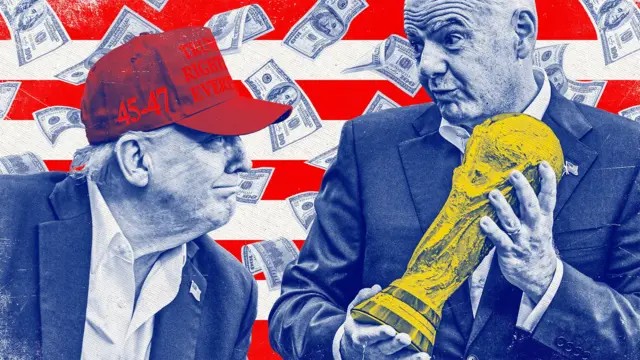
Montage shows Donald Trump and Gianni Infantino
BBC
Whatever the point of view, what seems certain is that, in addition to the spectacle on the field, this gigantic World Cup could become one of the most controversial in history.
From the controversy over the costs for fans and the impacts of geopolitics and migration policies to issues of security, extreme weather conditions, sustainability and the role of the president American, Donald Trump, the mega-tournament has caused unrest and enthusiasm in equal measure.
But what are the biggest problems? How did we get here? And what's at stake, beyond the champion's trophy?
While all eyes in the football world turn to Mexico City for the opening game of the World Cup, the host countries offer a clear picture of what will make the coming weeks so fascinating and, at the same time, so challenging.
The legendary Azteca Stadium, a landmark in world football, makes history as the first to host the opening of three different World Cups.
Estadio Azteca, in Mexico City, where it took place the first of three opening parties for the 2026 World Cup
REUTERS/Kai Pfaffenbach
Expectations are immense. But, just like in its northern neighbor - the United States, which will host around 75% of the matches -, the high ticket prices cause outrage.
Mexico also has security concerns, as the country has suffered a lot from the violence of the big cartels.
In the Mexican capital, protesters tore down statues of players related to the World Cup. And groups of teachers, demanding better salaries, threaten to jeopardize the matches if their demands are not met.
In Tijuana, in the west of the country, the presence of the Iranian team is the greatest example of the complex political tensions affecting the competition.
The BBC details below the main points that make this World Cup one of the most controversial in history.
1. United States and Iran
Trump government announced that the Iranian national team will be able to enter American territory just 36 hours before each match
In addition to its enormous magnitude, the 2026 World Cup is unprecedented in several other aspects.
Never before in the history of World Cups, for example, has a host country been at war with a participating nation.
Last month, FIFA confirmed the transfer of the Iranian national team's base of operations from the United States to Mexico.
This is yet another consequence of the military campaign that began in February, when the United States and Israel attacked Iran, triggering reprisals throughout the Middle East.
Despite the ceasefire established in early April, attacks between the parties involved continue to this day.
In recent months, Iran's participation in the World Cup has been surrounded by uncertainty.
Trump even warned that it would not be "appropriate" for the team to participate, "for his own life and security."
His special envoy to the region even suggested replacing Iran with four-time world champion Italy, which failed to qualify for the World Cup.
Now, apparently, Iran will participate in its fourth consecutive World Cup, even though the country has accused the United States of denying entry visas to some of its managers and members of the coaching staff.
A government official stated that the players were instructed to enter and leave the United States on the same day as each of the three group stage games.
Na Tuesday (9), the Iranian Football Federation announced that the ticket allocation for its fans in the group stage has been revoked. For the entity, the decision "raises serious questions about the interference of non-sporting and political considerations in the organization of the biggest football event in the world."
FIFA declared that it is working to "maximize opportunities for Iranian fans to watch the matches."
But, considering that, apparently, it will be prohibited to display the flag of Iran prior to the Islamic Revolution in the tournament venues, the Iranian team's games will be fraught with political tensions - especially the first two, which will be played in Los Angeles, where resides a large Iranian community.
2. Entry restrictions to the USA
Why are fans from Iran and Haiti banned from entering the USA for the World Cup?
Already in 2017, during Donald Trump's first term, Infantino had indicated that banning citizens from several Muslim-majority countries from entering the United States would be incompatible with the World Cup regulations and could frustrate the country's aspirations to host the 2026 edition.
"Evidently, in relation to FIFA competitions, any team that qualifies for the World Cup you need to have access to the country, including its fans and leaders", warned Infantino. "Otherwise, there will be no World Cup."
But the immigration policies implemented by Trump during his second term will lead fans from four participating countries to face total or partial travel bans: Iran, Haiti, Senegal and Ivory Coast.
The White House credits the taking of this measure to the need to manage security threats.
An analysis carried out by the BBC revealed that fans from more than 25% of the 48 countries participating in the World Cup face travel bans, restrictions more strict or high visa denial rates.
Last month, exceptions were granted to visitors from five countries participating in the World Cup: Algeria, Senegal, Ivory Coast, Cape Verde and Tunisia. They were released from the obligation to deposit a deposit of up to US$15,000 (around R$77,000) to obtain a visa to enter the United States.
Last weekend, the International Sports Press Association denounced "a persistent and unacceptable problem for us journalists: the denial of entry visas to duly accredited colleagues."
In addition, on Monday (8/6), FIFA announced the exclusion of referee Omar Artan from the collegiate list, having been denied entry into the United States.
He would be the first referee from Somalia to officiate games in the final phase of the World Cup.
American immigration authorities did not provide explanations, but Somalia is on the list of countries affected by travel restrictions under the Donald Trump administration.
"This is a tournament in which the players, fans and officials are not free from risk, if they are even able to enter", says former captain of the Australian team Craig Foster, current human rights defender.
He denounced that, "for a sport that has been advocating for a decade its commitment to its own human rights policy, this is simply shameful."
"This should put to rest once and for all the idea, still widespread around the world, that there is a separation between politics and sport", continues Foster.
"Unlike any other sporting tournament we can remember in modern times, this is a deeply politicized World Cup."
Since his election as FIFA president in 2016, Infantino has regularly approached the leaders of the countries hosting his events.
But the controversial awarding of the FIFA Peace Prize to Donald Trump, during the World Cup draw last year, highlighted his close relations with the American president.
Since then, the United States has carried out military actions in Venezuela, Nigeria and Iran. And Trump has been hinting at the possibility of new operations in Greenland, Mexico and Colombia, which is also competing in the 2026 World Cup.
Tensions have also arisen between the three hosts, on topics related to trade, immigration and the fight against drug trafficking.
Last week, the American president once again referred to Canada as America's "51st State". But there is also hope that the tournament will bring an opportunity for diplomacy.
Completing the picture, the United States will celebrate 250 years of its independence in 2026. Trump is expected to occupy a central place in the tournament, as occurred in last year's Club World Cup final and in the World Cup draw in December.
Following accusations against Russia and Qatar for using the last two World Cups to improve their image, the organization Human Rights Watch claims that this year's event will be a "festival of sportswashing", the washing of image through sport.
Amnesty International also warned that the tournament runs the risk of becoming a "stage for repression."
The organization highlights the "abusive, discriminatory and lethal practices of immigration control and mass detentions in the United States" and also warns of "significant risks" for spectators.
Much of the criticism focuses on the United States Immigration and Customs Enforcement (ICE), which is part of the event's overall security apparatus.
Earlier this year, ICE agents shot and killed two American citizens during a immigration control operation in Minneapolis.
In response to criticism, the White House World Cup working group promised that the tournament will be "the safest and most welcoming sporting event in history." And he also said he is working to offer a championship "that highlights America's hospitality, commitment to safety and spirit of excellence."
3. The price controversy
World Cup matches will be played in 16 cities in the United States, Mexico and Canada
Getty Images via BBC
FIFA awarded the 2026 World Cup to the United States, Mexico and Canada eight years ago. At the time, the organization was trying to recover from the existential corruption scandal raised by the huge controversy surrounding the votes held in 2010, which elected Russia and Qatar as hosts for the 2018 and 2022 World Cups, respectively.
With both countries being forced to deny accusations of bribery, the World Cup in North America must have seemed like a much less risky option, as the stadium infrastructure in the three countries was already ready.
The other big attraction was financial.
Driven by multi-billion-dollar broadcast rights and sponsorship deals, the expanded tournament will be the most lucrative event in the history of sport - and will take place in the world's most commercialized sports market.
Forecasts indicate that FIFA will generate record revenue of US$9 billion (about R$46 billion) this year alone.
All this money will allow the redistribution of US$2.7 billion (about R$14 billion) between national football associations over the next four years. This amount will contribute to the global development of the sport and increase the likelihood of Infantino's third re-election as FIFA president, in 2027.
But the controversy over the origin of much of this money left major marks on the preparations for the World Cup.
In 2018, those responsible for the triple candidacy stated that tickets for the final would cost, at most, US$1,550 (around R$8,000). But when tickets went on sale in December to members of each country's official fans' clubs, the most expensive ticket cost US$8,680 (about R$45,000).
An important group of fans called the costs a "monumental betrayal." FIFA responded by announcing a limited quantity of tickets priced at US$600 (around R$3,100).
But the pricing strategy generated strong rejection, combined with the implementation, for the first time in a World Cup, of "dynamic rates", with prices varying according to demand at the time of purchase.
There was fear that many of the most loyal and passionate fans would be excluded from the tournament, due to the high costs.
On the official resale platform, the prices were massively inflated, with FIFA retaining a 30% commission on each ticket sold.
Last month, authorities in New York and New Jersey officially launched an investigation, in the face of accusations that FIFA was "artificially inflating prices" and "misleading fans" during ticket sales.
FIFA highlighted the purchasing power of American consumers and strong demand. The organization stated that more than five million tickets had been sold and that tickets were sold out.
But BBC Sport found that there were thousands of tickets available for games involving less popular teams, at prices well below their nominal value, both on FIFA's official resale website and on the secondary market.
The organization was also accused of transferring stock to the SeatGeek platform that could not be sold in other ways.
Other costs also caused discomfort.
Train tickets from the center from New York to MetLife Stadium in New Jersey, host of the World Cup final, they normally cost US$12.90 (about R$66). But the price shot up to US$150 (R$771), and was later reduced to US$98 (around R$504).
The governor of the State of New Jersey held FIFA responsible for the increase, for refusing to subsidize transport costs.
Fans' discontent increased even more last week, when FIFA announced that, for security reasons, access to the stadiums with bottled water will not be allowed. reusable. Many attributed this last-minute decision to commercial interests.
Researchers indicate that temperatures in 14 of the 16 World Cup venues will reach dangerous levels during the tournament. Therefore, fears arose that the ban on water bottles could put spectators' health at risk.
Faced with strong criticism from fan groups and politicians, FIFA backed down and ended up allowing entry with sealed disposable water bottles.
The first World Cup held in the United States, 32 years ago, contributed to popularizing the sport among the country's public.
The 1994 World Cup boosted football in the United States United
Getty Images via BBC
Now, with a consolidated national league and American investments spread across European football, the expectation is that a new important step will be taken.
"In 1994, the football market in the United States was beginning.
Today, we have thriving professional leagues and some of the best stadiums in the world", J.T. Batson, executive director of the American Football Federation (US Soccer), told BBC Sport. in almost all host cities, which reinforces the perception that record costs, combined with the political context, acted as a deterrent.
"There will be a lot of people who won't be able to attend due to the prices", the leader of the Football Supporters' Association of England, Thomas Concannon, told the BBC. Jersey.
"These numbers are a bit disappointing, considering the expectations that were generated", laments Concannon. "We expected a bigger audience."
4. The environmental damage
FIFA has committed to reducing its carbon emissions by 50% by 2030, reaching zero emissions in 2040.
Holding all matches of this World Cup in existing stadiums helps with this objective. 80% to 90% of their carbon footprint.
Ecologists say this will be the "most climate-damaging" event in World Cup history. and Canada expressed their desire to "set new standards of environmental sustainability in sport."
Six matches of last year's Club World Cup were delayed due to extreme weather conditions
Getty Images via BBC
Just weeks ago, a group of world-renowned scientists warned FIFA that its current heat safety measures during the World Cup are "insufficient" and could put players at risk of serious harm.
FIFA said it was "committed to protecting the health and safety of players, referees, fans, volunteers and staff" and ensuring that all weather-related risks are being assessed.
But the effects of extreme weather conditions must undergo intense evaluation.
They include the long delays that could occur if matches were interrupted by storms.
An example was Saudi Arabia's warm-up game against Puerto Rico, played in Texas on June 6, which was stopped for almost two hours.
Questions will also arise about the possibility that FIFA is contributing to this problem.
As if all this were not enough, authorities must also address the growing concerns caused by the Ebola outbreak in the Democratic Republic of Congo.
Qualified for the World Cup, the country's national team will play in the group stage in Houston and Atlanta, in the United States, in addition to Guadalajara, Mexico.
A spokesperson for the US State Department confirmed that the United States is coordinating a strategy "to protect our citizens, including the millions of visitors, fans, athletes and tourists expected during the FIFA World Cup."
In May, Infantino expressed his enthusiasm about the economic potential of football in the United States.
He highlighted that the American market represents only 3% of the global sports GDP, which represents a huge growth opportunity for investors, valued at trillions of dollars.
The next few weeks will determine whether this sporting and commercial phenomenon will finally be able to triumph in the United States, or if the tournament itself risks being tarnished by the high costs and political issues involved.
Everything is ready to make the biggest football stars on the planet shine. But the event could also reveal the extent to which football and its fans are willing to support its expansion and excessive prices.
Source: G1