The flight of tragedy: the 146 deported by the USA on the day of the earthquakes who were left under the rubble in Venezuela
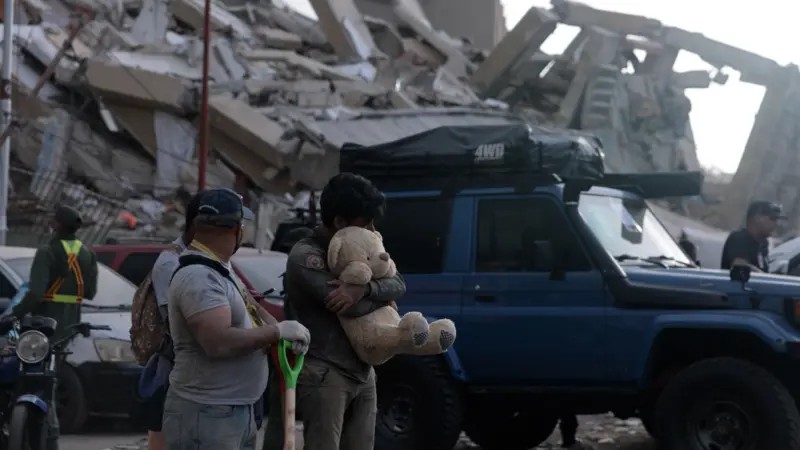
Teams try to rescue a man under rubble in a shopping mall parking lot in Venezuela
Orlando Torres owes his life to a missed phone call.
He is one of the passengers on the so-called flight 164, which took back to Venezuela 146 Venezuelan migrants deported by the United States on June 24 - just hours before the double earthquake that shook the South American country.
The two earthquakes left at least 2,000 people dead and tens of thousands of injured and missing people.
The repatriated migrants were received in Venezuela by the government program Mission Return to the Homeland. From the airport, they headed to the Hotel Santuário La Llanada, in La Guaira, capital of the Venezuelan state of Vargas, the most affected by the earthquakes.
The building where the deported migrants carried out a series of administrative, sanitary and security procedures collapsed during the double earthquake, leaving a tragic death toll and great uncertainty.
It was precisely one of these procedures that allowed Torres to save his life. He was one of the last passengers to leave the plane and arrive at the hotel, according to an audio provided by his family to BBC News Mundo, the BBC's Spanish-language service.
A few minutes before the earthquake, Torres was in a building attached to the main one to complete one last step: speaking on the phone with his brother, the person to whom he would be handed over by agents of the Bolivarian Intelligence Service (Sebin), the Venezuelan government body in charge of the process.
But Torres' brother did not answered the call. Therefore, his processing was delayed by a few minutes, which were vital to prevent him from being in the main four-story building, which housed most of the deportees and was reduced to rubble.
Flight 164 was one of the weekly deportation planes, which returned tens of thousands of Venezuelans to their country of origin, as part of the Donald Trump administration's migration offensive in the United States.
Like millions of other compatriots, many of the repatriates had emigrated to the United States in recent years, to escape Venezuela's economic collapse and persecution by the country's government, risking their lives on a dangerous journey.
Uncertainties
Relatives of migrants who were deported on flight 164, which arrived in Venezuela on the day of the two earthquakes (24/6), outside the buildings that collapsed in La Guaira
Nicole Kolster/BBC
Hours before the tragedy, the Mission Volta a Pátria announced, in a post on delivering toys to children.
The Venezuelan authorities did not offer a public assessment of what happened to these people. BBC News Mundo submitted requests for information to Maldonado and the Grande Missão Volta à Pátria, but there was no response until the publication of this report.
An initial informal count, based on testimonies from a group of survivors, indicates that only 12 people survived.
Later testimony from victims and family members suggests the number may be higher.
When asked by BBC News about the passengers on Flight 164, the United States Department of Homeland Security (DHS) provided only a brief statement, without further details.
"This flight arrived safely in Venezuela and all illegal aliens on board were returned to their country," a DHS spokesperson responded to the BBC on Tuesday (30/6).
"When a person is no longer in the custody of ICE, ICE is no longer responsible for her."
Saved by themselves
Torres is one of the few migrants deported that day who managed to emerge practically unharmed from the earthquakes.
The double earthquake threw him to the ground, but he managed to get back on his feet. He put a chair over his head and ran to the exit of the outbuilding.
That's when he saw the horror around him. The building in which he was staying that night and where almost all of his traveling companions were, as well as several public servants, had collapsed.
At that moment, the rescue process began, according to testimonies collected by BBC News Mundo. Several survivors say they had to save themselves, with the help of other deported migrants.
This was the case of Pedro (fictitious name). He had taken a shower and was lying in his room, when he heard a crash coming from far away and realized that everything was shaking.
Alongside the others, he tried to run towards the stairs when, suddenly, something fell on top of him.
"I was left with one leg stretched out and the other knee against my chest, my head against the floor and, on my back, a terrible weight that hurt me a lot", he tells the BBC.
"Many of us were huddled together. We were screaming. It was dark, We felt the dust entering our noses when we breathed. It was a very difficult moment."
"The boys around me, all crushed, said 'I can't feel my legs', 'my head hurts' and I started to pray, trying to calm them down", continues Pedro.
He says that he stayed there for a long time, until he discovered that some of the deported migrants who had managed to get out were trying to rescue them. And, at one point, he felt part of the weight on his back being released.
"I was able to move my leg, I thought it was broken," he says. "I took it to the side and stretched it."
"I put myself in a straight position, face down, and I crawled until I reached a place where I saw an exit to the top. The boys came and took me out."
Ninoska Gutiérrez had a similar experience.
When the earthquake started, she left the room where she was with just over 10 women to try to escape. But she fell to the ground amid the chaos and, with the ceiling and a wall collapsing, her legs were trapped.
"I was in a state of shock," recalls Gutiérrez. "We came from so far, after going through so many things, being trapped for months, waiting for the much-desired deportation plane, to arrive in our country and find a misfortune like this." move your legs, continues Gutiérrez. She then managed to reach an opening in the ceiling that collapsed and one of the surviving deportees helped her get out.
"There, those who managed to get out, got out by their own means, by ourselves, by our will to survive, not because the firefighters arrived, the civil defense, or with their [Sebin's] help. No, at least while I was there", she reports.
"We rescued ourselves", confirms José Navas.
He says he was left under the rubble of the building on the third floor.
Navas explains that, beside him, there were 10 other men alive and conscious after the earthquake. They received help from another man, while they dug a hole big enough to leave the place.
This complaint of lack of assistance from the authorities is a constant in the reports of survivors and their families, as well as the loved ones of the victims who remain missing.
"Initially, they didn't react", commented a witness. "There was no Sebin employee removing rubble, nothing. They were in shock."
Other testimonies received by BBC News Mundo indicate that, after the earthquake, the Sebin agents present focused on rescuing other agents.
"The police officers who were there on guard fought for their comrades", comments another survivor. "Afterwards, the firefighters only came to take people away, not to rescue or remove anyone from the rubble."
The BBC was unable to confirm this information.
Several testimonies indicate that the first external help received at the hotel was a small group of firefighters who arrived at the scene after 11 pm on June 24 (about five hours after the earthquake).
According to these same reports, they initially transported the injured and later, around three in the morning, began helping to lift rubble and remove people, some injured and others dead.
Relatives say that, to their frustration, when daylight broke on June 25, Sebin employees had already closed access to the hotel.
'Waiting to take him in a coffin'
José Rincón shows on his cell phone screen the photo of his grandson Abelardo Rincón, who was returning from the United States, deported on the flight 164
Nicole Kolster/BBC
On the same afternoon as the earthquake, family members began asking on social media about the fate of the deported migrants, visiting hospitals and morgues to try to locate them.
On Monday, in La Guaira, José Rincón carried a photo of his grandson Abelardo Rincón, aged 23, on his cell phone. He was desperate looking for him, dead or alive.
"I went to recognize more than 200 bodies", he told BBC News Mundo. "I checked them one by one, to see if I could find it, and nothing."
Rincón approached, like others who were looking for his own, to the La Llanada Sanctuary Hotel. But he says that they wouldn't let them pass and that Sebin had locked the access.
He remembers that the employees told him that, in the hotel, "there is no life".
"I've been here for days and the problem is that they don't let us pass", says Rincón.
"If we could see what we want to see... If I saw the rubble, I would stay quiet, but I haven't been able to [see my grandson] for days, neither alive nor dead. So, what am I going to do? do?"
Abelardo, his grandson, had lived for six years in Atlanta, the capital of the American state of Georgia. There, he got married and his wife lives there, who is expecting a girl.
"I'm waiting until the last moment to take him in a coffin, however I can, but take something", laments Rincón.
Paola Chacón is the cousin of Darwin Eliécer Serrano López, 35 years old. He also returned to Venezuela on flight 164, after living in the United States for four years.
On Monday (29/6), she was resigned to López's death. And she declared that her fight was for the delivery of the body.
"We are going to stay here until we take the bodies of our family members," Chacón told the BBC.
"Darwin made a call to my brother in San Cristóbal [in the state of Táchira, in western Venezuela] at 5:32 in the afternoon and, at that moment, we found out that he was here," she recalls. "The tragedy happened, we came to look for them. We drove all night."
"We want to bury our family members. Please help us! The state of decomposition is severe.
We want them to be handed over to us, to recognize them and be sure that, yes, they are our family."
Photo of Darwin, one of the migrants deported from flight 164
Nicole Kolster/BBC
The sad joy of returning
When flight 164 (an Airbus A320 from the transport company Global X) began to approach Maiquetía airport, an uproar took over the aircraft.
Even Handcuffed and tied at the feet and waist, the deported migrants began to express their joy at returning home, according to those interviewed by BBC News Mundo.
"People applauded, there was a lot of joy", recalls Pedro. "You know how we are, Venezuelans."
"I told the boys: 'Our American dream has not come true, but we are going to move forward.'"
Navas' feelings were a little more moderate.
"We came with our hearts tight. If you ask me if I wanted to return, for me, it wasn't the time yet", he laments.
"What happens is that we are detained in the United States for so long that we start to assimilate and say: 'Well, I'm going to see my family, my mother, my children, my wife, my sister.'"
"You assimilate and your heart rejoices. Therefore, we were already satisfied. We wanted them to take off the handcuffs and enter our country", he comments.
Once at the hotel, Navas remembers that the deportees gathered in a room.
"Each one told a story. 'I want to go to a beach', said one. 'The beaches in Venezuela are not cold and those in the United States are freezing', commented another."
This atmosphere of joy and camaraderie was also present in the women's room, where Ninoska Gutérrez stayed.
"We were happy because we had arrived in our country", she says. "We started telling stories, our experiences, how we were detained in the United States."
Uncertainty and questions
Isolated from the world in a hotel Nestled on a hill in La Guaira, without their cell phones, the migrants deported from Flight 164 were unable to know the magnitude of the tragedy they were experiencing, nor that it was shared by a large part of Venezuelans.
In their testimonies and in the reports of their families, many lament the "late and indifferent" reaction of the authorities.
But their story is also full of gestures of solidarity between people who, in most cases, did not know each other and did not even know their names from each other.
Driven by the very Venezuelan custom of calling people by a nickname referring to their origin, physiognomy or behavior, they were baptized as el gocho (from the Venezuelan Andes), el llanero (from the plains of the Orinoco River) or el viejo (due to their advanced age).
During the tragedy, one of them also received the nickname Superman, for having supposedly jumped out of a window at the time of the earthquakes.
Reports say that he not only saved himself, but also helped rescue those who were trapped and even got a motorcycle to go to the Sebin headquarters, in Maiquetía, to ask for help.
His family members carried out parallel work on social media.
United by the desolation, they exchanged information and created a group that had more than 500 members, sharing clues to try to find their loved ones.
On the same afternoon of the tragedy, the families of the deported migrants began asking for information in the comments section of the same post in which the Mission Volta à Pátria had announced the arrival of flight 164. And it is exactly there that, now, the family members are demanding justice.
"I demand justice for the death of each one of them", wrote the cousin of one of the dead deported migrants.
"If the flight arrived in the morning, they needed to let them go with their families. If that had been the case, none of this would be happening."
"Now, we are grieving the death of our family member, without seeing him for three years, until they brought him here to die."
Source: G1