The doctor who had his image cloned by AI to sell miracle cures on YouTube: 'They could be causing fatal harm to the elderly'
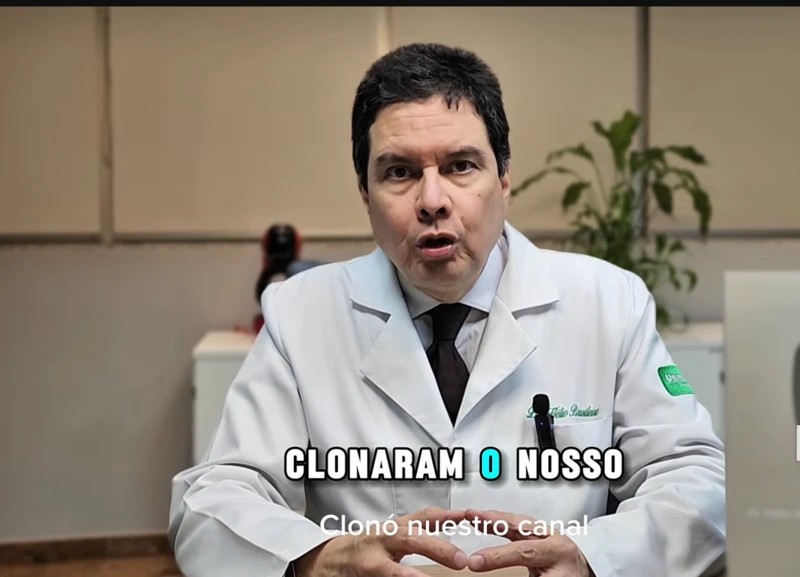
Doctor Hélio Brasileiro complains on his channel about clones using his image; BBC News Brasil mapped at least five pages of this type
Reproduction
ENT doctor Hélio Brasileiro had his image and identity cloned by artificial intelligence.
At least five channels on YouTube used his image, without his authorization, to disseminate content about health in an alarmist tone, with the aim of engaging the audience, especially among the elderly.
Join the g1 Sorocaba e Jundiaí channel on WhatsApp
The practice can be classified, according to the police and experts interviewed by the report, in the crimes of ideological falsehood, false identity and illegal practice of medicine, in addition to cybercrimes and crimes against honor.
BBC News Brasil identified that these videos are part of a network of channels on the platform, which also copy the image of other real doctors, with the aim of monetizing them with views on YouTube.
Now on g1
The channels that cloned the Brazilian identity associate, for example, hot baths with heart problems ("the hidden danger of hot baths in winter that overloads your heart") and recommend "natural" treatments that would replace medicines recommended by health professionals.
Together, these pages have hundreds of thousands of followers.
BBC News Brasil identified evidence that the channels may be being operated by the same person or group. The pages were created in the same period and share identical titles and even scripts.
The Dr. Hélio - Medical Information page shared, for example, on May 22, a video about "four cheeses that can destroy your health after the age of 60".
The following day, another channel, Dr. André Tavares, published the same content.
Two days later, another channel, Dr. Helio Consejos de Salud, continues with the same title. The flow is repeated at least until June 8th, with videos of the same content on the channels of Dr. Aline Vitta and Dr. Hélio Saúde em Foco.
This reuse of content is constant and appears on other topics, spread across at least 20 different channels mapped by the report.
A survey by the non-profit organization CTRL+Z mapped that channels of this type, which use AI to talk about health, total more than 70 million views.
A report from BBC News Brasil showed how these channels operate, and Google removed part of these pages after publication.
Hélio Brasileiro's clones, however, who are part of the survey, remained on the air even after the alert to the company.
'I reported several videos from a channel. Then I saw that there are countless others'
In addition to being a doctor, Hélio Brasileiro is also a YouTuber. His channel has 270 thousand subscribers and almost 700 videos.
The first publications, from 14 years ago, aimed, he says, to disseminate information about sleep medicine to other doctors.
Then, during the pandemic, he decided to reactivate the channel to dispel lies about vaccines and healthcare. "See what an irony of fate: I reactivated the channel with a slogan: medical information without fake."
He was surprised to see his image in a BBC News Brasil report about fake doctors generated by AI. "I reported several videos from just one channel. Then I saw, in a conversation with you [BBC News Brasil reporter], that there are countless others."
After the BBC article, he says that he made a new complaint to YouTube and that he also registered an online police report with the São Paulo Civil Police.
The case was forwarded to the 3rd DP of Sorocaba, where it is being investigated for ideological falsehood, false identity, false alarm and attempted defamation.
The responsible delegate, Alessandra Silveira, stated in her order that "the fraudulent scheme gained international repercussions", causing damage to the Brazilian reputation and "risk of poisoning or self-medication to the population".
"The seriousness of the dissemination of medical misinformation through biometric simulation requires the immediate action of the Judiciary Police", stated the delegate.
In a note to the BBC, the São Paulo Public Security Secretariat reported that steps are being taken to identify the perpetrators of the crimes and hold them accountable.
The doctor says that he received guidance from YouTube to register his image on the platform, which would facilitate the reporting and removal of content that uses his identity in a
YouTube stated, in a note to BBC News Brasil, that all content on the platform, including that generated with AI tools, must follow community guidelines.
"This covers our policies on medical misinformation, which prohibit incorrect information regarding prevention and treatments capable of demonstrably causing serious harm in the real world."
The company said it added labels to AI-generated content to ensure that viewers are informed about what they are watching.
"When we identify violative material on YouTube, we apply appropriate measures in accordance with our Terms of Service, the rules of the YouTube Partner Program and our Community Guidelines."
The company did not respond to questions from BBC News Brasil about the misuse of the image of doctor Hélio Brasileiro.
Network that copies the image of doctor Hélio Brasileiro uses identical titles and even the same script
Reproduction/Youtube
'Who creates this lacks empathy'
Brazilian said that his biggest concern is the harm that the videos can cause to those who watch them: they discourage medical monitoring and suggest ineffective miracle recipes, at the same time that they use his authority as a doctor to convey credibility. says.
"Imagine that you are hypertensive and have been using a medication for a long time. A video appears with my image saying: 'if you, an elderly person, are hypertensive and take this medication, you don't know the harm it is doing to your kidneys - it is much healthier to drink passion fruit juice'", he exemplifies.
"And then you see comments from elderly people saying: 'My God, I have been taking this medication for a long time, why didn't the doctor inform me? I'm going to stop take the medicine and start drinking the passion fruit juice'."
His biggest wish, he says, is that the channels are taken down and that this type of fraud becomes public knowledge, "so as not to cause harm to users".
"I'm not a police investigator, I have no intention of punishing - this is for the Judiciary, for the police, my role, as a doctor, is to inform and make it clear that this misinformation is dangerous. That these channels are closed and do not appear. new ones, so as not to harm the health of the population."
He also calls for this type of video to stop being produced: "Whoever creates this has no empathy. Anyone who seeks to make money in this way could be causing fatal harm to the elderly and other people who follow this information. And it could be the father, mother or even the son of those who created the channel."
The practice could be considered a crime, experts say
Experts interviewed by BBC News Brasil warn that this type of content could pose a health risk to the public. discourage proven treatments or encourage conduct without a scientific basis.
"People's health is something individual. A medication or advice can be beneficial to one person and harmful to another, depending on comorbidities and interactions with other medications.
We see this as a great risk", says the vice-president of the Federal Council of Medicine (CFM), Jeancarlo Cavalcante.
According to him, the danger is even greater for the elderly, who may fail to seek adequate medical care, as shown by reports published by people in this age group in the comments of the videos analyzed by the report.
Cavalcante adds that the Council can forward complaints about this type of content to the Public Ministry and the police authorities.
In the assessment of Thiago Bottino, professor at FGV Law Rio, the simple publication of this type of video does not constitute a crime. The situation changes, however, when the fake doctor begins to perform functions exclusive to the profession.
"The problem is when someone who is not a doctor, be it a real person or artificial intelligence, acts as a doctor, prescribing medication, saying what the appropriate treatment would be. It is a case of irregular practice of medicine, which is a crime provided for in the Penal Code."
Bottino also states that those responsible for the videos may be liable for the crime of false identity by presenting themselves as doctors without informing that they are characters generated by artificial intelligence.
Filipe Medon, professor at FGV Direito Rio and deputy coordinator of the AI Hub, states that the problem is not in producing content about medicine based on scientific research, but in creating artificial intelligence characters that pretend to be doctors and induce the public to error.
According to him, in addition to the creators, platforms can also be held civilly liable if they do not remove this type of content after being notified and, in cases of paid promotion, the obligation to remove it may exist even without prior notification.
Source: G1