The day Guimarães Rosa escaped death because he went out to buy cigarettes
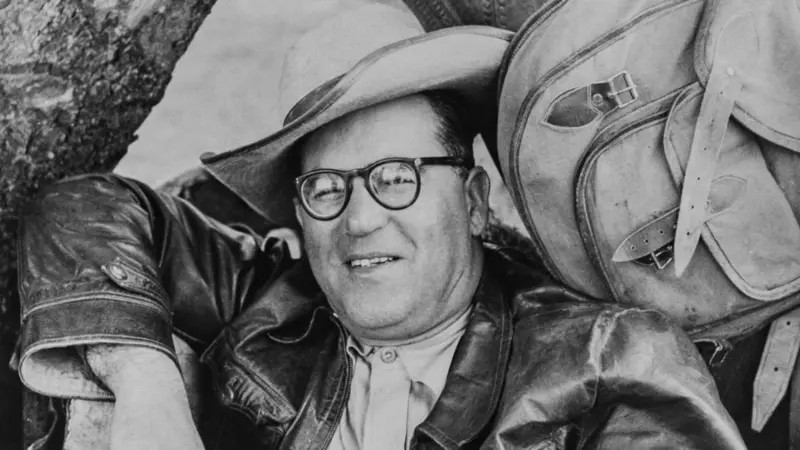
Guimarães Rosa during an expedition to the backlands of Minas Gerais, in 1952
Eugênio Silva/Casa Guimarães Rosa Museum Collection
One morning in 1941, Guimarães Rosa woke up wanting to smoke. As there were no cigarettes at home, Brazil's deputy consul in Hamburg put on a coat over his pajamas and went out to buy a pack.
In a nearby cafe, he heard a siren and ran to the nearest shelter. In the morning, when he returned home, the building where he lived had been reduced to rubble. "They say that cigarettes kill. But that one saved my life", he said ironically.
Still in Germany, another scare: an air attack had partially destroyed the consulate where Rosa worked. As the risk of collapse was imminent, the German authorities prohibited any representation employee from entering the part of the property that was still standing.
Rosa, however, bypassed security, entered the property and took confidential paperwork from the safe. When I left there, the rest of the building collapsed.
"God had a mission in store for me. That's why he saved me from death twice", Rosa secreted to Vilma, her firstborn, who recorded her father's confidence in the memoir Relembramentos (1983). "Twice?", marvels journalist Leonêncio Nossa, author of the recently released João Guimarães Rosa - Biografia (Nova Fronteira and Topbooks).
"Rosa escaped death countless times. One of them was in 1958 when he survived a heart attack, at the age of 50." (1956).
In 2007, Alaor Barbosa published Sinfonia de Minas Gerais - A Vida e a Literatura de Guimarães Rosa, but the book, due to a court decision, was withdrawn a year later. Rosa's family claimed that they had not been consulted and withdrew the biography from circulation. Since then, the work has not been re-released.
Leonêncio Nossa divided Rosa's biography into three parts: the doctor (1908-1938), the rebel diplomat (1938-1951) and the soldier (1951-1967).
The suggestion was given by the biographer himself in an interview with Austrian journalist Günter Lorenz in 1965: "As a doctor, I knew the mystical value of suffering; as a rebel, the value of conscience; as a soldier, the value of being close to death." There is, among other attachments, a timeline and a family tree.
Incredible, fantastic, extraordinary
Right in the prologue, the biographer confirms the most supernatural of the stories starring Rosa: that a gypsy had prophesied her death.
Superstitious, the writer postponed his entry into the Brazilian Academy of Letters for four years, three months and eight days. He believed he would die on the day of his inauguration. Elected on August 8, 1963, Rosa only donned the ABL uniform on November 16, 1967. He died three days later, on November 19, 1967.
The week leading up to his inauguration at the ABL was a farewell week. Rosa asked Vilma, if the premonition came true, to send the originals of These Estórias and Ave, Palavra to the editor José Olympio. Then, he scheduled a meeting with Agnes for after his granddaughter's school. "Don't forget me", he asked little Maria de Lourdes, Busi, five years old. Vilma and Agnes were daughters of Lygia Cabral Penna. With Aracy Moebius de Carvalho, he had no children.
Finally, Rosa agreed on a signal with Austregésilo de Athayde, then president of the ABL: if, during the speech, the immortal raised his hand to his forehead, he was to immediately suspend the session. "You know, maybe it's silly, but the bad feeling won't leave me," he commented. "Rosa chose three academics to enter the main hall with him. None had a literary affinity with the immortal. The selection criteria? All three were doctors", reports Our.
On the day of the inauguration, already dressed in her uniform, Rosa was reluctant to leave the house. "I'm not going", he told his friend Geraldo França de Lima. "I'm going to die." On the way to ABL, I prayed the rosary that the youngest girl gave as a gift.
When the car arrived at number 203 Presidente Wilson, in the center of Rio, Rosa, distressed, asked the driver, Ubirajara, to circle the block. "I have no secrets from you," he said again to França de Lima. "I won't make it to December."
Aracy de Carvalho and Guimarães Rosa in Paris, in 1949
Family Collection
Guimarães Rosa's inauguration speech took one hour and 15 minutes. Two phrases went down in history: "People die to prove that they lived" and "People don't die, they are enchanted". Upon arriving home, at Francisco Otaviano, in Copacabana, the newest occupant of chair number 2 let out a long sigh: "It's over, thank God...". Then he drank a glass of water with sugar and went to his room. It wasn't over. Still.
On Sunday, three days after taking office, Rosa began to feel ill. At the first symptoms of chest pain, he called his secretary, Maria Augusta. "I'm dying," he stammered. "Hang up the phone. I'll call the doctor," she ordered. "Do you forget that I'm a doctor? I know I'm dying," he insisted. It really was. When Aracy and her granddaughter Vera returned from mass, they found Rosa lying on the office floor. He had suffered a heart attack.
Pact with the devil
In an interview with Nossa, architect Nora Rónai, widow of translator Paulo Rónai and friend of the couple Rosa and Aracy, reports that, days before taking office at ABL, the writer seemed worried: he believed he had made, at some point in his life, a pact with the devil. Rosa himself, in an interview with journalist Ascendino Leite, a reporter for O Jornal, admits to having made, in the May 26, 1946 edition, "provisional pacts with the devil".
"It's when you make a pact with the demo to get something in return, like a job or a girlfriend. If you get what you want in three months, you pay for an ox, a goat or a calf. But, if he dies during this period, your soul becomes his."
Professor of Aesthetics at the Faculty of Communication at the University of Brasília (UnB), Castro is the author of another biography of Guimarães Rosa, with no defined title yet. The book is expected to be published in the second half of 2026. In addition to the biography, Companhia das Letras plans to launch, this month, an audiobook of Grande Sertão: Veredas narrated by actor Caio Blat and, in June, a commemorative edition of the novel published in 1956.
Of everything that caught his attention in Guimarães Rosa, the biographer highlights his polymathy. "He was a kind of Leonardo da Vinci from Minas Gerais", he defines. One of the subjects that most interested the biographer was the devil. There were, in his library, books and more books about cramulhão. "Riobaldo's pact with the devil in Grande Sertão: Veredas has an impressive wealth of details. Rosa was deeply knowledgeable on the subject", explains Castro.
About one of the greatest classics of Brazilian literature, a curiosity: Grande Sertão: Veredas, in principle, would be one of the novels in Corpo de Baile. However, The Devil on the Street in the Middle of the Swirl, its working title, grew so much that it became a novel. The two titles, by the way, were published in 1956: first, Corpo de Baile, soap operas; then, Grande Sertão: Veredas, the first and only novel of Rosa's career.
Another curiosity about Grande Sertão: Veredas was told by Haroldo de Campos. In 1966, during a writers' conference in New York, Rosa confided to the poet: "When the text comes to me, I get naked, roll on the floor, fight with the demo in the early hours of the morning in my office and then, on that impulse, I write." "When he talked about the demo, it wasn't a metaphor. The horror of the blank page.
It was a face-to-face, incarnate thing", said Campos.
Through the trails of the backlands
Rosa during a trip to the backlands of Minas Gerais, in 1952
Eugênio Silva/Casa de Guimarães Rosa Museum Collection
In 1952, Rosa participated in a nine-day expedition through the backlands of Minas Gerais. Riding on the back of a mule, he covered 240 kilometers, from Três Marias to Araçaí. Along the way, he made notes in six notebooks. "It cannot be said that the idea of writing Grande Sertão: Veredas came about on this trip", admits researcher Mônica Meyer, author of Ser-Tão Natureza (UFMG). 6pm to 8pm, around 60 people connect to read the work of Guimarães Rosa.
The initiative is from the Institute of Brazilian Studies (IEB), at the University of São Paulo (USP), which founded, in 2003, the João Guimarães Rosa Reading Workshop
"Until 2020, the meetings were in person. But, after the pandemic, they became virtual", explains Rosa Haruco Tane, one of the coordinators. "All of the author's books have already been read. But, without a doubt, those that attract the greatest interest are Sagarana (1946), Corpo de Baile (1956) and Grande Sertão: Veredas (1956). 1974. There, among other personal objects, are the typewriter, the ABL marlin and the bow tie collection. "A year, around 25 thousand people visit the Casa Guimarães Rosa Museum", calculates the institution's current coordinator, Ronaldo Alves. 1925, at the age of 16, Rosa entered the Faculty of Medicine of Minas Gerais, now the Federal University of Minas Gerais (UFMG). After graduating, he transformed the house in Itaguara into a clinic. At night, he went out on horseback to treat patients, as a form of payment, I abandoned medicine. he confessed.
As a diplomat, Rosa served in Hamburg, from 1938 to 1942. "More than once, he expressed discomfort with the discrimination against Jews", states Georg Otte, deputy director of the Faculty of Arts at UFMG, referring to the unpublished Hamburg Diary "There is no mention of helping Jews to escape Nazi persecution. He probably didn't want the action to be discovered." Rosa also worked in Bogotá, from 1942 to 1944, and in Paris, from 1948 to 1951.
Rosa met and fell in love with Aracy, a secretary at the Brazilian consulate in Hamburg, in 1938. Together, the two helped Jews persecuted by Nazism to escape to Brazil. "He once drew a caricature of Hitler, hanged. But he was reckless enough to keep it in his office", says Vilma in Relembramentos. "That drawing, however, never reached us. Dad suspected that some spy employee had stolen him."
Guimarães Rosa in his office, in 1958
Arquivo Público Minas Gerais
One step away from insanity
It was in Rio de Janeiro that Guimarães Rosa met Heloísa Vilhena de Araújo. When she started working at Itamaraty, in 1963, he was already heading the Borders Division of the Ministry of Foreign Affairs (MRE). One day, the two met, by chance, in a restaurant nicknamed "Bife de Zinco". "He liked to know what the new generation of diplomats thought", says the author of the book Guimarães Rosa: Diplomata (1987), now 86 years old. I don't know exactly what we were talking about. I replied no. He replied: 'I always pray. I'm afraid of falling into madness.'
At that moment, I didn't understand. Later, after reading and re-reading his work, I was able to glimpse the meaning of that information. In Grande Sertão: Veredas, Riobaldo also wants to pray all the time. His question was a revelation."
In the book, Vilhena reproduces the letter that Rosa wrote to the then consul in Frankfurt, Jorge Kirchhofer Cabral, in 1940. It would be a letter like any other if it weren't for a Rosian detail: all 431 words, from the greeting ("Dear Consul Colleague Cabral") to the postscript ("Confirm letter arrival, communicating with me with card"), are started by the letter C. "He had an obsession almost encyclopedic through the written word", says Castro.
In 1985, when she recorded the miniseries Grande Sertão: Veredas, written by Walter George Durst and directed by Walter Avancini, Bruna Lombardi was also, like Guimarães Rosa, afraid of 'falling into madness'. In order not to lose her reason, Diadorim's interpreter began to scribble the first pages of a diary. Originally published in 1986, Diário do Grande Sertão will be relaunched, revised and expanded, by Editora Autêntica later this year.
"I wrote the diary on the spot, straight from the recordings. It was a nomadic miniseries. There was no location. The backlands were our location. Sometimes he wrote his diary on the back of a horse. Others, in the middle of the bush. Many times, I didn't even understand what I had written", recalls the actress.
Videos trending on g1
Source: G1