The Brazilian family who found safety in Morocco: 'We are not afraid here'
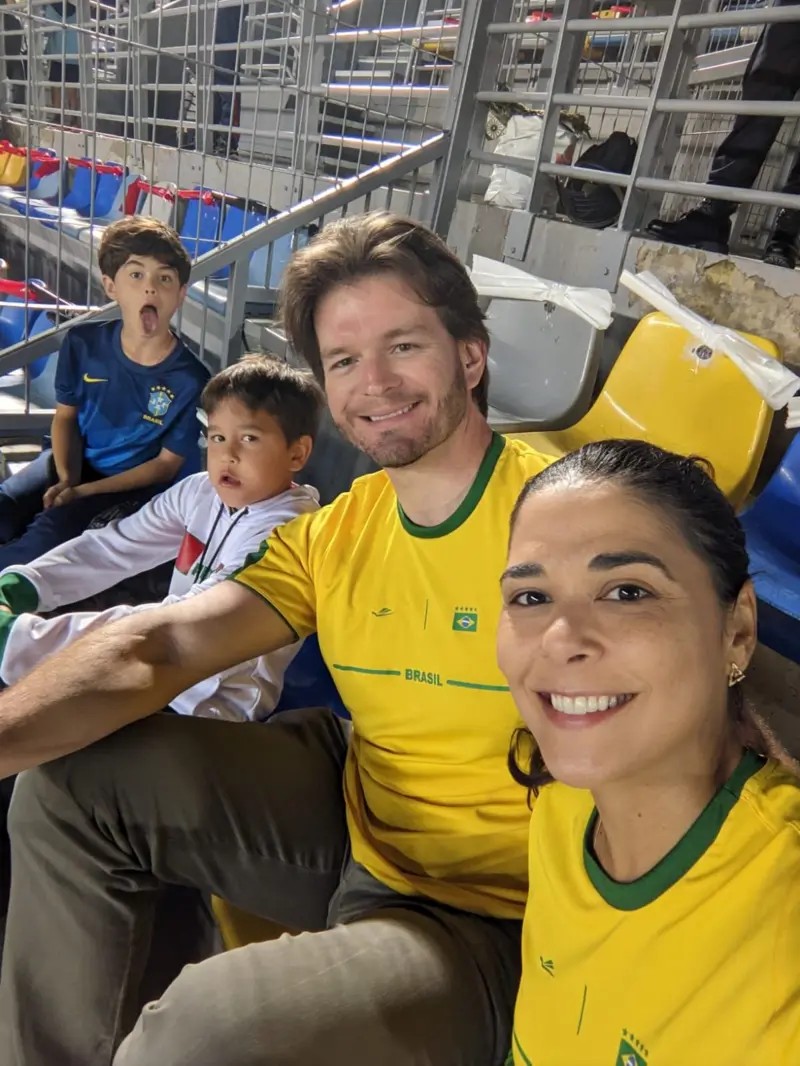
Family lives in Marrakesh, the fourth largest city in the country and one of the most important
Edison Veiga/BBC
Opening the car window in the middle of a crowd, talking to a stranger, a street vendor - and buying raspberries from him. Then, hearing from a guy who realized he was in front of a Brazilian woman: "Viva Neymar."
On the morning of May 20, 44-year-old chemist Teresa Cristina Fonseca da Silva had this interaction as she left the parking lot of the supermarket where she usually shops, in Marrakech, Morocco. A common experience, but one that is full of meaning for her.
When she moved to Morocco at the end of 2019 with her husband, agronomist Leonardus Vergutz, and her sons Davi and Gustavo, the international opportunity was based on the dream of having a life in a safe environment, far from the urban violence that has become part of the landscape of Brazilian cities.
Now on g1
In Brazil, they were both university professors. Vergutz, at the Federal University of Viçosa, and Silva, at the State University of Minas Gerais.
They lived in Viçosa, a city of less than 80 thousand inhabitants 230 kilometers from the state capital, Belo Horizonte. And they were trying to overcome a trauma: when they were preparing to go for a walk with their eldest son, then 3 years old and already in a car seat, Vergutz was surprised by an armed man who immediately demanded the vehicle key. From that moment on, the two began looking for opportunities to, at the very least, live a sabbatical outside the country.
The opportunity came in the second half of 2019. Specializing in fertilizers, Vergutz obtained a professorship and research position at the Mohammed VI Polytechnic University, UM6P - a private Moroccan institution created and maintained by the OCP Group, the Office Chérifien des Phosphates, a giant phosphate company in the country.
The company is the largest global producer and exporter of phosphate and phosphate fertilizers and holds more than half of the world's reserves of the rock - and Brazilian agribusiness is among the company's main customers.
What was supposed to be a sabbatical of one or two years ended up becoming a longer-lasting experience for the Silva-Vergutz family.
On the night of Saturday, June 13th, when the Brazilian team debuts in the 2026 World Cup against the Moroccan team, Teresa, Leonardus, Davi and Gustavo must be wearing the yellow shirt in front of the TV.
During the 90 minutes of the game, their hearts will not be in Marrakesh - but in Brazil, the country where they will embark a week later for their mid-year vacation.
It wasn't love at first sight
Teresa, Leonardus, Davi and Gustavo have lived in Morocco since 2019
Personal archive
"I'm 100% adapted to Morocco today. It wasn't a country that conquered me at first. But I learned to like it", says Silva.
She admits that at first she found everything "very ugly", "very poor", "everything brown, earth-colored, desert". "It was very difficult", she says.
But the memory of the fear she felt when her family was the victim of an armed robbery, and moments like the one with the raspberry seller, give her a sense of relief.
"I feel like I've achieved that security", she comments.
"We left Brazil very impacted by what had happened. Here I'm not afraid of stopping at a traffic light and being robbed, of people coming with a gun. Despite the poverty, I don't have that fear", says.
Morocco is a country of 37 million inhabitants in northern Africa where 400 Brazilians live according to updated data from the Brazilian consular sector in Rabat, the country's capital.
In the most recent comprehensive report carried out by the Ministry of Foreign Affairs on Brazilians living in other countries, with a base year of 2023, the estimate was 200 Brazilians in Morocco.
Marrakesh, where the Silva-Vergutz family live, is the fourth largest city in the country and one of the most important - more than 1 million inhabitants live there.
The feeling of security experienced by the Brazilian family echoes what is observed in Moroccan society. According to the collaborative database Numbeo, for example, crime in Morocco is considered moderate and safety for someone walking alone on the streets is high.
For a Brazilian, it is an arid, different landscape.
"There is a lack of greenery. In Brazil we are used to seeing forests on all sides. We pass by a highway and there are forests on both sides", says Silva.
And you really can't say that the grass is greener on the other side, for those who leave Brazil for the North African country. Objective indicators, such as the Human Development Index, place Morocco in 118th global position (with 0.698) - Brazil appears in 88th place in the ranking, with a mark of 0.76.
The chemist says that the initial idea of staying for one or two years in the country ended up being extended because there was a transition in her husband's career. He left university and today has a position on the OCP board.
Conditions improved, with a more comfortable house, two trips a year for the family to go to Brazil - before it was just one - and a prominent position.
She also started to undertake business. Since 2022, she has worked mediating imports of Brazilian commodities to the African market, mainly coffee, but she has also sold meat and black pepper, for example.
"I traveled all over Morocco. Women don't do that here, there are few women entrepreneurs", she comments.
"There are few who talk about business. Many times I felt admiration. In others, prejudice. There is a lot of machismo."
But when analyzing the local people, the balance is favorable.
"Moroccans are very kind. It's the country where I feel safe", she reflects. "There's machismo and everything. But here I feel like I've achieved that security."
Their children study at an American international school. Fluency in English, acquired by them in this format, was one of the points that weighed in the balance in the decision to immigrate.
On a daily basis, in interactions with Moroccans, they use French - according to Silva, learning the Arabic variant used by the locals is a practically impossible task.
For Silva, Moroccan daily life does not mean full integration into local life. There was no connection to the point of creating bonds of friendship, for example.
"I have two Moroccan friends, but contact is limited to one lunch a month, more or less", he comments. "What exists is a family overdose."
She sees this as resulting from the decision to immigrate. If in Viçosa the presence of her parents in the day-to-day life of her own family was intense - "it was like a cake animal, everyone had an opinion on her life" -, now she defines the moment as a space for the four of them to share their hardships and joys among themselves. from Brazil? The way they organized themselves, they end up spending two to two and a half months a year in Minas Gerais - so, according to her, this relationship remains present and sufficient.
"In terms of company, we miss our family a lot. But we learned to live with each other. And that [this situation] doesn't matter as much today," says Silva.
What she notices is that her children, having gotten used to Moroccan daily life, have lost their Brazilian malice and have become an object of concern.
"Before I go, I have to tell them to be careful, not to have their cell phones in their hands on the street, that kind of thing. They are very innocent", she analyzes.
In terms of eating habits, we miss pork. As the vast majority of the Moroccan population is Muslim - and Islam prohibits the consumption of this type of meat -, Silva says that pork parts are more expensive and difficult to access. It became a delicacy only for special occasions, therefore.
Expiry date
Despite recognizing the value of experience, Silva says that it is not a definitive change. "This has an end date.
I believe it will be another two or three years", she says.
In the meantime, she says she tries to alleviate her longing for Brazil with the cassava flour for cheese bread that she takes from Minas Gerais to Marrequexe on her two trips a year to Brazil. She rationalizes it, using it sparingly - that's how it lasts for the six months that separate one transatlantic flight from another.
Source: G1