The 50th anniversary of the 'Doces Bárbaros' quartet show generates tribute in Rio with echoes of the energy and high spirits of 1976
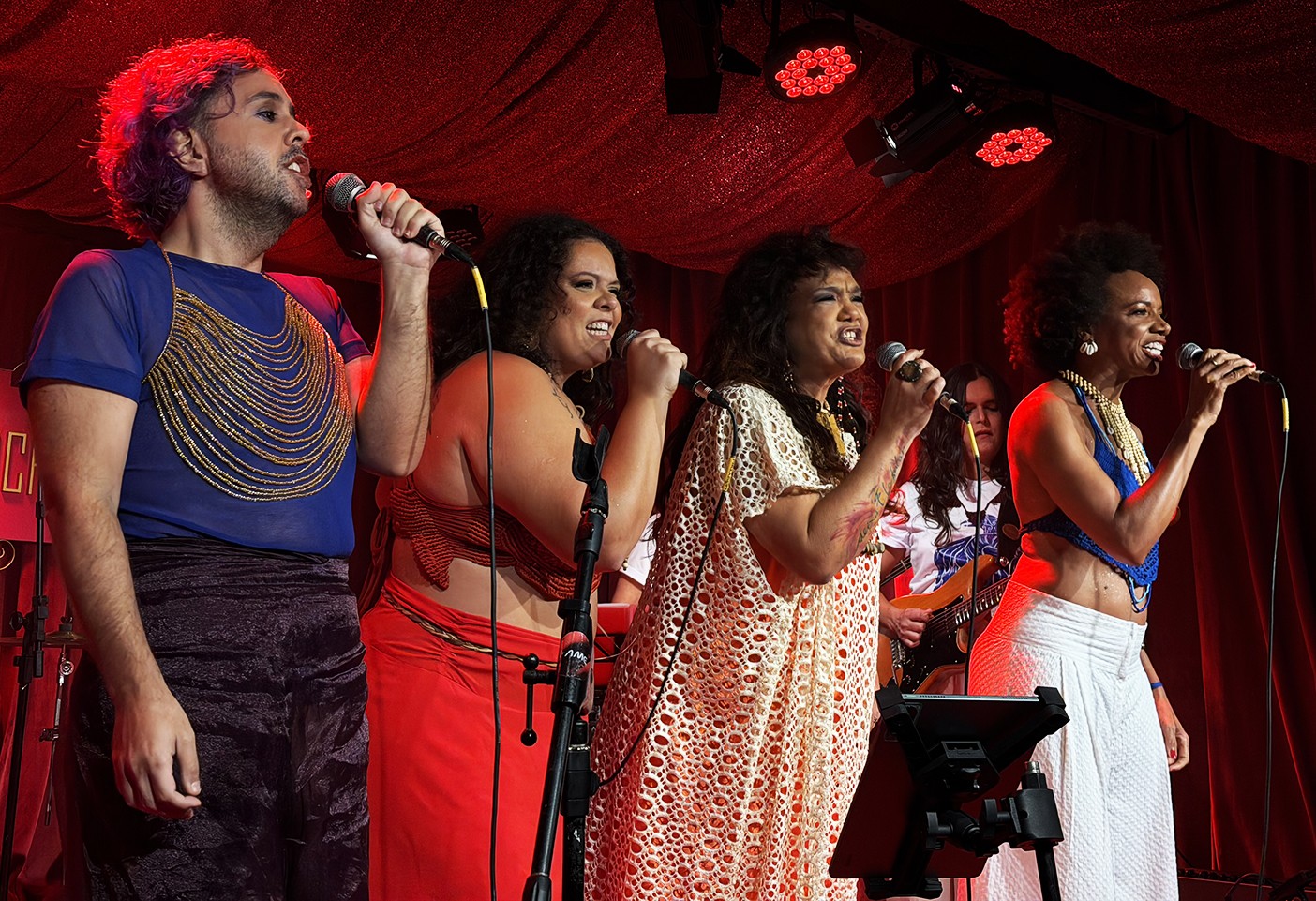
Guilherme Borges, Maíra (in red), Simone Mazzzer and Verônica Bonfim (on the right) perform the show 'Our love for Doces Bárbaros'
Rodrigo Goffredo
♫ SHOW CRITICISM
Title: Our love for Sweets Bárbaros
Artists: Guilherme Borges, Maíra, Simone Mazzer and Verônica Bonfim
Date and place: June 25, 2026 at Manouche (Rio de Janeiro, RJ)
Quote: ★ ★ ★ 1/2
♬ In the social context of June 1976, the year in which Brazil was still living under a bloodthirsty dictatorship, the formation and entry on the scene of the group Doces Bárbaros symbolized a political act by preaching affection and freedom as peaceful weapons of resistance to repression.
After 50 years, the country breathes a democratic air, but threats to individual and collective freedoms of bodies, creeds and ideologies still fill the air - which (also) justifies the existence of a tribute show like "Our love for Sweet Barbarians".
In the social context of June 2026, the show " Nosso amor aos Doces Bárbaros " also represents a political act by celebrating the meeting of Caetano Veloso, Gal Costa (1945 - 2022), Gilberto Gil and Maria Bethânia - creator of this fantastic quartet that lives up to the adjective that has now become cliché - with the re-presentation of the repertoire of the live album "Doces Bárbaros" (1976), released 50 years ago by the record label Philips, in double LP format, with the recording of the show premiered on June 24, 1976 at Anhembi, in São Paulo (SP).
On the stage at Manouche, a Rio club with a cabaret feel that represents in itself a symbol of cultural resistance, Guilherme Borges, Maíra, Simone Mazzer and Verônica Bonfim presented last night, June 25th, an unprecedented show, scripted with the 17 songs from the 1976 album, but without sticking to the order of the album and without trying to copy the Bahian group.
The 2026 quartet even reproduces gestures and signs from the 1976 quartet on stage, but with its own organization and collective spirit of freedom, manifested both in the artists' costumes - created by Brunna Napoleão with echoes of hippie aesthetics - and in the movements (orchestrated by Iasmin Patacho, artistic director of the show alongside Yasmin Lima) and in the displays of affection between the artists.
Affection, for example, governed the duo of Maíra and Simone Mazzer in "Eu te amo" (Caetano Veloso, 1976), made with the original quote from "Boneca de tar" (Ary Barroso and Luiz Iglesias, 1938) and with the gestures of Caetano and Bethânia in the song of "Fé blind, knife sharpened" (Milton Nascimento and Ronaldo Bastos, 1974).
With greater scenic and vocal grandeur from the three women, all actresses as well as singers, the quartet relied on the musical direction of arranger Guilherme Borges, based on a trio of guitar (that of Navalha Carrera, exponent of the instrument in the alternative scene), bass (that of Lelena Anhaia) and drums (that of Flávia Belchior).
This sound is in tune with the aesthetics of Doces Bárbaros, a group that played rock, often in the form - as in "nós, eg" (Gilberto Gil, 1976, with a title alluding to the show that brought together the Bahian quartet in 1964 on the stage of Teatro Vila Velha, in Salvador) and as in "Chuckberry fields forever" (Gilberto Gil, 1976), a solo in which Verônica Bonfim holds metaphorically Xangô's ax - and many other times in attitude.
There was rock's resistance even in the singing of a samba-canção from the end of the radio era, "Atiraste uma Pedra" (Herivelto Martins and David Nasser, 1958), the highlight of the show in the duo of Guilherme Borges (also on harp) and Verônica Bonfim.
Even stumbling over a verse at the beginning of the lyrics of "Um Índio" (Caetano Veloso, 1976), Simone Mazzer made the number one of the show's highlights with her usual vocal and interpretative strength.
The high spirits in the singing of so many beautiful songs freed the 2026 quartet from comparisons with the sovereign interpretations of the 1976 group.
The energy of the show was good, as exemplified by the singing of "Esotérico" (Gilberto Gil, 1976) with Guilherme Borges, Maíra and Verônica Bonfim sitting on the stage, at the foot of the chair that housed Simone Mazzer.
This energy supported solos (like that of Verônica Bonfim on the guitar in "O Seu Amor", a song by Gilberto Gil written for Doces Bárbaros), duets and collective songs, such as that of "Fé blind, knife sharpened" and that of the hymn "The Sweetest Bárbaros" (Caetano Veloso, 1976), songs strategically reserved for the encore.
In essence, Guilherme Borges, Maíra, Simone Mazzer and Verônica Bonfim achieved the most important thing, which was to evoke, even from afar, the atmosphere of debauchery and counterculture that guided the meeting of Doces Bárbaros, without falling into the temptation of trying to reproduce the irreproducible.
The raising of a flag with the colors of Brazil which read "Free to love", at the end of the show, confirmed the great intentions of the 2026 quartet in line with the beginning of the presentation, opened with the performance singing of "As Ayabás" (Caetano Veloso and Gilberto Gil, 1976), an example of a repertoire that explained in several numbers the African matrix of world music.
If being Doce Bárbaro was a state of mind in 1976, Guilherme Borges, Maíra, Simone Mazzer and Verônica Bonfim captured that spirit in 2026, celebrating, and not trying to imitate, the strength of a quartet that marked an epoch by making the meeting itself a political act of resistance.
Guilherme Borges, Simone Mazzer, Maíra (in red) and Verônica Bonfim (on the right) present the tribute at the Manouche club, in Rio de Janeiro (RJ)
Rodrigo Goffredo
Source: G1