TCU recommends improvements to the INSS automatic benefit granting system
An audit carried out by the Federal Court of Auditors (TCU) to which Globonews had access recommended that the National Social Security Institute (INSS) update the technologies used to automatically grant benefits and seek improvements in this process.
The automatic granting of benefits is when a request for retirement, pension or aid is analyzed by a robot, without going through an INSS server.
This type of analysis began in 2017 and has gained ground over the years. Last year, around 11 different types of benefits already underwent this type of analysis. Among them, the BPC (Continuous Payment Benefit) for the elderly and people with disabilities.
Now on g1
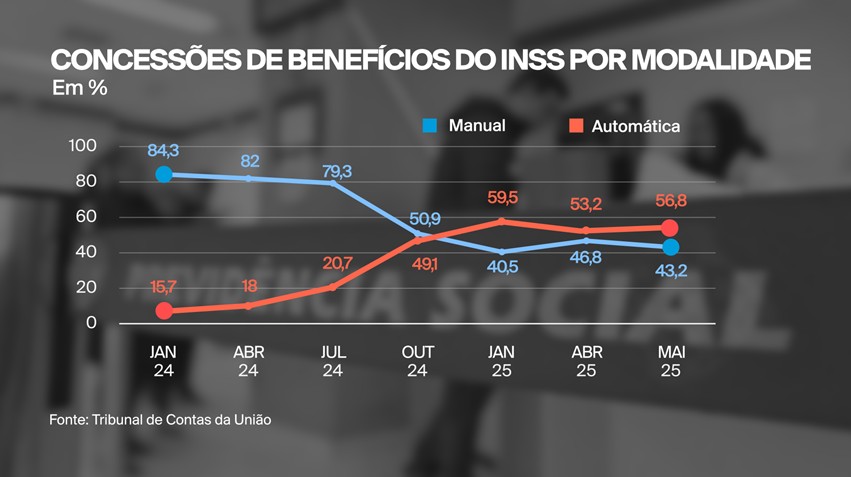
At the beginning of 2024, only 15.7% of benefits were automatically granted. In the same month of 2025, more than half of the benefits were already analyzed by automation (see image below).
Even with the growing percentage of automatic concessions, the TCU audit points out that they were still not enough to reduce the INSS queue nor the time that the insured person is waiting to have the benefit granted.
Among the difficulties, according to the TCU report, are a reduced team to take care of automation and a limitation in the performance of Dataprev, the technology company responsible for operating systems of the INSS.
According to the audit, most services are provided by systems developed in the early 1990s, which makes integration with more modern systems difficult.
Granting of INSS benefits by modality.
Reproduction/GloboNews
The Federal Court of Auditors highlights the importance of continuing to have automatic granting as a priority, due to the potential for reducing queues. But it recommends that, to this end, the INSS updates the technologies used and seeks improvements in this process.
The INSS stated, in a note, that it has implemented the TCU's recommendations and has made significant progress in recent months. He also highlighted that he has held weekly meetings with Dataprev.
The Authority also emphasizes that there are no undue denials automatically and that, when there is a need for additional analysis, the application is sent to a server.
However, the president of the Social Security Law Commission of the Brazilian Bar Association São Paulo Section (OAB-SP), Joseane Zanardi, states that there are undue denials - that is, benefits that should have been granted, but were denied.
According to the lawyer, one of the problems would be in the National Register of Social Information (CNIS), a document that brings together a person's entire work history. The INSS pulls information from the CNIS to grant benefits.
If the information is wrong in this registration, the INSS will therefore make a wrong reading.
Currently, it is possible to request corrections to the CNIS data by calling INSS Central 135. But policyholders report difficulties in communicating over this phone, such as delays in service and poor call quality.
"If this service were available on the 'Meu INSS' platform, on the website, the correction would be a little easier, because talking on the phone 135 is very difficult", says lawyer Zanardi.
The president of the OAB-SP Social Security Commission also highlights that investments are needed from the federal government to improve this information record.
"We have already requested, through various letters and conversations with the INSS, that efforts be made to correct the National Information Registry, but so far this has not been carried out. What is missing is investment in systems that communicate and integrate information correctly."
Source: G1