Starship: what happened in the 12th launch of the world's largest rocket
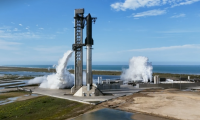
SpaceX completed another test of the expanded version of Starship last Friday (22). The launch was marked by a dramatic balancing act between successes and failures.
After liftoff from the southern tip of Texas, the vehicle flew over the Gulf of Mexico and the upper part of the spacecraft splashed down in the Indian Ocean about an hour later, despite an engine problem that repeatedly threatened to destroy the vehicle.
The return took place around 8:35 pm Brasília time.
During launch, the spacecraft lifted off exactly at the top of the orbital window, with all of its 33 Raptor engines at full power. After achieving an "in-limits" orbital trajectory, Starship was able to release a batch of 22 simulated satellites, two of which were equipped with cameras to monitor the spacecraft's heat shield.
Despite this, the Super Heavy rocket did not complete the return burn - which allows a controlled landing - and only five of the "ship's" six engines lit.
SpaceX launches new Starship; see moment | CNN PRIME TIME
The problem prevented it from entering the correct orbit, although the trajectory remained within the limits for a suborbital flight. Given the situation, the team was unable to restart the engines in space before landing.
Even with the difficulties, and with only two of its three engines lit for the landing burn, reentry and landing in the water occurred normally.
Images from the broadcast
The launch is part of Elon Musk's company's program to develop a fully reusable space system aimed at future missions to the Moon and Mars.
Images from the official broadcast show the moment in which Starship descends and performs the landing maneuver during the suborbital test flight. See below:
https://admin.cnnbrasil.com.br/wp-content/uploads/sites/12/2026/05/WhatsApp-Video-2026-05-22-at-20.41.26_a3051f.mp4
Under the supervision of Manuella Dal Mas*
Source: CNN