Smuggling, espionage, sabotage: how Russia uses 'ghost fleet' to circumvent Western sanctions
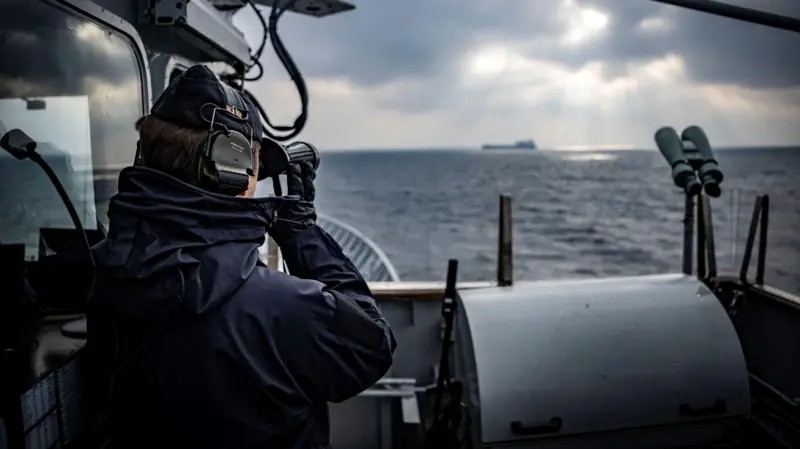
The patrol vessel HSwMS Carlskrona accompanies a cargo ship off the coast of Sweden, as part of NATO's Baltic Sentinel mission
AFP via BBC
The Kremlin says Russia is "immune" from the sanctions imposed by US President Donald Trump on two of its biggest oil companies.
Do you have any suggestions for reporting? Send to g1
What keeps Russian oil exports by sea is a "ghost fleet": "zombie" oil tankers transport millions of barrels of oil to bargain-seeking buyers around the world, avoiding sanctions.
The fleet has other clients besides Russia, such as Iranian ayatollahs, Venezuelan generals and even opportunistic and unscrupulous traders in the West, who care more about profit than threats to environment, security and, in some cases, the freedom of the crew, abandoned more and more frequently on ships that remain isolated at sea for months or even years.
But the activity of the ghost fleet reached its peak after the invasion of Ukraine in 2022. And the main beneficiary of this secret navy is the regime of Vladimir Putin.
It serves not only to smuggle Russia's main export, bringing in revenue to finance the Russian "war machine", in Trump's words, but also for operations "hybrids" of espionage and sabotage against NATO countries in Europe and the pipelines and submarine cables that connect them.
Now in g1
Russia is one of the world's three largest oil exporters, alongside the United States and Saudi Arabia.
In 2024, Russia extracted about 10% of the world's oil, according to the United States Energy Information Administration.
Before the war in Ukraine, almost all of its Oil exports by sea were carried out using Western tankers, mainly from Greece. Commercial operations were carried out in Switzerland and insurance was taken out in London.
But now, up to four out of every five tankers carrying Russian oil do not have insurance recognized by one of the 12 mutual insurance companies of the International Group of Protection and Indemnity Clubs, which cover about 90% of all sea cargoes, according to analysts at the financial information company S&P Global.
Analysts estimate that the ghost fleet currently transports 80% of Russia's oil exports by by sea, defying Western sanctions
AFP via BBC
Data indicates that the ghost fleet now transports 80% of Russian oil, defying Western sanctions.
"Russia has formed a ghost fleet of tankers, which allows the country to dodge sanctions," according to senior economist at the Kiev Institute School of Economics, Benjamin Hilgenstock.
"But they are also old, not properly maintained, and probably do not have sufficient insurance coverage against oil spills. oil."
"And what happens is that about 75% of Russia's oil exports by sea have to leave ports in the Baltic and Black Seas," the economist continues, "which means that these ships cross European waters several times a day."
Most of Iran's oil is transported to terminals like this one in the Chinese province of Shandong
Getty Images via BBC
About one in every five tankers in the ocean is part of the fleet ghost, according to S&P. They are corroded ships, which sail under obscure flags, to smuggle oil from sanctioned countries.
Of these, 50% transport only Russian oil and its derivatives, 20% only from Iran and 10% only from Venezuela.
But the remaining 20% are not affiliated with any country and transport oil produced by more than one of the sanctioned countries.
The largest fleet, which serves Russia, Iran and Venezuela, has as its main destination India and China, the world's most populous countries and the largest importers of oil and oil products by sea.
Smaller buyers of Russian oil include Turkey, Singapore and the United Arab Emirates.
To cover their tracks, ships from ghost fleets use several tricks:
they carry out oil transfers to other vessels in international waters, where there is less monitoring by port authorities; Sometimes these transfers occur in bad weather, to hide the origin of the cargo
ships also turn off or manipulate their automatic identification system, which transmits data such as their position, speed, route, name, flag and ship type; Sometimes they falsify their locations so clumsily that they are shown as if they were "sailing on land", as occurred with the Black Pearl ship in the Pirates of the Caribbean film series (2003-2017) zombies", transmitting International Maritime Organization registration numbers that are actually assigned to ships scheduled for scrapping, as if using the identity of a dead person
The number of false-flagged ships grew by at least 65% between January and August 2025, according to marine analytics firm Windward. She estimates that the ghost fleet now comprises 1,300 ships.
Flag registration services have also soared. Many are simply frauds.
While others are technically legal, issuing countries are new to this industry and have no willingness or ability to monitor the use of their flags.
"Under global shipping regulations, flag-issuing states are tasked with ensuring that technical standards are followed and that adequate insurance against oil spills is in place," according to Hilgenstock.
"But in relation to Russia's ghost fleet, we are talking about jurisdictions that simply cannot be trusted to carry out this function."
In October 2025, a Benin-flagged oil tanker, suspected of serving as a launch platform for mysterious drones that forced the closure of airports in Denmark, was detained near the coast of France.
Initially, the public prosecutor of Brest, France, Stéphane Kellenberger, told the France-Presse news agency that the detention occurred due to "the crew's refusal to cooperate" and the "lack of justification for the nationality of the ship."
The ship was called Boracay and had recently changed its name. Previously, she was called Pushpa and had already been named Odysseus, Varuna and Kiwala - and sailed under seven different flags.
When intercepted by the French navy, she was transporting 750,000 barrels of oil from the Russian oil terminal of Primorsk, near Saint Petersburg, to Vadinar, in western India.
There were also suspected incursions by Russian drones in the skies of three NATO allies: Sweden, Norway and Germany.
And on November 6, 2025, Brussels airport in Belgium was forced to temporarily close when drones were identified in nearby locations and in other regions of the country, including a military base.
Russia denies that it is waging a "hybrid war" against Ukraine's allies.
As a result of the Boracay investigation, NATO countries launched the Baltic Sentinel mission.
"Ship captains need to understand that potential threats to our infrastructure will have consequences, including possible boardings, seizures and arrests," said NATO Secretary General Mark Rutte.
The United Kingdom, Denmark, Sweden and Poland say they are inspecting insurance documents in the English Channel, the Danish Straits, the Gulf of Finland and the strait between Sweden and Denmark.
Estonia, Finland, Germany, Iceland, Latvia, Lithuania, the Netherlands and Norway have agreed to "intercept and detain" Russian ghost ships in response to several cable cuts and unexplained underwater incidents near critical infrastructure in the Baltic Sea.
But ghost fleet ships can only be intercepted in ports or in territorial waters, a narrow zone 12 nautical miles (about 22 km) from the coast.
In international waters, interception is much more difficult, especially since the West is the main defender of freedom of navigation in the world. And, according to the principle of "innocent passage", States can only intercept ships that they believe threaten their security.
Russian politicians demand that any hostile actions against tankers transporting oil produced in the country be considered an attack on Russia. And when Estonia tried to stop a tanker sailing without a flag between Estonia and Finland in May 2025, Moscow sent a fighter jet to fly around it.
But the ghost fleet could pose an even greater threat to global security.
Major shipping companies typically retire tankers with about 15 years of service. And at 25, they are normally turned into scrap.
But ghost fleet ships are not accepted for dismantling. And in December 2024, Russian authorities struggled to contain up to 5,000 tons of oil, which leaked from two 50-year-old tankers damaged in a strong weekend storm in the Kerch Strait.
A leading Russian scientist called the spill the country's worst "environmental catastrophe" in the 21st century. Danilov-Danilyan.
Shell companies in jurisdictions such as Dubai in the United Arab Emirates - some of them financed by Russian oil companies, according to the Financial Times newspaper - buy ships at the end of their useful life, destabilizing the market and discouraging investment in new tankers. as bad as its regulation, leaving ships prone to leaks and mechanical failures. Broken or disconnected transponders also increase the risk of collision with other ships in shallow waters.
But this clandestine and high-risk business is extremely profitable.
A 15-year-old oil tanker capable of crossing the Suez Canal costs around US$40 million (about R$202 million), according to brokerage Xclusiv Shipbrokers. S&P claims that a single one-month trip transporting Russian oil from the Black Sea to India could earn its owner more than US$5 million (around R$25.2 million).
The owners of ghost ships pocket the profits, passing on the possible losses to the rest of the world.
After all, without insurance coverage, someone will have to pay for the damages in the event of accidents or oil spills.
And, even when sanctions are lifted, the ghost navy will continue sailing and forming new groups in other sectors of maritime transport.
The sketches of a "Ghost Fleet 2.0" are already emerging, according to the specialized publication Lloyd's List. She mentions, as an example, a Chinese container ship called Heng Yang 9, repeatedly identified on routes between Russian-occupied Ukraine and Istanbul, Turkey.
With collaboration and editing by Olga Sawczuk, BBC World Service
Source: G1