Size of the Ebola outbreak in Congo remains unknown
A month after Ebola cases were confirmed in eastern Congo, the true scale of the outbreak remains unknown, with large data gaps clouding the picture and persistent, sometimes violent, community resistance hampering the response, health professionals and officials say.
The three affected provinces in the east of the Democratic Republic of Congo have so far recorded 782 confirmed cases and 181 deaths, meaning this is already the third deadliest Ebola outbreak in history.
The figures released by the government likely underestimate the true number of victims, humanitarian organization Doctors Without Borders said in a statement, echoing a view shared by aid groups and some Congolese officials.
"No one knows the true extent or exactly where the disease is spreading in the DRC," said Kate White, emergency medical coordinator for MSF, which operates treatment centers across the Ebola-affected eastern region.
Data Sources Difficult to Harmonize
Testing remains "one of the biggest weaknesses in the response", said the MSF statement.
Many communities, especially those affected by active armed conflict, still do not have access to testing kits, while treatment centers face significant delays in receiving laboratory results, he said.
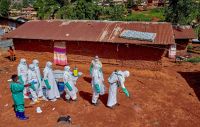
Red Cross workers disinfect floors outside the home of an unidentified man who died of Ebola, in Mongbwalu, Djugu Territory of Ituri province, Democratic Republic of Congo - REUTERS/Gradel Muyisa Mumbere
A senior Congolese public health official, speaking on condition of anonymity because he was not authorized to speak to the press, said the problems run deeper than just testing.
Data coming from three distinct sources - laboratories, hospitals and treatment centers, and epidemiological surveillance teams - is extremely difficult to harmonize, creating distortions in both directions, the official said.
Cases may be overestimated when patients cross health zones and are tested more than once. Meanwhile, people continue to die in communities without ever coming to the attention of health authorities, the official said, adding that he believes the virus began circulating in February.
The discrepancy between official figures and the reality on the ground is visible at the local level.
Reuters reported on Friday that two people died in a displacement camp in Ituri's Nizi health zone on May 31 and June 1, citing a report from the UN refugee agency.
On Saturday, the chief doctor of the Nizi health zone, Jean-Claude Lonzama, told Reuters that his zone had recorded 19 positive cases and 17 deaths since the outbreak was declared.
However, the latest national report on the situation, published by health authorities on Sunday, recorded just 11 cases and one death in the region.
Dieudonné Mwamba, director general of Congo's National Institute of Public Health, which publishes daily reports on the situation, told Reuters that the figures are updated regularly as new information arrives.
Burial teams attacked, patients fled
Beyond the data, rescuers continue to face a wave of resistance and violence from the community.
On Sunday, security forces fired warning shots and tear gas at a funeral in Mongbwalu to disperse a crowd trying to seize the body of a suspected Ebola victim, according to authorities and images verified by Reuters.
The World Health Organization has warned that these security incidents pose a threat across the region, citing an attack two weeks ago on a burial team in South Kivu that forced healthcare workers to abandon a body before completing safety protocols.
The report states that patients are also fleeing treatment or isolation centers, with at least four such incidents recorded in the first week of June.
MSF stated that the problem of mistrust was widespread in Ituri.
Mwamba from Congo told Reuters that safe burial teams will now seek to include a family member in burial arrangements in order to build trust.
Treatment centers overwhelmed
The World Health Organization said on Monday that hospital capacity to treat and isolate Ebola patients was insufficient.
There are only 14 treatment centers and facilities in nine health zones in the provinces of Ituri, North Kivu and South Kivu.
But the outbreak has already reached 31 of at least 90 health zones - a defined area with a network of clinics and a referral hospital - in these provinces.
In Nizi, the absence of any treatment or isolation facilities means patients return to their communities and die there, said Lonzama, the chief doctor.
MSF warned that the window of opportunity to contain the outbreak was closing. The worst outbreak occurred in West Africa between 2014 and 2016 and killed more than 11,000 people.
"Diagnosis, surveillance, access to healthcare and community engagement must be urgently strengthened," said Frederic Lai Manantsoa, MSF emergency coordinator in DRC.
"We urge authorities and all interested parties to do everything possible to facilitate the movement of health professionals and the transport of supplies, and to enable a response that matches the scale of this crisis."
(Reporting by Clement Bonnerot in Dakar and Emma Farge in Nairobi; additional reporting by Benoit Nyemba and Gradel Muyisa in Bunia, Fiston Mahamba in Goma; editing by Robbie Corey-Boulet and Alison Williams)
Source: CNN