Shortage of tests delays fight against Ebola in Congo, says WHO official
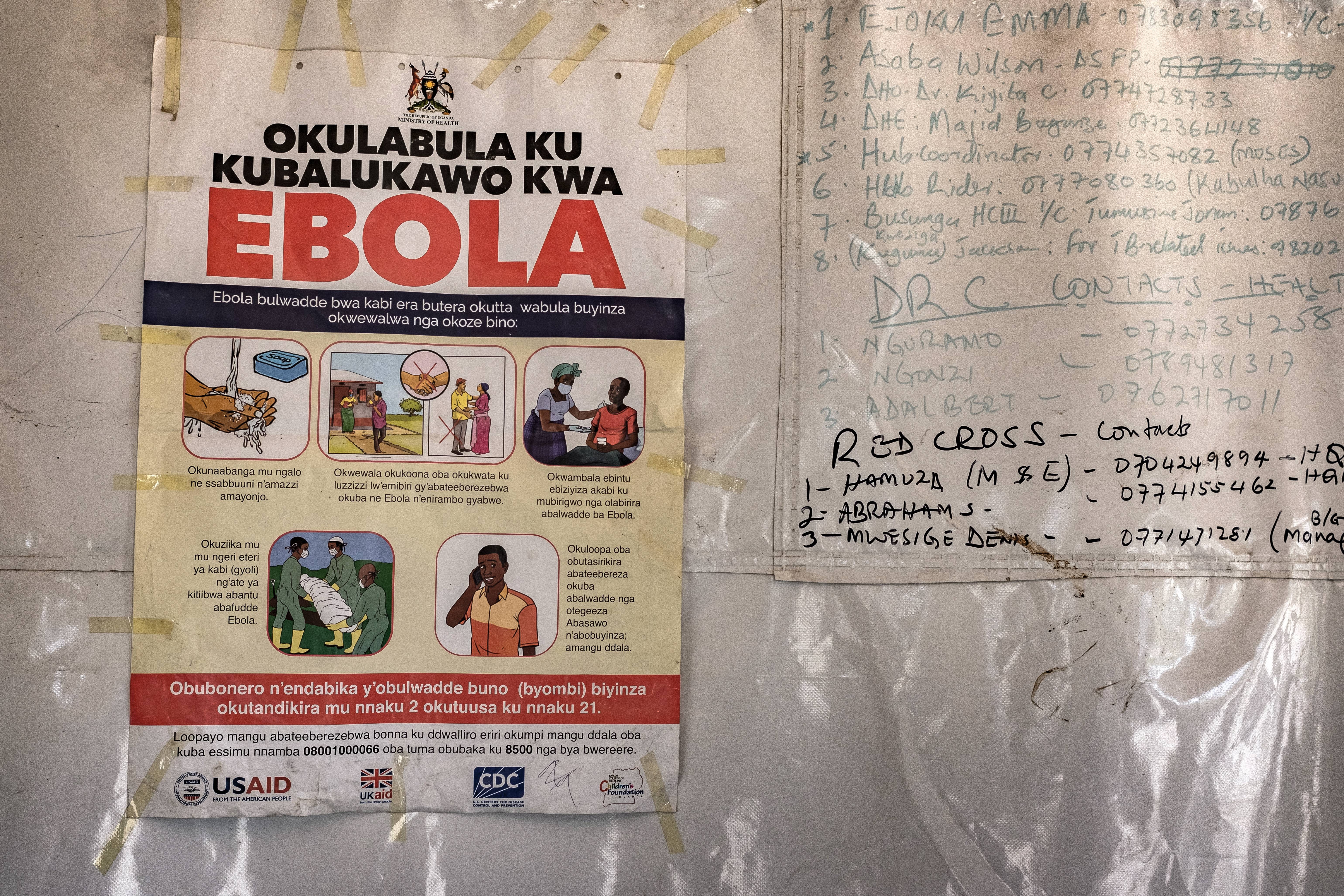
A poster with emergency contact numbers for Ebola is displayed on a tent at the Busunga border crossing between Uganda and the Democratic Republic of Congo in Bundibugyo on May 18, 2026
BADRU KATUMBA / AFP
The lack of specific tests to detect the Bundibugyo variant of Ebola is delaying the response to the outbreak advancing in eastern Democratic Republic of Congo, it said this Tuesday (19) the representative of the World Health Organization (WHO) in the country, Anne Ancia.
According to the WHO, more than 500 suspected cases and at least 130 suspected deaths have been recorded linked to the outbreak, which has also spread to Uganda, where two confirmed cases have been identified.
According to Ancia, the affected region can only carry out six tests per hour to identify the Bundibugyo strain - a rare variant of Ebola for which there are no vaccines or approved treatments.
The problem, according to her, helped to delay the identification of the epidemic.
WHO very concerned about the scale and speed of the Ebola outbreak
"It took weeks to detect the outbreak because the tests used in the region were aimed at the Zaire strain, which is more common," she said.
The WHO representative also stated that there is "great uncertainty" about the real size of the epidemic and that the capacity for epidemiological surveillance and investigation is limited.
"The capacity for surveillance and investigation is very limited in this region in general", he said.
WHO sends tons of supplies
According to the organization, 12 tons of medical materials have already been sent to Congo and another six tons are expected to arrive in the country this Tuesday.
The shipments include:
personal protective equipment for health professionals;
sample collection materials;
laboratory supplies;
items used in contact tracing.
The authorities health authorities are trying to expand epidemiological surveillance, testing and monitoring of people who have had contact with infected patients.
Experts discuss vaccines and treatments
Amid the escalation of cases, experts are participating this week in a series of technical meetings led by the World Health Organization during the 79th World Health Assembly, held between May 18 and 23 in Geneva, Switzerland.
The discussions take place as health authorities try to define whether vaccines have been developed for other variants of the virus. Ebola can be used in an emergency against the Bundibugyo strain.
Among the topics discussed are:
the emergency use of existing vaccines;
possible clinical studies for new immunizers;
experimental treatments;
expanding diagnostic capacity;
surveillance and contact tracing strategies.
Today, there is no vaccine specifically approved for the Bundibugyo variant.
Experts are, however, evaluating the possibility of using the Ervebo vaccine, from the pharmaceutical company Merck, approved against the Zaire strain of Ebola and which showed signs of cross-protection in animal studies.
The final decision on any emergency use of vaccines will be up to the governments of Congo and Uganda.
The international alliance Gavi reported that it already has 2,000 doses of vaccines against Ebola in Congo if experts recommend starting emergency tests or campaigns.
Company expands production of tests
BioFire Defense, linked to the French company bioMérieux, stated that it is expanding production of a test approved by the United States regulatory agency (FDA) capable of detecting different variants of Ebola, including Bundibugyo.
According to the company, the test - called BioFire Global Fever Special Pathogens Panel - can identify multiple species of the virus.
"BioFire Defense is in active contact with public health authorities and international partners to monitor the evolution of the outbreak and assess possible support needs", said a company spokesperson.
Lack of money worries WHO
The WHO also warned of financial difficulties in responding to the outbreak.
According to Anne Ancia, the global reduction in health resources had a direct impact on the organization's operations in the Congo.
She cited the United States' official withdrawal from the WHO in January and the cuts in international funding promoted by President Donald Trump's government.
Despite this, the representative stated that technical cooperation between the US and the WHO continues to function.
"We understand that we will not receive funding, that's okay, but we want to continue exchanging information and collaborating," he said.
The United Nations Office for the Coordination of Humanitarian Affairs (OCHA) reported having received only 34% of the R$7.9 billion (US$1.4 billion) requested for humanitarian actions in Congo this year. According to the agency, more than half of the resources received came from Washington.
Rare variant hampers rapid response
Experts say that outbreaks caused by the Bundibugyo variant are unusual and unpredictable, which makes it difficult to develop specific vaccines and rapid response protocols.
In addition, researchers warn that the security situation in eastern Congo - marked by armed conflicts and logistical difficulties - could make it difficult to both contain the disease and carry out clinical studies.
Source: G1