Sensors, AI and VAR: FIFA's bet on technology generates controversy at the World Cup
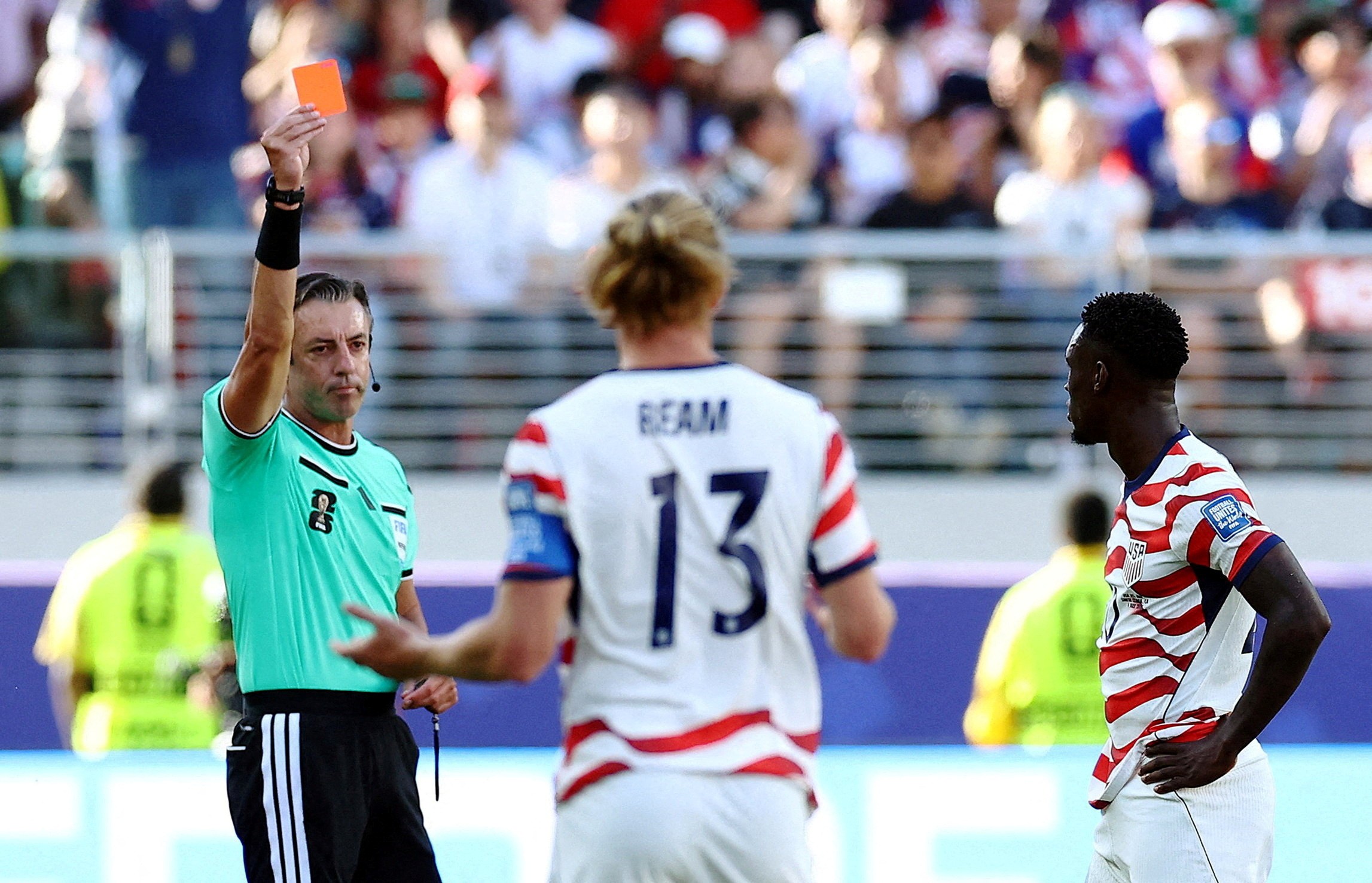
Folarin Balogun, from the USA, receives a red card from referee Raphael Claus.
Phil Noble/Reuters
If FIFA president Gianni Infantino hoped that technology would help reduce refereeing controversies, the World Cup showed that the debate is far from over.
The use of technology was at the center of the tournament's main controversies, including the expulsion of Folarin Balogun, a case that even caught the attention of the president of the United States, Donald Trump.
Favorite g1 on Google and follow the main news of the day
Criticisms ranged from accusations of excessive interference and lack of uniform criteria in the application of VAR to conspiracy theories that the technology was favoring certain teams or players.
Egypt coach, Hossam Hassan, brought together these criticisms after the 3-2 defeat to Argentina in the round of 16. In the match, his team had a goal disallowed by VAR due to a foul at the other end of the field and a penalty request that was not granted.
Now in g1
"What is happening is not fair," he said.
Fifa refereeing chief Pierluigi Collina said in an interview on Wednesday that he was satisfied with the way things were going and, in particular, defended the decision to disallow Egypt's goal because of a foul in the play that preceded the goal.
"There is no pre-established limit for the distance of the play in relation to the goal nor for the time elapsed until the completion of the play", said Collina.
"We believe that a foul is a foul. Regardless of whether the foul seems 'obvious', if the referee did not see it on the field, the VAR can intervene."
The Video Assistant Referee (VAR) was created to correct errors considered clear and evident, such as the famous goal scored with his hand by Diego Maradona against England in the 1986 World Cup.
The introduction of VAR in the World Cup faced resistance from Joseph Blatter when he was president of FIFA, but was quickly adopted by Infantino when he took office in 2016.
There were 20 VAR interventions in the 64 games of the 2018 World Cup and less than 30 in the same number of matches in Qatar in 2022. In the 2026 edition, these numbers they were surpassed in the early stages of the competition, which now included 104 games.
FIFA expands the role of VAR
The increase in interventions did not occur by chance. Expanding the role of the four referees responsible for VAR is one of the pillars of the strategy adopted by Collina for this World Cup.
In partnership with the International Football Association Board (IFAB), the body responsible for football rules, Collina expanded the situations in which VAR can intervene, adding four new categories of review.
Network science expert Brennan Klein stated that a future in which an ever-growing network of cameras and artificial intelligence systems took over part of the refereeing decisions in real time - although possible - was unlikely, simply because fans seem increasingly unwilling to accept a greater level of technological intervention.
"This kind of dystopian future, of too much officiating in everything, ends up not addressing the issue that prompted the initial intervention," Klein, who has been analyzing data throughout the tournament with his team at Northeastern University, told Reuters.
"I think the fans seem to be voting with their boos."
'Abuse of technology'
If the match between Croatia and Portugal had taken place at the 2014 World Cup, it would probably have ended in a 2-2 draw in regulation time.
Josko Gvardiol scored in the 13th minute of stoppage time and tied the game for Croatia.
However, VAR pointed out that the ball had touched Igor Matanovic before reaching the defender, which placed a teammate in an irregular position.
The touch could not be perceived with the naked eye and did not visibly alter the ball's trajectory. Still, a sensor installed in the equipment recorded the contact, possibly even with Matanovic's hair.
"(The sensor) is capable of detecting even the slightest contact, providing referees with unprecedented information to make quick and accurate decisions," FIFA said in a post on social media.
Luka Modric, the Croatian who said goodbye to the World Cup after the 2-1 defeat, was not impressed with the decision.
"The technology is useful in certain situations, but it is being used incorrectly or selectively, depending on the team involved or other factors", said the player.
"If it is an obvious error, the intervention makes sense. But, when the play is in a gray area and subject to interpretation, there is no reason to interfere."
The Croatian Football Federation (HNS), which supports the use of VAR, sent a letter to FIFA asking for explanations about the decision and classifying the episode as "an abuse of technology".
Source: G1