See how the baby gorilla who was born after a rare cesarean section is doing
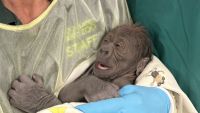
The western lowland gorilla cub, born May 24 after an emergency cesarean section, is making a positive recovery and is under intensive care at Woodland Park Zoo. So far, he still doesn't have a name.
The baby, a male who was born weighing approximately 2.45 kg (5.4 pounds), a weight above the average of 1.8 kg for the species, is considered healthy by the medical team. According to the most recent bulletins, he is managing to maintain a stable body temperature.
Although experts remain cautious, as the first 72 hours are the most critical, the mood is optimistic.
Jamani, the "assistant mother"
As the biological mother, Olympia, is still recovering from surgery, another gorilla in the group, Jamani, has taken on a vital role.
Jamani, who gave birth to a cub a week ago on May 18, is nursing and carrying Olympia's baby along with her own son.
The dynamic is possible thanks to prior training: the keepers taught the gorillas to bring "dolls" to the protective net to simulate breastfeeding.
Now, Jamani responds to caregivers' commands, leading both babies to complementary bottle-feeding sessions through the protective mesh, ensuring they both receive the nutrition they need.
Olympia's recovery
Olympia has already returned to her social group and, although she has not yet kept the cub, she remains very close and shows constant interest in the baby. The animal health team monitors the birth mother 24 hours a day to ensure her injuries are free from complications.
She still shows good signs of recovery and healing after the cesarean section.
The plan is that, as soon as Olympia shows clear signs that she is ready to resume full care for the baby, the transition will be made gradually.
Understand birth
The gorilla at Woodland Park Zoo, Olympia, performed an emergency cesarean section to give birth to a male cub on May 24.
The team that performed Olympia's procedure actually performs human births. Of the 17 gorilla births at the Zoo, this is the first cesarean section, an extremely rare episode, with less than a dozen cases performed worldwide.
This is the second cub of Olympia, a western lowland gorilla. Gorillas' gestation period lasts eight and a half months, producing cubs weighing around 1.8 kg.
The decision to have a cesarean section was made after a final ultrasound performed on the gorilla, which showed complications. According to Woodland Park veterinarian and director of Animal Health, Dr. Tim Storms, it was necessary to take quick action following the test results.
"We made the crucial decision to anesthetize Olympia and call in a team of medical consultants to evaluate the fetus and determine the best intervention," said the veterinarian.
After being anesthetized and taken to the veterinary hospital by ambulance, the obstetric team performed another ultrasound, which revealed a decrease in amniotic fluid with incomplete dilation of the cervix, which indicates unproductive labor.
"This meant that Olympia would not be able to give birth without our help, so we made the crucial decision to deliver by caesarean section," said Storms. The director of Animal Health claimed that the birth involved, in addition to the Zoo's veterinary team, a volunteer obstetric team.
Medical care
Dr. Sachita Shah, from the Department of Emergency Medicine at Butterfly and the University of Washington, is a member of the team that made Olympia's birth possible and informed about the care.
"When the baby was born, we used the probe to guide neonatal intensive care and resuscitation. It was incredibly well coordinated for everyone to see the same information on the screen, which allowed for shared decision-making with the animal health and gorilla care teams at Woodland Park Zoo," says Sachita.
After the operation, on the baby's first night, a gorilla keeper and a veterinary technician supervised the mother and baby for further care for the first 24 hours, out of public view. One of the experts who carried out this initial monitoring explained that keeping both together and in a place without public was essential for Olympia to get used to this new phase.
The next day, Olympia returned to her group and a few hours later, she introduced her new son to the group. Throughout the day, another gorilla who had a calf a week earlier, Jamani, took him and her other cub to the screen so the care team could conduct bottle-feeding training sessions. She was aware of the act because, during her pregnancy, she was taught by the keepers to take a doll to them, for when the real baby needed feeding.
Keepers expect that, while Olympia recovers from the cesarean section, Jamani will continue to care for her friend's puppy and her own baby. According to experts, "as long as both babies remain healthy, which is our priority. As soon as Olympia shows signs of being ready for her puppy, we will move forward with plans to reunite them."
Source: CNN