Section of Metro Line 6-Orange begins operating next week in SP
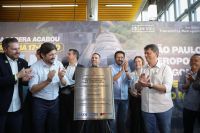
The first section of Metro Line 6-Orange will be delivered next week by the São Paulo State Government, with six of the 15 stations planned to be in operation. Opening hours will be reduced and there will be no charge.
The route became known as the "Universities Line", as the branch will serve institutions such as UNIP, PUC, FAAP, Mackenzie and FMU. According to the government, the first section delivered includes the stations of João Paulo I, Freguesia do Ó, Santa Marina, Água Branca, Sesc-Pompeia and Perdizes.
The line will operate in assisted operation for the first time, with no charge for use and with reduced hours, only between 10am and 3pm, Monday to Friday, except holidays.
The operation will feature two trains in the so-called Shuttle system, with only one train running on each route. Therefore, the average interval between trains will be 19 minutes, the time needed to travel through all stations.
For now, the trains will be operated manually, with the presence of a conductor. According to the government, trains on Line 6-Orange will have autonomous driving in the future.
Each of the planned stations must have more than one entrance or exit, however, during the opening period, the only access in operation will be the main one at each station. Access will be indicated through visual communication on trains and stations.
The Água Branca station, which is part of the first section to be opened, will integrate the São Paulo metro with Line 7-Rubi. While access to other metro stations will be free, connection to the metropolitan train line, such as Line 7-Rubi, will be paid.
The line is the result of a PPP (Public-Private Partnership) between the Government of São Paulo and the concessionaire Linha Uni, with a contract worth R$ 19 billion.
When Line 6-Orange is completely inaugurated, it will connect Brasilândia Station to São Joaquim, connecting the north zone to the center of the capital of São Paulo. This journey, when taken by bus, takes around 1h30, and will be reduced to 23 minutes with the new line.
Metro Line 6-Orange intends to connect the northwest region of the city of São Paulo (Brasilândia) to the center (São Joaquim). - Edson Lopes Jr/A2AD
The forecast is for 15 stations and connections with lines 1-Blue and 4-Yellow of the Metro and 7-Rubi of Companhia Paulista de Trens Metropolitanos (CPTM).
See the predicted seasons:
- Brasilândia
- Maristela
- Itaberaba-Hospital Vila Penteado
- João Paulo I
- Freguesia do Ó
- Água Branca (access to CPTM line 7-ruby)
- Sesc Pompeia
- Perdizes
- PUC-Cardoso de Almeida
- FAAP-Pacaembu
- Higienópolis-Mackenzie (access to metro line 4-yellow)
- 14 Bis-Saracura
- Bela Vista
- São Joaquim (access to metro line 1-blue)
History of Line 6-Orange
The Metro line 6-Orange is an old project in the capital of São Paulo. The first plan for the project was to integrate Freguesia do Ó up to São Joaquim station. However, on December 4, 2008, the expansion to the Vila Nova Cachoeirinha and Brasilândia neighborhoods was announced.
The tender for the execution of the works was won by the Move SP consortium, in 2013, formed by the construction companies Odebrecht, Queiroz Galvão and UTC, in addition to the Eco Reality Fund and work was expected to begin in 2014. Completion would be in 2020.
The total value of the investment planned at this time was R$9.6 billion - of which R$8.9 billion was divided between the consortium and the State government. The other R$700 million refers to expropriations.
Only in 2015, however, the then governor of São Paulo, Geraldo Alckmin, began excavating the ventilation shaft for line 6-Laranja (VSE Tietê). Excavations began on April 13 of that year. The first station, Freguesia do Ó, began construction in September 2015.
The works, however, were halted in September 2016, practically a year after they began. The companies that are part of the Move SP consortium alleged difficulties in obtaining financing from BNDES (National Bank for Economic and Social Development).
On July 7, 2020, almost four years later, the Spanish construction company Acciona took over the work on the Orange line-6, with the concessionaire Linha Uni, of which the group is a partner. In October of the same year, works resumed.
*Under the supervision of Carolina Figueiredo
Source: CNN