'Robin Hood was no hero': how the character's dark and violent medieval origins were erased
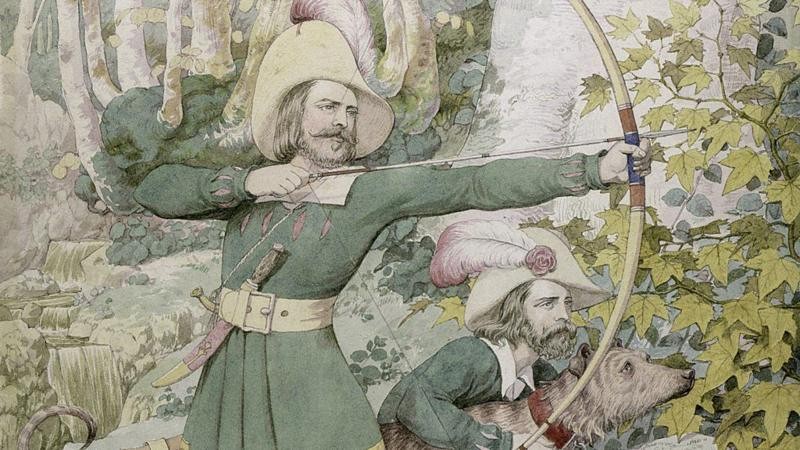
'Robin Hood Was No Hero': How the Character's Dark, Violent Medieval Origins Were Erased
Getty Images via BBC
Important: This report contains a clear depiction of violence that may be disturbing to some readers.
When writer-director Michael Sarnoski began filming his new feature film, he showed the cast and crew a cartoon he loved.
It was Disney's animated Robin Hood, from 1973, which shows the hero as a fox with a feather in his green hat, stealing from the rich and giving to the poor.
This popular version couldn't be further from Sarnoski's deep, dark drama The Death of Robin Hood.
Hugh Jackman plays a grizzled, battle-worn, brooding Robin at the end of his life, deeply aware of his own legend.
Now on g1
He meets a woman who talks about the virtuous vigilante Robin Hood, but he denies his identity and refers to himself in the third person.
"He wasn't a hero. He stole and killed for fun, nothing more than that."
In fact, this violent Robin Hood and other revisionist views against the character's heroic do-gooder image are closer to the original medieval legends than the familiar stereotype we imagine today.
The image of Robin Hood has transformed over the centuries. Each change reflected the era that reinterpreted it.
The darkest variations of the 21st century go back to the origins of history. But, as some of its creators highlight, they also reflect the present.
The character's complex views challenge a polarized world, where heroes and villains tend to be exclusively good or evil, in a way as simplified as the legend of Robin Hood has become over the centuries.
Who was Robin Hood?
There is a lot of speculation about whether there really was a Robin Hood in real life, but most historians agree that there was no living individual behind the character.
What existed was a society with immense inequalities, with rich landowners and impoverished peasants, which inspired its creation.
The stories emerged as an oral tradition in the 12th century, but the first written accounts only arrived two centuries later, in ballads that showed him as a famous character, even so much later.
In these first written accounts, it was not about the noble Sir Robin of Locksley, as later versions show. He was not a nobleman, but rather a small landowner, who was just a step above the peasants.
Lady Marian would only enter history in the 16th century. And Robin might be good to the poor, but his main objective was not to help them.
His enemies were the corrupt clergy and noble landowners, who took advantage of their subordinates.
Stories about Robin Hood emerged as oral tradition in the 12th century, but the first written accounts date back to 200 years later
Getty Images via BBC
In an afterword to her 2025 revisionist novel The Traitor of Sherwood Forest, medieval historian Amy S. Kaufman describes the Robin Hood of the early legends as "a morally questionable medieval swindler" - "trickster, violent and irreverent". a fox.
An important change in history came in the 16th century, during the reign of Henry 8th (1491-1547), an admirer of the legend who even dressed as Robin Hood.
It was during the time of the English monarch, who divided the Catholic Church, that Robin's devotion to the Virgin Mary disappeared from legend.
With the higher classes welcoming the character, Robin stopped hating the nobility in the influential chronicles of the time, becoming a nobleman himself.
By assuming the position of a nobleman with upright morals, who fights against his dishonest peers, Robin Hood stopped questioning the power structure of society.
He was summoned to help the good king Richard (1157-1199) to retake the throne usurped by his evil brother, Prince John (1166-1216) - a parable included in the Disney production, which shows John as an ambitious lion, thirsty for power.
The Disney animation produced in 1973, with Robin Hood as a fox, solidified his image as an intrepid benefactor in popular culture
Alamy via BBC
Children's books from 19th century helped transform Robin Hood into a less offensive do-gooder, acceptable to the Victorian era.
And in the 20th century, cinema perpetuated this image with matinee idol Errol Flynn (1909-1959) playing the intrepid Robin in the popular film The Adventures of Robin Hood (1938).
Disney would solidify this image in popular culture, perhaps in its most influential version.
'Two versions of the same character'
Sarnoski tells the BBC that the contrast between the Disney film and the original legend has fascinated him since he was a child, when he read a children's version of the medieval ballad The Death of Robin Hood.
In it, Robin dies in silence, murdered by an evil prioress and her lover.
"I met Disney's Robin Hood and then read The Death of Robin Hood, these two versions of the protagonist", says the director. "Trying to deal with that and understand how that could be the same character really impacted me when I was a child," says the director.
Errol Flynn (right) played the intrepid Robin in the film The Adventures of Robin Hood (1938)
Getty Images via BBC
In Sarnoski's film, Robin Hood is injured during a shocking battle shown in the film. An arrow passes through a boy's head from the back and exits through his eye and he is taken to a monastery to recover.
Jodie Comer plays the prioress. She is kind, unlike the portrait in the ballad.
"I didn't want the prioress to be just that evil nun, nor for Robin to be just that good hero", explains Sarnoski about his deeper characters.
When Robin reflects and begins to regret his past, the film "really becomes a story about him, who faces his own legend and his desire for what would be a right death", continues the director.
Hugh Jackman plays the protagonist of the new film of the studio A24, a revisionist vision of Robin Hood that revisits the dark original legend from the Middle Ages
A24 via BBC
The distortion of the legend is also an important theme in Kaufman's novel. Like Sarnoski, she formed her first impressions of the story with the Disney cartoon.
"I grew up with the fox Robin Hood," she tells the BBC. "Later, I delved into medieval studies, discovered ballads, and asked myself, 'Where is my Robin Hood, who I know and adore?'"
Her book focuses on the fictional character Jane, a peasant girl who falls in love with the legend of Robin Hood.
She falls in love with him and joins his gang, but begins to wonder if the heroic image and Robin himself have deceived her with his seduction.
True to the character's origins, Kaufman's Robin is neither a hero nor a villain.
She says that, in the ballads, "he is incredibly subversive, when you watch how he stands up against the people who hold power, like the kings, the nobility, the Church."
"But, in all cases ballads, he also has a tragic end or is a victim of his own imperfections."
In addition to Flynn, actors such as Douglas Fairbanks, Russell Crowe and Kevin Costner (pictured) played Robin Hood and almost all maintained the stereotypical image of the character.
Getty Images via BBC
In the 20th century, these more complex visions of Robin Hood were rare.
In cinema, actors such as Douglas Fairbanks (1883-1939), Kevin Costner and Russell Crowe played the role and almost everyone followed the stereotypical image.
A notable exception is Robin and Marian (1976), an elegant and intelligent film, which deserves to be much better known.
Sean Connery (1930-2020) plays an aging Robin who, after decades, meets Marian (Audrey Hepburn, 1929-1993), now a prioress.
This Robin denies that the stories legends about him are true and he appears contemplative at the end of his life.
"I always think about all the deaths I've seen", he tells Marian, questioning what his purpose was.
Robin and Marian (1976), with Sean Connery and Audrey Hepburn, is an elegant and intelligent film, which shows the character contemplative at the end of his life
Getty Images via BBC
Questions about power, heroes and how stories are told are exactly what he does with that revisionist views seem so current.
"The world is consolidating power in a way similar to the Middle Ages," according to Kaufman. "Some of the things they needed to study are the same things we will need to examine today."
Sarnoski highlights how his characters use their stories as instruments of power.
"Robin used stories as weapons and as a way to perpetuate violence", attracting followers, according to him. The prioress, on the other hand, "uses stories to help and heal people."
These days, these strategies are everywhere.
"We are now immersed in narratives, between social networks, the internet and simply in everything that surrounds us", continues Sarnoski.
"We divide ourselves very quickly into villages and tribes, creating heroes and villains, and we don't live in the gray area where life really lives."
As stimulating as new, more recent versions may be dark stories of Robin Hood, they probably won't replace the image created by Disney.
"Not everyone wants to see their Robin Hood costume destroyed," explains Kaufman.
"He has become a kind of Santa Claus, in the sense that he represents something bigger than the original legend, whatever that may be."
The Death of Robin Hood is showing in Brazilian cinemas.
Read the original version of this report (in English) on the BBC Culture website.
The original story of Pinocchio, short story Italian classic popularized by Walt Disney
The mystery of the warrior snails of the Middle Ages
The disappearance of 130 German children behind the magical legend of the Pied Piper of Hamelin
The mystery of medieval sword fights that intrigues historians
Mulan: the Chinese legend that inspired the new Disney film
'A Monster': what history doesn't show about King Henry the Eighth
Source: G1