Remember the songs, marches and vignettes that marked Brazil's victories - and defeats - in the World Cup
Remember songs, marches and vignettes that marked Brazil's participation in World Cups
Brazil's history in World Cups has as its backdrop songs that marked victories and defeats.
There are marches, popular songs and even TV vignettes that won over the public. It's difficult not to associate "Pra Frente Brasil" with the 1970 World Cup or "A Festa", by Ivete Sangalo, with winning the fifth championship in 2002.
In 2026, we don't have a prominent bet. In the stands, fans have the challenge of finding music that "rocks" the audience during the matches - something unusual in the national team's games.
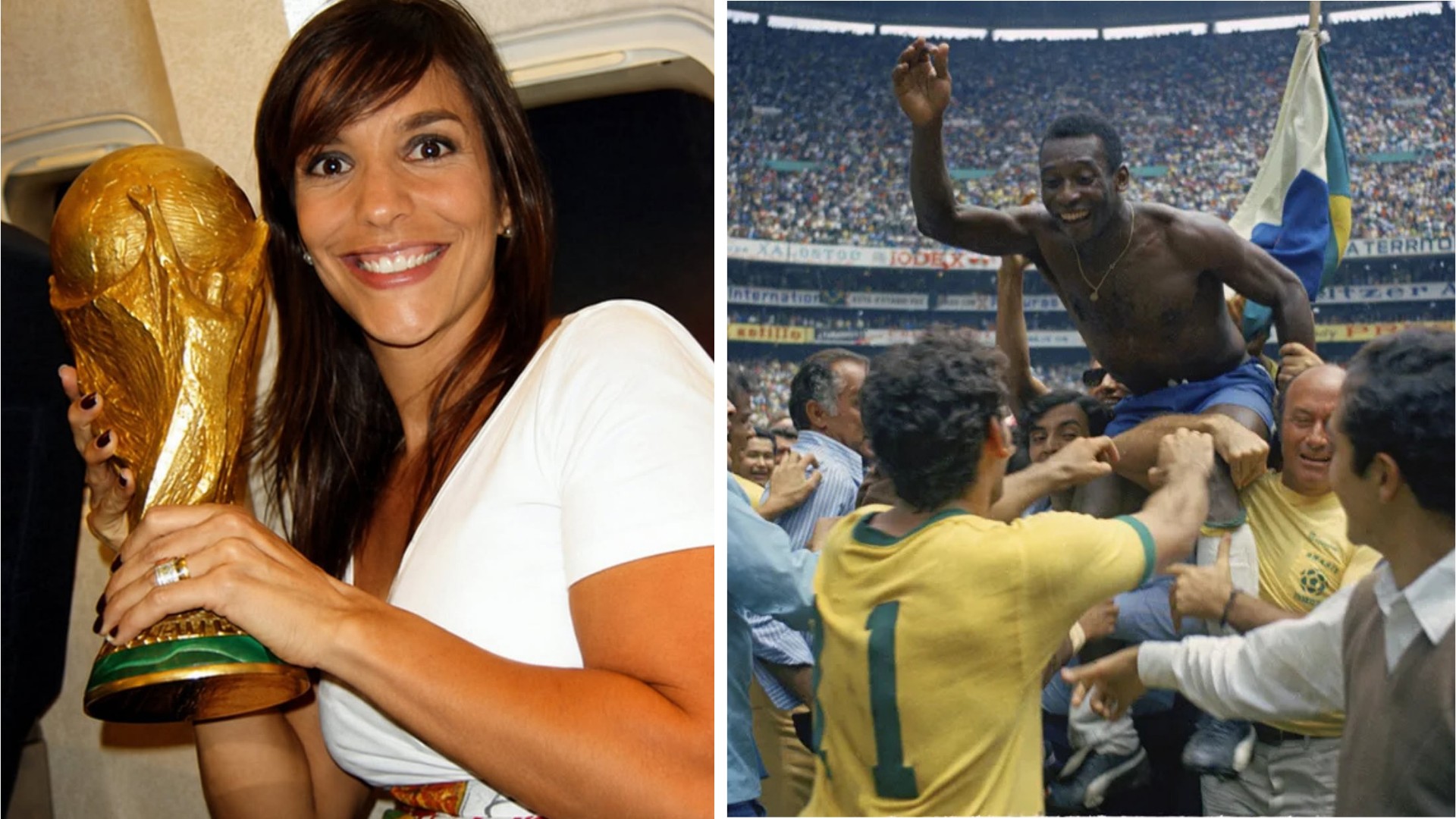
Ivete Sangalo holding the World Cup trophy; and Pelé celebrating his third championship in 1970
Reproduction/Instagram and Archive/AP
But this is not a recent problem. Even with so many historic campaigns and songs that became hits in the collective imagination, Brazil has never had a standout song.
The third championship based on marchinhas
In the second championship of 1958 and 1962, a marchinha was responsible for rocking the celebration of Brazilians through the streets of the country: "The World Cup is Ours".
Successful even in the 1959 Carnival, the song became an anthem for the team's first two titles.
In the third championship, the song that rocked the team led by Zagallo was "Pra Frente Brasil".
Created in the midst of the military dictatorship, with Emílio Médici as head of government, the song also served as a kind of anthem for the regime.
With boastful lyrics, the song called for unity, with all 90 million Brazilians holding hands.
It is noteworthy that both "A Taça do Mundo É Nossa" and "Pra Frente Brasil" were composed by advertisers.
In the first case, the authorship is by Wagner Maugeri, Lauro Müller, Maugeri Sobrinho and Victor Dagô. The music that accompanied the triumph was by Miguel Gustavo.
The songs and vignettes...
Since the 1970s, precisely the first World Cup to be broadcast on TV in Brazil, the country has watched the competition using TV vignettes or traditional music as the soundtrack.
In the case of vignettes, the great example is 1994, the year of the fourth championship. On TV Globo, "Coração Verde e Amarelo" had the chorus:
I know I'm going, I'm going the way I know how / From goal to goal, with the right to replay / I know I'm going with my heart beating fast / It's a cup in the race, Brazil
It was the second World Cup with a striking vignette, since in 1990 the song "Papa Essa Brasil" was the theme of the time. And it was composed by one of the greatest duos in Brazilian music, Michael Sullivan and Paulo Massadas.
In the case of songs from the traditional market, we had an example in 1982, which had a special detail. One of the most famous teams in history had a samba player on the left, Júnior.
And a samba player not only because he loved the genre and attended pagode circles, but because he took risks as a performer. He wrote the song "Povo Feliz", which shaped Brazil's trajectory in that year's World Cup - until the "Sarriá disaster" and the defeat to Italy. The chorus, in homage to the bird that ended up becoming the National Team's nickname, says:
Fly, little canary flies / Show these people that you are a king / Fly, little canary flies / Show in Spain what I already know.
Perhaps the biggest musical hit that became the soundtrack to the World Cup victory is "A Festa", by Ivete Sangalo.
It was the "victory theme" of Brazil's fifth title, in the competition played in South Korea and Japan in 2002.
Launched the previous year, the song excited fans during games played in the early hours of the morning here in Brazil and even in the national team's locker room.
And in the stands?
In Brazil's games at the 2026 World Cup, the public present in the stadiums will witness an unprecedented event: more than 30 representatives of organized fans will travel to the USA to accompany the team in partnership with the Green-Yellow Movement.
In the stands, they will have the challenge of having music that "rocks" all the fans. The big bet is "Brasil Ole, Ole, Ole", which refers to the five Brazilian titles and their representatives on the field.
Today the subject of an advertising campaign, the song born in 2022 has not stuck in the memory of the Brazilian people and, in the stadium, it has not yet captivated the public as the song once was: "I am Brazilian / With a lot of pride, with a lot of love".
Images of our rivals invading Copacabana beach in the 2014 World Cup went viral on social media. They sang a song that started with "Brasil, décime que se sentite" and ended with "Maradona és grandes que Pelé", mocking Brazilians.
Similar episodes were repeated in the following competitions: in 2018, in Russia, and in 2022, in Qatar. There, grandstand music is even adopted by athletes. One of the most iconic images of the 1986 World Cup, won by Argentina, is that of Maradona celebrating as a fan.
Without marching, music or a new vignette that has won over the masses, perhaps it's time for Brazil to have a grandstand song just like our "hermanos".
Source: G1