Refugee requests by Venezuelans are the lowest since the pandemic, when Brazilian borders were closed
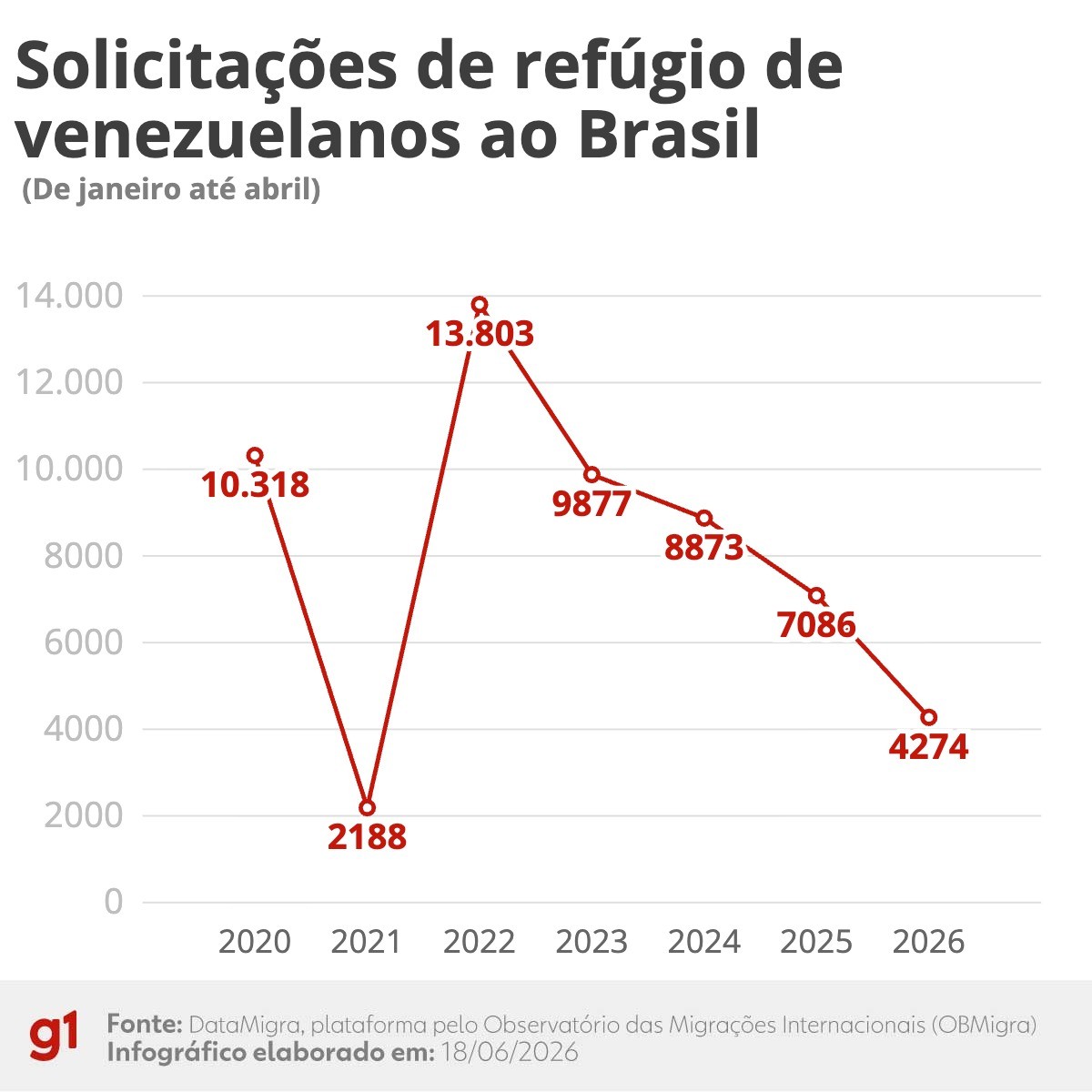
Requests for asylum by Venezuelans are the lowest since the pandemic
From January to April this year, 4,274 people of Venezuelan nationality requested refuge from the federal government. The number is 39.68% lower compared to the same period last year, when 7,086 requests were registered. This is the lowest volume of requests by Venezuelans for the first four months of the year since 2021 - when the land border was closed due to the containment of the Covid-19 pandemic.
The asylum request is a legal protection that Brazil offers to citizens of other countries who elect persecution for reasons of race, religion, nationality, social group or political opinions, or who are subject, in their country, to serious and widespread violation of human rights.
The data is from DataMigra, a platform run by the International Migration Observatory (OBMigra), and with information from the Ministry of Justice and Public Security (MJSP), by migration control bodies such as the Federal Police (PF). The information was confirmed to g1 by the folder.
G1 interviewed Carolina Pedroso, professor of international relations at the Federal University of São Paulo (Unifesp), who sees a correlation between Venezuela's economic situation and the flow of immigration - and asylum requests.
For the expert, the downward trend that had been occurring since 2023 was intensified by the capture of Nicolas Maduro by Donald Trump's government, in January this year.
Decline in the Venezuelan exodus to Brazil
As of 2016, Venezuela began to represent the nationality with the highest number of asylum requests to Brazil, due to the deepening economic crisis faced by the country.
From 2000 to 2025, Brazil received more than 553 thousand asylum requests - and Venezuela corresponded to more than 50% of the requests. In 2023, data from DataMigra shows a slight downward trend, as a reflection of the attenuation of internal inflation and other variables, such as economic growth, which have improved, according to Pedroso.
"In general terms, most people who leave Venezuela do so for material reasons, more than any other factor, so any relief in the economic situation of families ends up reflecting in the abandonment of immigration, which is always a difficult and uncertain process, which leaves people even more vulnerable", explains the teacher.
United States operation kills cartel leader in Venezuela
After capture of Nicolas Maduro
Despite the trend, the sharp drop in asylum requests to Brazil by Venezuelans occurred after the capture of the then dictator Nicolas Maduro, on January 3 of this year, by Donald Trump's government.
To give you an idea, requests did not fall below 7 thousand in the first four months since 2022, the year that registered 13,803 requests from January to April. Previously, the volume had only been interrupted in 2021 (with 2,188, for the period) when land borders were closed due to the Covid-19 health emergency. The opening of the Brazilian side only took place in June of that year.
Infographic shows requests for refuge from Venezuelans to Brazil for the first four months of the year, from 2020 to 2026.
Lara Bernardino/ g1
The professor understands that the return of resources frozen by North American sanctions, the permission for United States companies to enter the country and the restructuring of the Venezuelan debt improved the national economic climate.
"There is also the encouragement that companies from other countries would also feel more secure in returning to do business with Venezuela", he adds.
With interim president Delcy Rodríguez in government, unilateral US restrictions - which created barriers to the revenue of oil companies and other strategic sectors, such as mining - fell, which gave the population back the expectation that the financial crisis could ease.
"When these restrictions fall, at least in what is the engine of the economy Venezuela, resources automatically return, and makes the State better able to promote the basics", he says.
Brazilian flag with Venezuela on the border
Caíque Rodrigues/g1 RR
Source: G1