Record heat in Germany makes roads 'pop'
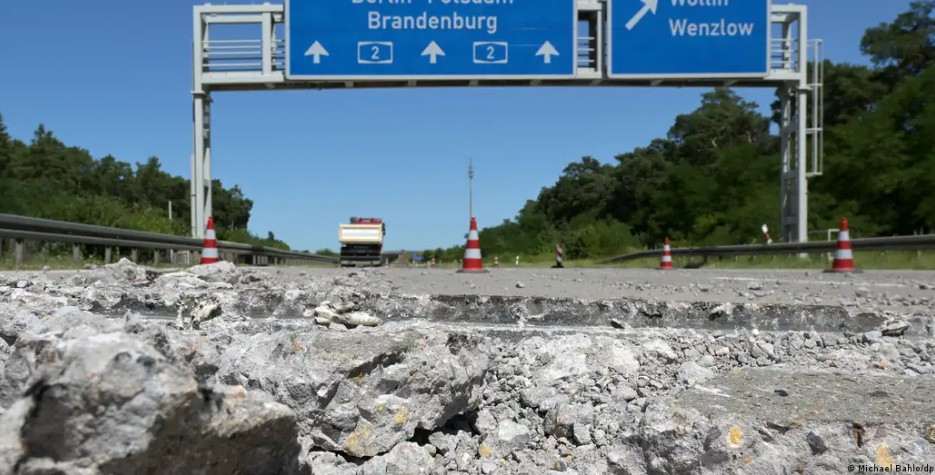
Concrete roads in Germany could "burst" under the heat
Reproduction/DW/Michael Bahlo
The current wave of extreme heat that has left Germany prostrate, with thermometers registering a record 41.3ºC, is causing roads to "pop" in the country.
Damage to the road network has led to the closure or restriction of traffic on several sections of the Autobahn, Germany's famous expressways.
✅ Follow the g1 international news channel on WhatsApp
There are blockades in the states of Lower Saxony, Brandenburg, Bavaria, North Rhine-Westphalia and Hessen in addition to the city-states Berlin and Brandenburg.
In a section of Brandenburg, more than 20 vehicles were damaged and two people were injured on Thursday (25/06), causing a traffic jam, the Berliner tabloid reported Zeitung.
"For many drivers, the dangerous section apparently came about completely unexpectedly. One vehicle after another passed over the raised parts of the track. As a result, tires, wheels, bumpers and possibly also the underside of several cars were damaged," the newspaper states, citing estimated damage of 100,000 euros to drivers. "Some apparently could no longer continue their journey and had to wait for a tow truck."
Now on g1
Why do the roads "melt"?
The heat causes the asphalt that covers the roads to soften and expand, causing cracks or deformities in the road. This damage happens when temperatures on the runway reach around 60ºC, which easily occurs on hot, sunny days like the ones Germany has seen in recent days.
Even more dangerous are the so-called "blow-ups", when the concrete expands and "lifts" the runway. Roads can suddenly swell or even "burst" under the heat and pressure of heavy traffic. The risk of this happening increases when thermometers start to show 30ºC.
The video below, taken in the United States in the summer of 2025 in the Northern Hemisphere, illustrates the phenomenon.
Initial plugin text
This phenomenon occurs mainly on older roads, which are heavily used or which have already undergone repairs several times.
The heat also led the ADAC automotive club to warn of the risk of tire explosions on the roads and advise drivers to adjust tire pressure.
"An under-inflated tire deforms excessively during driving, which generates heat which, in combination with high asphalt temperatures, can lead to a tire burst," explained the organization.
Snowmobiles mobilized to "cool" roads and prevent damage
To avoid damage to roads due to intense heat, German authorities mobilized trucks normally used to remove ice from roads in winter. Now, in the summer, they are pouring cold water on the asphalt, reported the Bild tabloid.
Infrastructure was not designed for the heat
The relentless heat wave sweeping the country is challenging German infrastructure, which was not designed to withstand such high temperatures.
But climate change is not the only problem. It is also a question of modernizing infrastructure.
As Der Spiegel magazine explains, many roads are made of layers of concrete, and the old roads have layers that were designed for a type of traffic that was not as heavy as today's.
In Bavaria, the situation led to the introduction of speed limits of 120 km/h for cars and 80 km/h for motorbikes - an irony since, as Spiegel noted, the state is staunchly opposed to imposing speed limits as a way of reducing speeds. emissions of gases that heat the planet, but was forced to give in precisely because of the threat of heat to infrastructure.
Problems with the deformation of asphalt in the heat can be solved by changing the proportion of bitumen in the mixture, but this, on the other hand, would make the roads more vulnerable to the cold.
Traveling by train in the heat is also not an option
This Saturday (27), Deutsche Bahn and other rail transport companies asked passengers, due to the heat, to stay at home. "Please avoid all non-essential travel on long-distance and regional transport today and tomorrow," declared the company and the Federal Association of Passenger Rail Transport (BSN). Tickets already purchased can be canceled free of charge.
"Transport infrastructure in Germany is heavily affected by the record heat this weekend," said DB and BSN. "Rail transport also suffers from extreme temperatures. Furthermore, the German Weather Service warns of storms with heavy rain." Therefore, there are delays and cancellations of trains.
Because of the current heat wave, the railway company implemented a special flexibility policy and warned on Thursday of possible interruptions in train operations.
Extreme heat in Europe is already the new climate reality; see what scientists say
Source: G1