Rare Brazilian crater could aid studies on Mars and the Moon
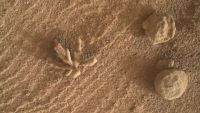
A rare geological formation, created after the impact of an asteroid around 100 million years ago, has become an important object of study for researchers seeking to better understand future space missions and the permanence of humans on the Moon and Mars.
But where is this crater? It is located in Domo de Vargeão, in Vargeão, in the west of Santa Catarina.
It was in this small town of 3,000 inhabitants that this rock, which contains a rare material called basalt, was found and studied by geologist Álvaro Penteado Crosta, graduated from USP (University of São Paulo) while he began his studies in a master's degree on geology in 1970, at the National Institute for Space Research (INPE).
Reproduction/Álvaro Crosta/Personal Archive
According to Crosta, this type of substance is analogous to the dominant material on the surfaces of the Moon and the red planet. By studying these terrestrial locations, researchers can simulate these environments, develop lunar soil substitutes, and test robotic drilling equipment for future space missions. It's as if missions were prepared without the high cost and risk of traveling to the satellite.
"To study impact craters in basaltic rock and try to study the evolution of planets through this, we can then access analogues here on Earth. So, the Varjão crater is precisely one of these analogues. So, these Brazilian basaltic craters are considered quite important in the study of planetary analogues", he explains.
Álvaro Crosta, geologist and researcher
Read also: Artemis II: NASA took 1st woman and 1st black man to orbit the Moon
But how would this formation help man go to the Moon?
The researcher explains: "Because it is very difficult to get directly from Earth to Mars. So one of the ideas of the lunar base is precisely to serve as a stopping point and fuel supply to go to Mars. Well, where would this fuel come from? It would come from, for example, hydrogen, helium, which are chemical elements that are found in these rocks. And for us to test all of this, we can use material that is easily collected here in these craters on Earth."
Álvaro also says that Italian researchers and even scientists from NASA (American Space Agency) plan to test sounding equipment, designed to collect scientific data, which will be taken in the future for missions to Mars, all from this crater located in southern Brazil.
"We are still seeing. Why? When you send a mission like this to Mars, they are currently robotic missions. So, the equipment is very small. They have to be small due to weight issues. And they have to work remotely, everything controlled by a robot. So, of course, they have to test in similar conditions here on Earth", he explained.
He also says that testing these prototypes here in Brazil helps determine how much energy is needed for drilling, how deep the probes can penetrate and identify whether the equipment can withstand the physical stress of the rock.
In other words, they collect materials from the craters to reproduce the lunar regolith, the base of the moon. This allows the environment to be studied and see how materials and humans would interact on this soil.
Another application involves studying these craters to understand how to extract chemical elements, such as hydrogen and helium, which can become a source of fuel extracted from the Moon and Mars.
"So, these tests are carried out, all here on Earth, they are very exhaustive, very intensive tests. So, I would take a prototype of the equipment, take it to Earth to perform the test on site, and do the necessary testing so that it can later work on Mars."
Álvaro Crosta, geologist and researcher
Read also: NASA tests new high-power thruster for missions to Mars | CNN Brasil
And how did the formation of this crater in Brazil happen?
The formation of the crater in Brazil, specifically Varjão, occurred through a catastrophic event that followed several stages.
Initially, a large asteroid, measuring between tens and hundreds of meters, entered a collision course with Earth. Although the atmosphere acts as a shield for smaller objects, it was unable to stop a body of this size, causing only slight braking.
The asteroid hit the Earth's surface at an impressive speed of up to 60 thousand kilometers per hour. At the moment of impact, energy equivalent to millions of atomic bombs was released, causing permanent transformations in the local rocks.
Image of the crater in satellite format - Reproduction/Álvaro Crosta/Personal Archive
This energy generated a hole several kilometers wide. In the specific case of Varjão, the depth reached almost one kilometer. The impact threw fragments of rock out of the crater and generated extremely high-intensity earthquakes, eliminating all forms of life and structures in the immediate region.
This event is estimated to have occurred between 100 and 120 million years ago. Since then, erosion has softened the edges and relief of the crater, making it a more subtle geological scar on the current topography than it was originally.
Brazil is one of the signatory countries of NASA's Artemis II program | CNN PRIME TIME
Crater generated economic development involving tourism and education in Varjão
According to the researcher, Varjão city hall is creating a museum dedicated to the crater, with the aim of attracting visitors and boosting tourism in the city. Furthermore, the rock is part of a tourist circuit that brings together attractions from several small towns in the region, encouraging people to get to know the location.
The museum will feature advanced 3D visualization and virtual reality technology. This will allow residents to not only learn about the science, but have an immersive experience of how the crater's formation occurred.
Should be opened this year, it will feature very advanced 3D visualization technology in virtual reality, things like that, so people can not only see how the crater was formed, but feel how the crater was formed, through immersion in virtual reality.
Álvaro Crosta, geologist and researcher
In addition, the phenomenon is counted as a natural heritage and attracts expeditions of international scientists.
"Normally, it's a bus with 30, 40 scientists from various countries around the world. We've already done this
a few times. And we are always very well received by local citizens. And we have done this whenever possible. So, this interest is always permanent, let's say. There's always somewhere in the world dealing with this", he concluded.
Students and researchers during studies in the Crater - Reproduction/Álvaro Crosta/Personal Archive
*Under the supervision of Thiago Félix
Source: CNN